Choucroute Garnie: The Alsatian Platter of Pork and Sauerkraut
Sauerkraut braised in Riesling under a mountain of smoked pork
Contents
↓ Jump to recipeThere is a moment in every choucroute garnie when the thing stops being a pot of cabbage and becomes an event. It happens when you lift the lid after the first ninety minutes and the steam comes up smelling of juniper, wine and smoke all at once, and the kraut has gone from harsh white to a soft translucent gold. Everything before that is preparation. Everything after is arranging.
This is Alsace’s flagship dish, and it is one of the few genuinely great platters of European cooking that a home cook can pull off without special equipment. You need a big casserole, a hot oven, two and a half hours, and a butcher who is willing to sell you four kinds of pork. That last one is the real constraint.
Choucroute Garnie: The Alsatian Platter of Pork and Sauerkraut
Ingredients
- 2 kg raw sauerkraut (choucroute crue), from a jar, tin or the deli counter
- 60 g goose fat, duck fat or lard
- 2 medium onions (about 250 g), thinly sliced
- 1 large carrot (about 100 g), left whole
- 3 garlic cloves, peeled and left whole
- 12 juniper berries
- 8 black peppercorns
- 3 cloves
- 2 bay leaves
- 400 ml dry Alsace Riesling
- 300 ml chicken or ham stock, plus more if needed
- 1 smoked pork knuckle (jarret fumé), about 800 g
- 400 g smoked pork loin (palette or kassler), in one piece
- 200 g streaky bacon in one piece, smoked
- 4 Strasbourg sausages (or good frankfurters)
- 2 Montbéliard or smoked Morteau sausages
- 1 kg waxy potatoes, peeled and halved
- 1 tbsp Dijon mustard, to serve
- 1 tsp fine salt, if the kraut is unsalted
Method
- Tip the sauerkraut into a colander and rinse briefly under cold water. Squeeze out roughly half the liquid by the handful, leaving it damp rather than dry, then pull the strands apart so they do not sit in clumps.
- Melt the goose fat in a large casserole over a medium heat. Cook the sliced onions for 10 minutes until soft and translucent, without letting them colour.
- Tie the juniper, peppercorns, cloves and bay leaves in a square of muslin. Add the sauerkraut to the pot along with the muslin bag, the whole carrot and the garlic cloves. Stir to coat everything in the fat.
- Pour in the Riesling and the stock. Bury the smoked knuckle, the pork loin and the piece of bacon in the kraut. The liquid should come about two thirds of the way up; add stock if it does not.
- Bring to a bare simmer, cover, and cook in a 150C fan oven for 1 hour 45 minutes.
- Lift out the pork loin and the bacon and set aside. Return the pot to the oven for a further 30 minutes, until the knuckle meat pulls easily from the bone.
- Meanwhile, boil the potatoes in well-salted water for 18-20 minutes, until a knife slides in without resistance. Drain and keep warm.
- Poach the Strasbourg and Montbéliard sausages in a separate pan of water held at 80C for 12 minutes. Never let that water boil or the skins will split.
- Return the loin and bacon to the pot for the last 10 minutes to warm through. Discard the muslin bag and the carrot.
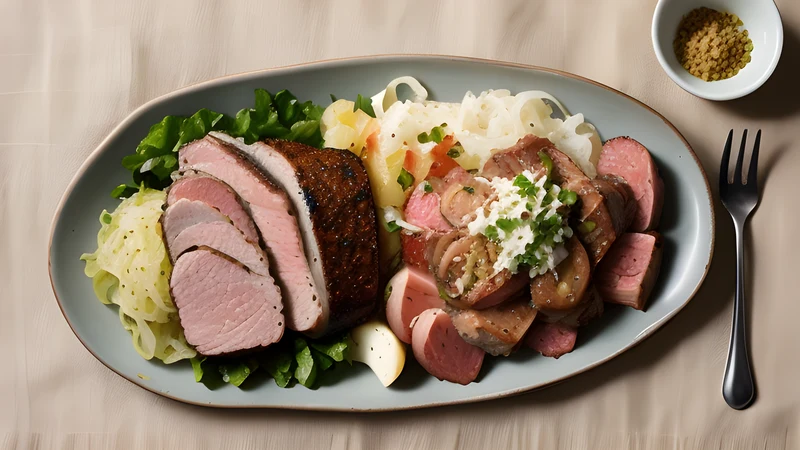
- Heap the sauerkraut onto a large warm platter. Slice the loin and the bacon, pull the knuckle into chunks, and arrange all the meats and the drained sausages on top. Ring the platter with the potatoes and serve with Dijon mustard and the rest of the Riesling.
What the name is actually telling you
Choucroute is the sauerkraut. Garnie means garnished — dressed, furnished, kitted out. The dish is fermented cabbage with things on it, and the grammar of the name is honest about the hierarchy. The kraut is the subject. The pork is adjectival.
That distinction matters when you cook it, because the commonest failure is treating the meat as the point and the cabbage as bedding. The kraut is what everyone will remember, and it is the only element you actually cook. The sausages get poached. The smoked cuts are already cooked and merely warmed and softened. All the technique, all the judgement, all the seasoning lives in the cabbage.
Alsace, and the argument about who owns it
Fermented cabbage is old and wide. The Romans salted it, Chinese labourers on the Great Wall ate a rice-wine-fermented version, and preserving cabbage in salt is such an obvious answer to a northern winter that no one gets to claim invention. What Alsace can claim is this specific assembly.
The region spent four centuries being handed between France and Germany — French from 1648, German from 1871, French again in 1918, German again in 1940, French since 1945. The food carries all of it. The wine is Germanic in grape and French in style. The sausages have German names and French appellations. Choucroute garnie is the dish where that doubleness stops being awkward and starts being the whole idea: German technique, French wine, and a plating logic that comes straight out of the garni tradition.
The Riesling is the tell. German sauerkraut braises tend to use water, stock or apple juice. Alsace uses its own dry white, and the wine’s acidity plus the kraut’s lactic acid produce something sharper and more lifted than the German equivalent. When Alsatian restaurants advertise choucroute au Riesling, they are advertising the border.
Strasbourg institutionalised it. By the nineteenth century the winstubs — the wine rooms attached to producers, where growers sold their own bottles with food to soak them up — had settled on choucroute as the dish that justified a second bottle. It is still true. The dish is engineered around the wine.
Choosing the kraut, which decides everything
Buy raw sauerkraut. The words to look for are choucroute crue, or in a German shop, rohes Sauerkraut. It should be pale, wet, and sharply sour when you taste a strand, with an audible crunch. If you can only find the pasteurised stuff in a tin, it will work, but it has already been cooked once and will go soft faster — cut the oven time to an hour and a quarter.
The rinsing is the step people get wrong in both directions. Rinse it hard and you strip out the lactic acid that gives the dish its spine; the result tastes of wet cabbage and disappointment. Skip the rinse entirely and the brine, concentrated by two hours of reduction, turns the whole platter into a salt lick. A brief rinse and a squeeze that leaves the strands damp is the target. Taste a strand after squeezing. It should still make you blink.
Pull the strands apart with your fingers before they go in the pot. Sauerkraut arrives compressed into a mat, and a mat braises unevenly — the outside dissolves while the core stays raw and squeaky. Loose strands cook at the same rate and, when you serve, pile into something that looks like a nest rather than a slab.
If you make your own, this dish is the single best use for it. A batch of sauerkraut from scratch fermented for four to six weeks has a fruitier, more complicated acidity than anything commercial, and you control the salt precisely.
The fat question
Goose fat is traditional and it is better. It carries the juniper in a way that neutral oil cannot, and it sets the whole dish on a richer base note. Duck fat is an honest stand-in. Lard is what most Alsatian households actually use midweek. Butter is a mistake — its milk solids scorch during the long braise and add a scalded flavour that fights the wine.
Use enough. Sixty grams for two kilos of cabbage sounds excessive until you remember that the kraut is essentially fat-free and will absorb every gram. Under-fat the pot and the cabbage stays stringy and mean.
The spice bag, and why muslin
Juniper is compulsory. It is the flavour that makes choucroute taste like choucroute rather than like braised cabbage, and twelve berries for two kilos is a floor rather than a ceiling — I often go to sixteen. Crush them lightly with the flat of a knife before they go in the bag to crack the skins.
The muslin matters for a practical reason. Whole cloves and peppercorns are almost invisible against a heap of pale kraut, and biting into a clove at the table ruins the mouthful and possibly the evening. The bag lets you use assertive whole spices and then remove every trace of them.
The whole carrot is an old Alsatian trick that sounds like nothing and does something. It contributes sugar slowly across two hours, softening the acid edge without ever reading as sweet, and you fish it out before serving. Grated carrot would dissolve and turn the kraut orange, which is why it goes in whole.
The meats, ranked by how much they matter
The smoked knuckle is the engine. It gives the braise its gelatine, its depth, and most of its salt, and it is the piece that turns the liquid into something with body. Buy it bone-in.
The smoked loin — palette in Alsace, kassler across the Rhine — is the piece people actually eat most of. It is lean and already cooked, so it comes out at the ninety-minute mark and goes back for a warm-through at the end. Leave it in for the full two and a half hours and you will serve smoked pork sawdust.
The bacon in one piece is structural: it lards the kraut from the inside as it renders.
The sausages are the finish. Strasbourg sausages are fine-textured and mild; Montbéliard and Morteau are coarser, heavily smoked over conifer wood, and worth hunting down. All of them must be poached separately at 80C in plain water. Boiling splits the skins and the fat leaks out, leaving a grey tube. Choucroute is a French version of the same instinct that produced Czech roast pork with dumplings and sauerkraut — cured pork against fermented cabbage — with the wine doing the arguing.
Building the platter
The assembly is the only showy part, and it rewards thirty seconds of thought. Warm the platter — a cold plate under two kilos of kraut drops the serving temperature by ten degrees before anyone sits down. Heap the cabbage down the centre in a long ridge rather than spreading it flat, because a ridge holds heat and gives the meats somewhere to lean.
Slice the loin across the grain into pieces about a centimetre thick and shingle them along one flank. Pull the knuckle into rough chunks with two forks and pile them at one end, skin and all — the collagen-heavy bits are the ones regulars fight over. Lay the sausages whole and unsliced; cutting them lets the juice run out onto the kraut, and a sausage that arrives intact and gets cut at the table is a better sausage. Ring the outside with potatoes so they stay clear of the acid.
Put the mustard in a separate pot. Somebody at the table will want a lot of it and somebody else will want none, and spooning it over the platter forecloses the argument.
What can go wrong
The kraut is watery. You did not squeeze, or your pot lid does not seal. Lift the meats out, put the pot on the hob uncovered, and reduce hard for ten minutes.
It tastes flat. Almost always under-salted, because raw kraut varies enormously in brine strength. Taste the liquid at the ninety-minute mark and correct then, while there is time for it to distribute.
It tastes like nothing but salt. Too little rinsing plus a salty knuckle plus reduction. Add 200 ml of unsalted stock and another 100 ml of Riesling and give it twenty more minutes.
The cabbage is still squeaky after two hours. Your oven runs cold, or the kraut went in as a compressed mat.
Variations, and one to avoid
Choucroute royale swaps the Riesling for Crémant d’Alsace and is genuinely lighter. Choucroute de la mer replaces every scrap of pork with salmon, haddock and monkfish, added in the last twelve minutes; it was invented in the 1970s by Strasbourg chefs and it is better than it has any right to be. Some houses add a peeled, quartered apple with the onions.
Avoid the version that adds tomato. It appears occasionally in French cookbooks aimed at people who find the dish austere, and it makes a perfectly good braise that has nothing to do with Alsace. If you want fermented cabbage with a red base, cook bigos instead — it is a great dish, and it is a different one.
Ahead and after
Choucroute improves overnight. Braise the kraut with the knuckle and bacon a day early, cool it, refrigerate it, and reheat gently in the oven for forty minutes; the acid rounds out and the juniper spreads. Poach the sausages and boil the potatoes fresh on the day.
Leftovers keep for four days. Reheated with a fried egg on top it makes a breakfast that will hold you until dark. It freezes acceptably for three months, though the potatoes should be left out — they go grainy — and the sausages should be added fresh on reheating.
Serve the same Riesling you cooked with, cold enough that the glass fogs. The wine has been in the pot for two hours; the least you can do is let it finish the job at the table.
Related Content