Chiles en Nogada: Puebla's Plate of Three Colours
A stuffed poblano under walnut cream, built to match a flag
Contents
↓ Jump to recipeChiles en nogada exists on a deadline. The walnuts need to be fresh, still soft-shelled and moist — nuez de castilla, harvested in central Mexico for roughly six weeks from mid-July — and once they’re gone, the dish more or less goes dormant until the following year. Restaurants in Puebla start their countdown the day the walnut crop comes in, and the good ones stop serving the dish the day it runs out. That’s not a marketing device. Dried walnuts give you a sauce that’s bitter and grey rather than sweet and white, and everyone at the table can tell the difference within the first mouthful.
This is also one of the few dishes in Mexican cooking that’s served cold on purpose while everything around it is hot. The stuffed chile comes to the table at room temperature, the sauce poured over just before it reaches the guest, the pomegranate scattered last of all. Nothing about that is an accident or a shortcut — it’s how a convent kitchen in the 1820s would have had to serve a banquet dish to forty guests without a modern kitchen’s ability to plate everything hot in sequence, and the tradition simply stuck.
Chiles en Nogada: Puebla's Plate of Three Colours
Ingredients
- 6 large poblano chiles, fire-roasted and peeled
- 500g mixed ground pork and beef (or all pork)
- 1 white onion, finely diced
- 3 garlic cloves, minced
- 3 ripe tomatoes, diced
- 1 apple, 1 pear, 1 peach, peeled and diced small
- 1 plantain, diced
- 60g raisins
- 30g slivered almonds
- 1 tsp ground cinnamon
- 1/4 tsp ground cloves
- 2 tbsp olive oil or lard
- salt to taste, starting with 1 tsp
- For the nogada: 250g fresh walnuts (nuez de castilla if you can find them), peeled
- 200g queso fresco or cream cheese
- 150ml whole milk, more as needed
- 50g sugar
- 2 tbsp dry sherry
- 1 pomegranate, seeds only
- small bunch flat-leaf parsley, leaves only
Method
- Fire-roast the poblanos over a gas flame or under a hot grill until the skins blister black all over, then seal in a bag or covered bowl for 15 minutes.
- Peel the blackened skin off each chile under running water, keep the stem on, then slit one side and remove the seeds and veins, leaving the chile whole.
- Heat oil or lard in a wide pan and brown the ground meat with onion and garlic until no pink remains, about 8 minutes.
- Add tomatoes, apple, pear, peach, plantain, raisins, almonds, cinnamon and cloves. Simmer uncovered for 20 minutes until thick and no longer wet, then season with salt and cool to room temperature.
- Peel the walnuts by soaking them in just-boiled water for 10 minutes, then rubbing the thin brown skin off between your fingers — this step determines whether the sauce is white or grey.
- Blend the peeled walnuts with queso fresco, milk, sugar and sherry until smooth and pourable, adding more milk a tablespoon at a time if it's too thick to coat a spoon.
- Stuff each chile generously with the cooled picadillo until it holds its shape but isn't split at the seams.
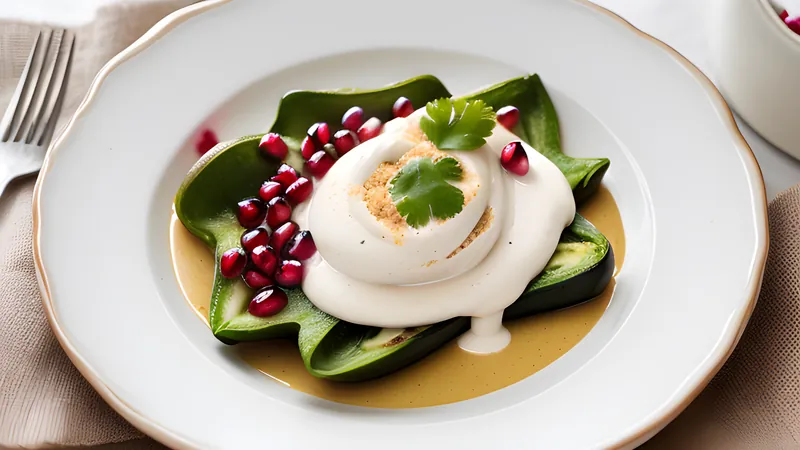
- Plate the stuffed chiles at room temperature, spoon the walnut sauce over generously, then scatter pomegranate seeds and parsley leaves to finish the red-white-green.
A dish built to argue a political point
The story attached to chiles en nogada is specific enough that historians have spent real effort trying to confirm or debunk it, which is usually a sign a dish matters. The most repeated version places its invention in August 1821 at the Convent of Santa Monica in Puebla, where Augustinian nuns prepared a banquet for Agustín de Iturbide, the general whose Army of the Three Guarantees had just secured Mexican independence from Spain under the Treaty of Córdoba. Iturbide’s army marched under a flag of green, white and red — liberty, religious unity, and unity between Mexican- and Spanish-born people — and the nuns are said to have built a dish that mirrored it exactly: green from the poblano and parsley, white from the walnut cream, red from the pomegranate.
Whether the nuns sat down and consciously designed a patriotic plate, or whether the colours were simply what late summer in Puebla offered and the symbolism got attached afterwards, isn’t fully settled. Puebla in August has poblanos, pomegranates just turning red, and the one brief walnut harvest, so the ingredients were always going to land close to the flag’s colours regardless of intent. What’s not in dispute is that the dish has been served every Mexican Independence season since, and that Puebla treats it as a civic possession the way Bologna treats ragù or Lyon treats quenelles — a recipe defended in print, argued over at length, and never quite standardised because every family believes their grandmother’s version is the correct one.
The picadillo filling carries its own layered history, separate from the flag story. Dried fruit and meat together is a Spanish colonial habit — an inheritance from Moorish Iberian cooking that made its way across the Atlantic in dishes like Cuban picadillo and the fruit-studded empanada fillings still made across the Southern Cone. Combining apple, pear, peach, plantain and almonds with beef or pork in one pan is a recognisably criollo move: European technique and produce meeting American ingredients, worked out over three centuries in convent kitchens where nuns had the time, the pantry, and a genuine reason to perfect elaborate dishes for visiting dignitaries and bishops. Puebla’s convents were wealthy, well-stocked, and staffed by women who had often entered religious life from prosperous families — the picadillo’s expense, with its imported almonds and dried fruit, reflects that.
Getting the sauce actually white
The nogada sauce is where most home attempts go wrong, and it’s almost always because of unpeeled walnuts. Fresh walnuts carry a thin papery skin that’s mildly bitter and, more importantly, turns the finished sauce a dull beige rather than the bright white the dish needs. Soak the shelled walnuts in water that’s just off the boil for ten minutes, then rub them between your fingers under running water — the skins slip off in strips once softened. It’s fiddly and takes longer than the rest of the sauce combined, but there’s no shortcut that doesn’t compromise the colour, and a grey nogada is the first thing a Poblano eye will notice on the plate.
Some cooks add a little bread soaked in milk to the blender for body, others rely purely on queso fresco or cream cheese; either works, provided the final texture pours from a spoon rather than sitting like paste. Sherry is a Spanish colonial addition that rounds off the sweetness without making the sauce taste boozy — a splash is plenty, and it’s not traditional to substitute in more on the theory that more will taste better. Taste the sauce before you commit it to the chiles: it should read as sweet first, with the walnut’s bitterness arriving a beat later and the sherry barely noticeable underneath.
Should the chile be battered?
Puebla itself is split on this, so don’t let anyone tell you there’s one correct answer. The older style, capeado, coats the stuffed chile in a light egg batter and shallow-fries it before saucing, giving a soft golden shell that some families consider essential and that shows up in the oldest printed versions of the recipe from the nineteenth century. The modern restaurant style, sin capear, serves the stuffed chile bare — just roasted, peeled, stuffed and sauced, a presentation that became common in the mid-twentieth century as restaurants wanted the poblano’s green skin visible rather than hidden under batter.
The bare version is easier for a home cook to get right on a first attempt, since a badly fried batter can slide off the chile in the pan, taking the stuffing with it, and it shows off the poblano’s roasted flavour more directly. Try it bare first; move to the fried version once you’ve got the peeling, stuffing and sauce timings down and have a spare hour to practise the batter technique on chiles you’re not serving to guests.
What tends to go wrong
Underdone picadillo is the most common failure — if the fruit hasn’t had its full 20 minutes to break down and the liquid hasn’t reduced away, the filling will be wet and the chile will slump rather than hold its shape on the plate. Cook it until a wooden spoon dragged across the pan leaves a brief trail before the mixture flows back, which usually happens closer to 25 minutes than 20 if your tomatoes were particularly juicy.
The second failure is over-charring the poblanos to the point the flesh underneath goes bitter and starts to break apart when you peel it. You want the skin blackened but the flesh underneath still pale and intact — pull the chiles the moment the skin blisters rather than waiting for it to blacken evenly, since carryover heat inside the resting bag finishes the job. If a chile tears while you’re removing the seeds, patch it by overlapping the torn edges before stuffing; the sauce covers small repairs completely.
The third, quieter failure is oversalting the picadillo. Because it’s tasted warm during cooking but served at room temperature, salt reads more sharply once the dish has cooled, so season slightly lighter than instinct suggests and adjust only after the filling has come down to room temperature.
Variations worth knowing
Some families in Puebla add a splash of pineapple or dried apricot to the picadillo alongside the classic apple, pear and peach — a way of using whatever stone fruit is at its best that particular July. Others fold in a spoonful of tomato paste for a deeper colour and slightly more acidity in the filling, cutting through the sweetness of the fruit. A vegetarian version, more common now than it was even a decade ago, replaces the meat with a mix of finely chopped mushrooms and walnuts bound with the same fruit and spice mixture — it won’t taste identical to the meat version, but it carries the same balance of sweet and savoury that makes the dish work.
Serving, storage and the parts that don’t keep
Chiles en nogada is served at room temperature rather than hot — another reason the sauce and filling can be made a few hours ahead and assembled just before guests arrive. The sauce doesn’t keep well past a day; walnuts oxidise and the cream base separates in the fridge, turning grainy and losing the pourable texture you want. Make it the same day you’re serving, ideally within a few hours of the meal.
The picadillo filling freezes cleanly for up to two months and is genuinely useful to have stashed for a smaller dinner — it also works spooned over rice or stuffed into empanadas if you’ve made a double batch and don’t have six chiles’ worth of eaters. If you’re assembling ahead, stuff and roast the chiles the morning of, keep them covered at room temperature, and add the sauce and garnish only once everyone’s sitting down; pomegranate seeds go soft and bleed colour into the cream within twenty minutes of being scattered, which turns the white sauce pink before anyone’s had a bite.
For the walnut-averse, pecans give a passable substitute in a pinch, though the sauce loses some of its floral edge — it won’t taste like a compromise so much as a slightly different dish, which is fine outside of Independence week. If fresh walnuts genuinely aren’t available, dried walnuts soaked overnight in milk soften enough to blend, though the sauce will lean towards ivory rather than the bright white a Poblano cook is aiming for.
A note on timing if you’re planning this for a dinner rather than Independence week itself: the walnut peeling is genuinely the long pole in the tent, so do it the night before and keep the peeled walnuts covered in the fridge. Roast and peel the poblanos the morning of, make the picadillo an hour or two ahead and let it cool fully, and leave only the blending of the sauce and the final assembly for the last thirty minutes before guests sit down. Treated that way, a dish with a reputation for being a full day’s project becomes a manageable few hours of active work spread across two days, and the only genuinely time-sensitive step is the last one.
Puebla’s kitchen produced two of Mexico’s most technically demanding dishes within a few decades of each other, and it’s worth trying both. If you want the other convent classic from the same city, go read our mole poblano piece — a sauce with an even longer ingredient list and an equally contested origin story. And if Puebla’s Lebanese immigrant history interests you as much as its convents, the tacos árabes piece traces the spit-roasted pork that eventually became tacos al pastor.
Related Content