Chicken and Preserved Lemon Tagine
Fragrant Moroccan braise with olives and saffron
Contents
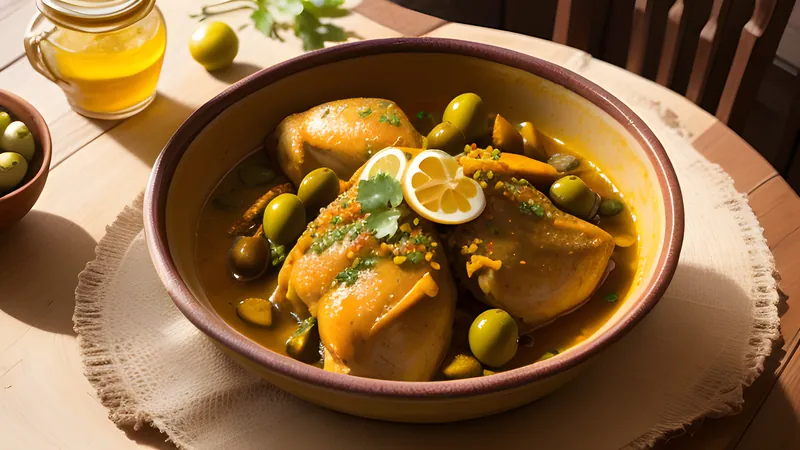
↓ Jump to recipeA tagine is one of those dishes that sounds far more intimidating than it is. Strip away the romance of the conical clay pot and what you have is a fragrant, gently spiced chicken braise that any heavy casserole can produce beautifully. What makes it unmistakably Moroccan, and what makes it sing, is a handful of bold, salty, perfumed ingredients working in concert: saffron, warm spices, briny olives, and above all preserved lemons. This is the dish that taught me how electric a salt-cured lemon can be, and it is the one I reach for when I want the kitchen to smell of somewhere warmer.
Before you begin, a note on shopping. The three ingredients that carry this dish, preserved lemons, saffron and good green olives, are all things you buy once and keep for months, so the outlay feels large the first time and negligible ever after. None of them can be faked convincingly, and all three are the reason a home tagine tastes like the real thing rather than a stew with a Moroccan accent.
Chicken and Preserved Lemon Tagine
Ingredients
- 8 bone-in, skin-on chicken thighs
- 2 tbsp olive oil
- 2 onions, thinly sliced
- 4 garlic cloves, crushed
- 1 thumb of ginger, grated
- 1.5 tsp ground cumin
- 1.5 tsp ground coriander
- 1 tsp ground ginger
- 1 tsp sweet paprika
- ½ tsp ground cinnamon
- Generous pinch of saffron threads, steeped in 3 tbsp warm water
- 400ml chicken stock
- 2 preserved lemons, flesh discarded and rind finely sliced
- 150g green olives (cracked Moroccan or Castelvetrano)
- 1 cinnamon stick
- Salt and black pepper, to taste
- Large handful each of coriander and flat-leaf parsley, chopped
Method
- Season the chicken thighs well. Heat the oil in a tagine or wide casserole and brown the thighs skin-side down until deeply golden, then turn and brown the other side. Remove and set aside.
- Lower the heat and cook the sliced onions in the chicken fat for 10 minutes until soft and golden.
- Stir in the garlic, grated ginger, cumin, coriander, ground ginger, paprika and ground cinnamon and cook for 2 minutes until fragrant.
- Pour in the saffron and its soaking water along with the stock, scraping up any sticky bits, then add the cinnamon stick.
- Nestle the chicken thighs back in, skin-side up, with half the preserved lemon rind. Cover and simmer gently for 35 minutes.
- Add the olives and the rest of the preserved lemon and cook, uncovered, for a further 15 minutes until the sauce has reduced and the chicken is tender and falling from the bone.
- Taste and season carefully (the lemons and olives are salty). Discard the cinnamon stick.
- Scatter generously with chopped coriander and parsley and serve with couscous or warm flatbread.
What a tagine actually is
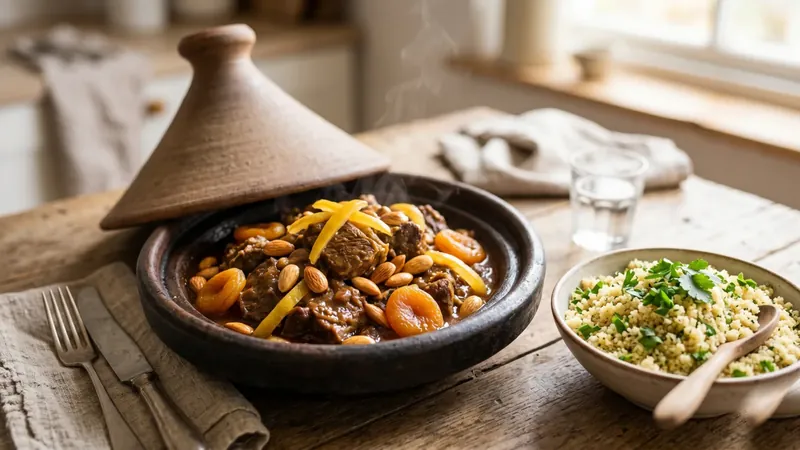
The word tagine refers both to the dish and to the vessel it is traditionally cooked in: a shallow earthenware base topped with a tall conical lid. That cone is not decorative. As the stew simmers, steam rises, condenses against the cool peak and trickles back down, continuously basting the food and keeping everything moist with very little added liquid. It is an ingenious bit of low-tech engineering, perfectly suited to slow, gentle cooking over coals or a low flame.
The pot has deep roots. Earthenware cooking vessels of this kind are associated with the Berber, or Amazigh, peoples of North Africa and have long been used across Morocco, designed for slow cooking over charcoal braziers where fuel was precious and moisture had to be conserved. The name itself refers to both the vessel and the food cooked in it, a useful reminder that the technique, not the crockery, is what defines the dish.
You do not need one, though. A wide, heavy casserole with a well-fitting lid does the same job, trapping the steam and letting the chicken braise gently in its own fragrant juices. The principles are what matter: brown well, build a base of softened onions and toasted spices, then braise low and slow until the chicken is meltingly tender and the sauce concentrated and glossy. If anything, a cast-iron casserole holds heat more evenly than traditional clay and is far less likely to crack, so you lose nothing by using what you already own.
The clever twist that isn’t really a twist: preserved lemons
If beef bourguignon has its bacon and chocolate, the tagine has its preserved lemons, and here they are not so much a twist as the entire soul of the dish. Preserved lemons are whole lemons packed in salt and left to cure for weeks until the rind turns soft, intensely savoury and almost floral. The flavour is unlike anything you can achieve with fresh lemon: it is mellow, deeply citrusy and packed with a salty, umami funk that defines Moroccan cooking. You discard the soft pulp and use only the rind, sliced thinly, which dissolves a little into the sauce and studs it with bursts of bright, salty perfume.
You can buy them in jars from any decent supermarket or Middle Eastern shop, and a jar lasts for ages in the fridge, so they are well worth keeping in. If you genuinely cannot find them, you can fake a version with strips of fresh lemon zest and a little extra salt, but it is a pale imitation; the slow cure is the whole point. Because the lemons and the olives are both salty, season the finished dish with real care, tasting before you reach for the salt.
Saffron, spices and the green olives
Saffron is the other signature flourish, and a little goes a long way. Steep a generous pinch of the threads in a few tablespoons of warm water for ten minutes to release their colour and honeyed, hay-like aroma, then add the lot to the pot. It tints the sauce a beautiful gold and lends a luxurious, faintly floral depth that no other spice can mimic. The warm spice blend around it, cumin, coriander, ginger, paprika and cinnamon, is the backbone of so much Moroccan cooking, sweetly aromatic rather than fiery; toast them in the oil to wake them up before the liquid goes in.
Green olives bring the third salty-savoury note. Cracked Moroccan olives are traditional, but plump Castelvetrano work wonderfully, their buttery flesh softening in the sauce. Give them a quick rinse before they go in if they came from a heavily brined jar, and add them only in the final fifteen minutes so they warm through and lend their brine to the sauce without turning soft and bitter. With four cloves of garlic and a good knob of fresh ginger underpinning everything, the result is layered and complex, savoury and bright all at once.
A word on the two gingers, because it confuses people. This dish uses both fresh grated ginger and ground dried ginger, and they are not interchangeable. The fresh brings a sharp, juicy pungency at the front of the palate; the dried, milder and warmer, folds into the background alongside the cinnamon and cumin. Together they give the braise its characteristic Moroccan hum. If you only have one, the fresh is the more important of the pair.
Bringing it together
Use bone-in, skin-on thighs and brown them properly; the skin renders its fat and the caramelised bits left in the pan form the foundation of the sauce. Browning is the step people rush, but a deep golden crust is worth the extra ten minutes. After that the dish more or less looks after itself, bubbling gently until the chicken is falling from the bone and the sauce has reduced to something rich and clingy.
Finish with an avalanche of chopped fresh coriander and parsley, far more than seems reasonable, because their fresh green bite is the perfect foil to the salty, spiced richness beneath. Serve it over fluffy couscous to soak up the saffron sauce, or with warm flatbread for tearing and scooping.
What can go wrong, and how to fix it
The commonest mistake is a watery, pale sauce, and it almost always comes down to two rushed steps. The first is browning: give the thighs their full deep-golden crust skin-side down, letting the fat render out, and do not move them until they release cleanly from the pan. Those caramelised sticky bits, the fond, are the flavour foundation of the whole braise, so scrape every scrap up when the liquid goes in. The second is the final uncovered stage. If the sauce is still thin after its fifteen minutes with the lid off, keep simmering and let it reduce; you want it clinging and glossy, not soupy.
The other classic error is over-salting. Both the preserved lemons and the olives are heavily salted, and they release that salt slowly into the sauce as it cooks, so a dish that tasted balanced at the start can turn aggressive by the end. Always add salt, if at all, right at the finish, and taste first. If you have overshot, a spoonful of the couscous or a squeeze of fresh lemon on serving will pull it back a little.
Serving, and getting the couscous right
Couscous is the natural partner, and it deserves better than the sad, claggy version most of us made when we first tried it. Tip the couscous into a bowl, pour over just enough boiling stock or salted water to cover it by about a centimetre, add a knob of butter or a slick of olive oil, then cover tightly with a plate and leave it for five minutes off the heat. Fluff it thoroughly with a fork, lifting and separating the grains, and it steams into something light and distinct rather than a solid mass. A scatter of toasted flaked almonds and a few sultanas plumped in the warm stock turn it into a proper accompaniment. Warm flatbread is the alternative, for tearing and scooping up the saffron sauce, and a bowl of harissa on the side lets anyone who wants heat add their own.
Make-ahead and storage
Like all good braises this deepens overnight, the lemon and saffron settling into the chicken, so it is one of the rare dishes that genuinely improves if you make it a day ahead. Cool it, chill it, and reheat gently on the hob the next evening, loosening with a splash of stock or water if the sauce has thickened too far. It keeps three days in the fridge and freezes well for a couple of months; the flavours are robust enough to survive freezing without dulling. Cook the couscous or warm the flatbread fresh, though, since those do not keep in the same forgiving way.
If you have fallen for the salt-cured lemon the way I did, my quicker chicken thighs with preserved lemon and olives uses the same magic ingredient in a weeknight tray-bake, and the richer, deeper lamb tagine is the next step once you are comfortable with the braise. Fragrant, generous and far easier than its reputation suggests, this is the dish that turns a quiet evening into something that smells, gloriously, of somewhere else entirely.
Related Content