Cherry and Almond Frangipane Galette
A free-form tart that forgives you everything
Contents
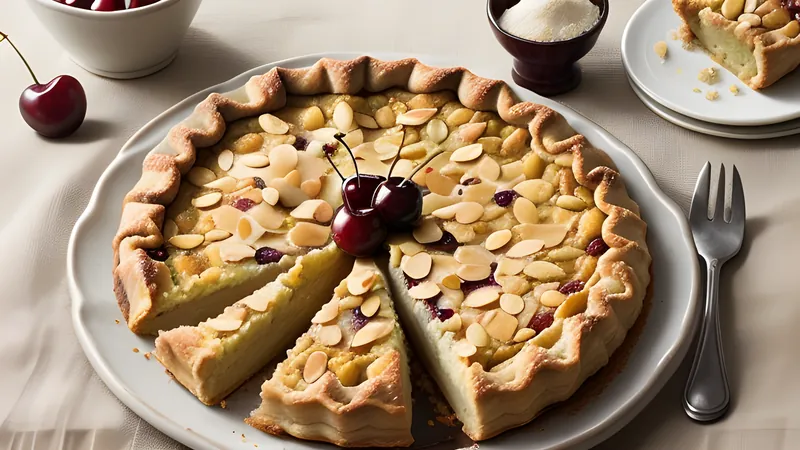
↓ Jump to recipeThere is a particular kind of pudding that rewards confidence over precision, and the galette is its patron saint. Where a proper tart demands a tin, blind baking and a neatly crimped edge, a galette asks only that you roll out some pastry, pile filling in the middle and fold the edges up however they happen to fall. The rougher it looks, the more charming it is. This one pairs cherries with frangipane, the soft almond cream that turns up under fruit in French bakeries everywhere, and the small clever twist is a good slug of almond extract that makes the cherries taste somehow more like themselves.
Cherry and Almond Frangipane Galette
Ingredients
- 250g plain flour, plus extra for dusting
- 0.5 tsp fine salt
- 1 tsp caster sugar
- 180g cold unsalted butter, diced
- 4 to 5 tbsp ice-cold water
- 80g unsalted butter, softened, for the frangipane
- 80g caster sugar
- 100g ground almonds
- 1 large egg
- 1 tbsp plain flour
- 0.5 tsp almond extract
- 400g cherries, stoned and halved (fresh or frozen and thawed)
- 1 egg, beaten, to glaze
- 2 tbsp flaked almonds
- 1 tbsp demerara sugar, for sprinkling
Method
- Make the pastry: rub or pulse the flour, salt, sugar and cold butter until the mixture looks like coarse breadcrumbs with a few larger flecks of butter remaining.
- Add the ice-cold water a tablespoon at a time until the dough just holds together when pressed. Shape into a flat disc, wrap and chill for at least an hour.
- Make the frangipane: beat the softened butter and sugar until pale, then beat in the egg, ground almonds, flour and almond extract to a smooth paste.
- Heat the oven to 190C fan and line a large baking tray with greaseproof paper.
- Roll the chilled pastry on a floured surface into a rough circle about 32cm across and lift onto the tray.
- Spread the frangipane over the pastry, leaving a 6cm border bare all the way round.
- Pile the halved cherries over the frangipane, then fold the bare border up and over the filling, pleating as you go and leaving the centre open.
- Brush the pastry edge with beaten egg, scatter with flaked almonds and sprinkle the whole galette with demerara sugar.
- Bake for 40 to 45 minutes until the pastry is deep golden and the frangipane is set and puffed.
- Cool on the tray for 15 minutes before sliding onto a board. Serve warm or at room temperature.
What a galette actually is
In France the word galette covers a confusing range of things, from the buckwheat pancakes of Brittany to the puff-pastry kings’-cake eaten at Epiphany. The version we mean here, a free-form fruit tart on a single round of pastry, is closer to what an American baker might call a crostata, borrowed in turn from rustic Italian baking. The unifying idea is humility: this is the tart you make when you do not own a fluted tin, or cannot face the fuss of one. It began as country baking, a way to use a glut of summer fruit without ceremony, and that lack of ceremony is exactly why it has survived. A galette that slumps a little, leaks a little juice and browns unevenly still looks beautiful, because nobody expected it to look perfect.
Frangipane itself has a longer pedigree than the rustic galette it sits in. The name is usually traced to Marie-Anne de la Trémoille, a member of the Italian Frangipani family whose perfumed leather gloves were fashionable at the French court in the seventeenth century; pâtissiers, the story goes, borrowed the scent for an almond cream. Whatever the truth of that origin, almond cream became a fixture of French baking, the soft filling you find under fruit or inside a Twelfth Night galette des rois. It is essentially the same batter I use for almond financiers with brown butter, only softer and less sweet, spread rather than baked into little bars.
Cherries and almonds belong together for botanical reasons as much as culinary ones. The cherry is a stone fruit in the genus Prunus, the same family that gives us the almond, and the two share aromatic compounds, chiefly benzaldehyde, the molecule behind that unmistakable marzipan note. Crack a cherry stone and sniff it: it smells faintly of almond. Baking the two together, and nudging them along with a little almond extract, is simply leaning into a kinship that nature set up first. The same pairing carries a pear and cardamom frangipane tart, where the almond cream plays host to a different fruit entirely.
Making the galette
Start with the pastry, because it needs a proper rest. Keep everything cold and handle it as little as possible, leaving a few visible flecks of butter in the dough, since these melt in the oven and create flaky layers. Rest it for at least an hour so the gluten relaxes and the pastry rolls without springing back or shrinking.
The frangipane comes together in one bowl: beat softened butter with sugar, then the egg, ground almonds, a spoon of flour and the almond extract. Do not over-beat once the egg goes in, or you whip in too much air and the frangipane can puff up and then sink in the oven; you want it smooth and just combined. Spread it across the rolled pastry in an even layer, but keep a generous bare border, because that is what you fold up to make the rim. Pile the halved cherries on top, cut-side up so they hold their juice, then fold the border up and over in loose pleats, leaving the middle open so the fruit shows and the juices can bubble. Brush the pastry with beaten egg for shine, throw on flaked almonds and a good sprinkle of demerara for crunch, then bake hot until the base is properly cooked through. The single most common galette failure is a soggy bottom, so do not pull it out early; you want a deep golden, almost biscuity underside. Baking on a preheated metal tray, or slipping the galette onto a hot baking stone, gives the base a head start and helps guarantee it.
Tips, swaps and getting ahead
If you are using frozen cherries, thaw them fully and drain off the liquid thoroughly, or the galette will weep and the base will go sodden. A spoonful of ground almonds or fine semolina scattered over the frangipane before the fruit acts as a sponge for any stray juice and protects the pastry, a small insurance step well worth taking with any juicy fruit. Fresh cherries in high summer need nothing more than stoning; out of season, frozen are honestly excellent here and far less work than pitting a punnet by hand. A quick toss of the stoned cherries with a teaspoon of cornflour and a little sugar also helps thicken the juices they release as they bake.
The pastry can be made up to three days ahead, or frozen for a month, and the frangipane keeps a couple of days in the fridge. You can even assemble the whole galette, freeze it solid on the tray, then bake from frozen with an extra ten minutes or so, which makes it a brilliant thing to have waiting for guests. Cherries are the obvious filling but the same template welcomes apricots, plums, blackberries or sliced pears, and the frangipane base means almost any fruit will taste as though it was meant to be there.
If the pastry tears as you fold it, do not panic; a galette is meant to look hand-built, and a small patch of overlapping pastry or a damp finger pressed along a crack will hold everything together. Should juice escape and catch on the tray, it caramelises into chewy, jammy bits that are honestly some of the best parts. The most important things are a properly chilled dough and a hot oven, so that the base sets and browns before the fruit can soak it. Serve it warm with cold cream or a scoop of vanilla ice cream, and accept the compliments for something that asked almost nothing of you.
Why the technique works
Cold butter is the whole game with this pastry. When you leave those visible flecks of butter through the dough and then hit them with a hot oven, the water inside the butter turns to steam and pushes the layers apart, which is what gives a shortcrust-style pastry its flake rather than a dense, sandy crumb. Warm your hands too much or overwork the dough and the butter smears into the flour, the fat coats the gluten evenly, and you lose that structure. This is also why the rest in the fridge matters: it firms the butter back up and lets the gluten you developed relax, so the pastry rolls out without springing back and holds its shape instead of shrinking away from the fruit in the oven.
The bare border does more than look rustic. Folding the pastry up into a rim gives the frangipane and fruit a wall to bubble against, and the thicker edge, brushed with egg and dusted with demerara, browns into the crunchiest, most caramelised part of the whole thing. Leaving the centre open lets steam escape and the fruit concentrate rather than stew, which keeps the base from going to mush.
Substitutions, storage and getting ahead
The frangipane welcomes swaps. Ground hazelnuts in place of some of the almonds give a deeper, praline note; a splash of kirsch or amaretto in the frangipane leans into the cherry-almond theme, since both spirits carry the same benzaldehyde note that ties the fruit to the nut. Pistachios ground fine and stirred through the frangipane turn it faintly green and grassy, a good foil to darker fruit like plums or blackberries. If you want the crust more tender, swap 25g of the plain flour for the same weight of ground almonds, though the pastry will be a little more fragile to handle. For the fruit, this same galette is a brilliant home for apricots, plums, blackberries or thinly sliced firm pears; whatever you use, keep the fruit in a single generous layer so it cooks through.
The pastry can be made up to three days ahead in the fridge or frozen for a month, and the frangipane keeps for two days covered in the fridge. The best make-ahead trick is to assemble the whole galette, freeze it solid on the tray, then bake straight from frozen with an extra ten minutes or so; it is a genuinely useful thing to have waiting for people who might turn up. Once baked, the galette is best on the day but keeps for two days at room temperature under a cloth; a few minutes in a hot oven brings back the crisp base. If you love this loose, fold-it-and-forget-it style of baking, the savoury fig, walnut and blue cheese galette uses exactly the same pastry and folding, just pointed in a different direction.
Related Content