Maple, Olive Oil and Cardamom Granola
Clustery, fragrant and not too sweet
Contents
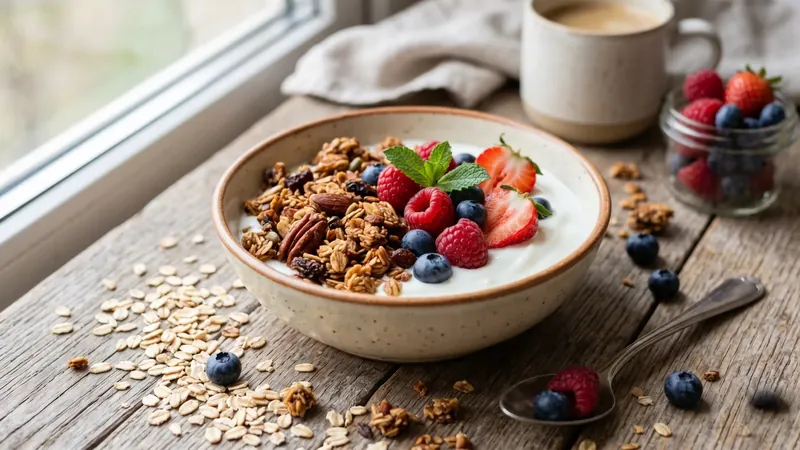
↓ Jump to recipeShop-bought granola is too often cloying and dusty, a bowlful of loose oats and not much character. This homemade version goes the other way: it is properly clustery, only gently sweet, and perfumed with ground cardamom. The twist is olive oil in place of the usual neutral oil, lending a savoury, grassy backnote that plays beautifully against maple syrup. Toasted slowly until deep gold, it keeps for weeks in a jar and makes the morning bowl something to look forward to.
The whole thing takes about ten minutes of work and forty minutes in a low oven, most of which is hands-off. What you get in return is a jar of granola that costs a fraction of the good stuff in the shops, contains no palm oil or mystery syrups, and tastes distinctly of what you chose to put in it. Once you have made it a couple of times you will stop measuring quite so carefully and start treating the recipe as a framework, which is exactly how it should be.
Maple, Olive Oil and Cardamom Granola
Ingredients
- 300g rolled oats
- 100g flaked almonds
- 75g pumpkin seeds
- 1 tsp ground cardamom
- 1/2 tsp fine salt
- 120ml maple syrup
- 75ml extra-virgin olive oil
- 1 tsp vanilla extract
- 1 egg white (optional, for extra clusters)
- 75g dried apricots, chopped
Method
- Preheat the oven to 150C fan and line a large baking tray with baking parchment.
- In a large bowl, mix the oats, flaked almonds, pumpkin seeds, ground cardamom and salt.
- Pour over the maple syrup, olive oil and vanilla, then stir thoroughly until every flake is coated.
- If you want big clusters, whisk the egg white to a loose foam and fold it through the mixture (omit for a vegan version).
- Tip onto the lined tray and press into an even layer about 1.5cm thick.
- Bake for 20 minutes, then remove and gently turn the granola in large clumps rather than stirring it smooth.
- Return to the oven for a further 10 to 15 minutes until evenly golden, watching closely near the end.
- Leave to cool completely on the tray without disturbing it, so the clusters set firm.
- Break into pieces and toss through the chopped apricots.
- Store in an airtight jar for up to three weeks.
The Story
Granola began life in the United States in the 1860s. Dr James Caleb Jackson, running a health spa at Dansville, New York, baked a stiff dough of graham flour into hard sheets he called Granula, broken up and soaked overnight before it was edible. A few decades later John Harvey Kellogg at the Battle Creek Sanitarium made his own oat-and-wheat version, kept the near-identical name, was promptly sued by Jackson, and renamed it Granola to sidestep the trademark. Those early versions were dense and unsweetened, baked rock-hard and cracked into pieces. The clustery, sweetened granola most people recognise today is a later and more indulgent descendant, popularised through the health-food revival of the 1960s, but the basic method has barely changed: combine oats with a fat and a sweetener, toast slowly, and let the mixture set into crunch.
Two things make a granola clusters rather than scatters. The first is moisture from the sweetener, which binds the oats together; the second is leaving the baked mixture completely undisturbed as it cools, so it sets into sheets you can snap into clumps. Stirring too often during baking, and turning it while warm, are the usual reasons homemade granola ends up loose. A whisked egg white folded through before baking helps even more, acting as a glue between the flakes, though it can be left out to keep the recipe vegan.
The hero ingredient here is cardamom, one of the most valuable spices in the world by weight, behind only saffron and vanilla, largely because the pods must still be picked by hand just before they ripen. The little green pods hold black seeds whose flavour is hard to pin down: floral, citrusy, faintly camphorous, with a warmth that sits somewhere between eucalyptus and pine. Native to the forests of the Western Ghats in southern India and now grown heavily in Guatemala too, it appears across an enormous span of cooking, from the Swedish kardemummabullar to South Asian sweets and the cardamom-scented coffee of the Gulf. It has a particular affinity for oats and maple. Ground cardamom loses its perfume quickly, its aromatic oils volatile and fleeting, so a freshly opened jar, or seeds crushed from the pods in a mortar just before you bake, gives by far the best result. Buy it in small quantities and use it up; a tired, months-old jar contributes little but a vaguely dusty warmth.
Maple syrup is the other defining note, and it is worth using the real thing rather than the “maple-flavoured” syrups that are mostly glucose and colouring. Real maple carries a rounded, faintly caramel-and-toffee depth that stands up to the cardamom, and because it is a liquid sugar it binds the oats far better than a granulated sugar would. A grade with a darker colour, sometimes sold as amber or dark, has more of that characteristic flavour than the palest grades and is the one to reach for here.
The olive oil is the real departure. Granola is usually made with a flavourless oil such as sunflower, chosen precisely so it disappears. Swapping in a good extra-virgin olive oil does the opposite: it brings a gentle, peppery, grassy character that frames the sweetness of the maple and the spice of the cardamom rather than hiding behind them. It is a trick borrowed from the wider revival of olive oil in baking, the same logic behind an olive oil lemon drizzle cake or an almond, olive oil and orange blossom cake, where the fruitiness of a good oil turns out to pair surprisingly well with sweet flavours. Use an oil you would happily taste on its own, and the finished granola will carry a savoury depth that keeps each spoonful interesting.
Getting the clusters right
The single most common complaint about homemade granola is that it comes out as loose, sandy oats rather than proper clumps. Three things fix this. First, do not skimp on the syrup; it is the glue, and a mixture that looks a touch too wet before baking will set firmer than one that looks dry. Second, press the mixture into a genuinely even, compacted layer about 1.5cm thick rather than scattering it loose across the tray; the clusters form where the oats are pressed together. Third, and most important, leave it completely alone as it cools. The temptation to poke and turn a warm tray of granola is what breaks the sheets before they have set. The egg white is optional insurance: whisked to a loose foam and folded through, it coats the flakes and dries into a brittle scaffold that holds the clumps together. Leave it out for a vegan version and simply lean harder on the pressing and the patience.
The low oven matters too. At 150C fan the oats toast slowly and evenly and the sugars in the maple deepen without catching. Go hotter to save time and the edges scorch while the middle is still pale, and burnt oats taste acrid all the way through. The single stir at the twenty-minute mark should move the granola in large slabs, flipping the paler underside up, not raking it into loose grains.
Substitutions, storage and make-ahead
The dried apricots, stirred through only after baking, are there for chew and tang rather than crunch, which is why they are kept out of the oven where they would harden and scorch. Treat them as a template: chopped dates, sour cherries or sultanas all work, and 50g of toasted hazelnuts in place of some of the almonds is lovely with the cardamom. For a nut-free version, swap the almonds for extra pumpkin seeds and a couple of tablespoons of sunflower seeds. If you like it sweeter, push the maple up to 150ml; for a drier, more savoury granola, drop it to 100ml and add an extra tablespoon of olive oil.
Stored airtight at room temperature, the granola keeps its crunch for three weeks, and often longer if your kitchen is dry. Keep it in a proper sealed jar rather than a loosely folded bag; oats are hygroscopic and pull moisture from the air, and a soft granola is a sad thing. If it ever softens, spread it on a tray and give it ten minutes in a 150C oven to crisp back up, then cool again undisturbed. It is happiest spooned over thick yoghurt, and it is worth making a batch of strained yoghurt or labneh to go with it, or simply eaten by the handful straight from the jar when no one is looking.
Once this becomes your default granola you will find the ratios worth remembering more than the exact recipe: roughly four parts dry oats and seeds to one part liquid sweetener and a bit less oil, a good pinch of salt, and whatever spice suits your mood. Cinnamon and orange zest one week, cardamom and maple the next, a little cocoa and hazelnut when you want something closer to a breakfast pudding. The method is forgiving and the reward is out of all proportion to the effort, which is exactly what you want from something you will make again and again.
Related Content