Carbonade Flamande: Beef Braised in Brown Ale
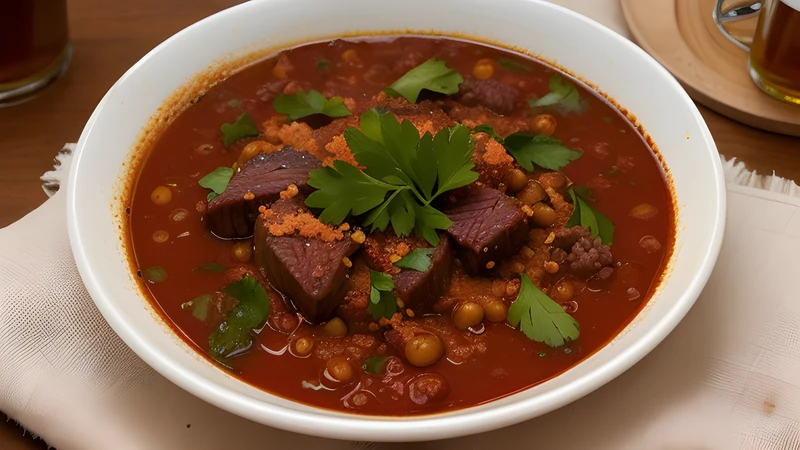
Beef, onions, dark Belgian ale and a slice of mustarded bread laid on top to melt in
Contents
↓ Jump to recipeCarbonade flamande is beef stew for people who think beef stew is boring. The sauce comes out almost black and glossy, sweet at the front and sour at the back, and the whole thing is held together by a slice of mustard-smeared bread that you lay on top of the pot and then destroy with a spoon two and a half hours later.
The bread is the detail that convinces people. It sounds like a garnish. It is structural: as it collapses it thickens the sauce, and the mustard it was carrying disperses through the whole pot at exactly the point when the fat needs cutting.
Carbonade Flamande: Beef Braised in Brown Ale
Ingredients
- 1.2 kg beef chuck or shin, cut into 5 cm cubes
- 2 tsp fine salt
- 1 tsp freshly ground black pepper
- 3 tbsp beef dripping, lard or vegetable oil
- 800 g onions, halved and sliced 5 mm thick
- 2 tbsp plain flour
- 500 ml Belgian brown ale (a dubbel or oud bruin, such as Westmalle Dubbel or Rodenbach)
- 250 ml beef stock
- 2 tbsp dark brown sugar or 1 tbsp Belgian sirop de Liège
- 2 tbsp red wine vinegar
- 2 bay leaves
- 4 sprigs thyme
- 1 clove
- 2 thick slices of country bread, crusts on
- 3 tbsp Dijon mustard
- Chopped flat-leaf parsley, to finish
Method
- Pat the beef completely dry with kitchen paper and season with the salt and pepper. Wet meat steams instead of browning.
- Heat 2 tbsp of the dripping in a heavy casserole over high heat until it shimmers. Brown the beef in three batches, 4 minutes per batch, turning only when each face releases from the pan. Do not crowd it. Set the browned meat aside.
- Lower the heat to medium, add the remaining 1 tbsp dripping and the onions with a pinch of salt. Cook for 20 minutes, stirring occasionally and scraping the browned residue off the base, until the onions are soft, slumped and deep gold.
- Sprinkle in the flour and cook, stirring, for 2 minutes.
- Pour in the ale, bring to a boil and let it bubble hard for 3 minutes to drive off the rawest alcohol. Scrape every brown fleck off the base.
- Return the beef and any resting juices. Add the stock, brown sugar, vinegar, bay leaves, thyme and clove. The liquid should just about cover the meat.
- Spread the bread slices thickly with the Dijon mustard and lay them mustard-side down on the surface of the stew.
- Bring to a bare simmer, cover, and cook in an oven preheated to 150°C for 2 hours 30 minutes, until a fork twists freely in the beef.
- Uncover and stir hard: the bread will disintegrate and thicken the sauce. If it is still loose, simmer uncovered on the hob for 10 minutes.
- Taste. Balance with more vinegar if it is cloying, or a little more sugar if it is bitter. Fish out the bay and thyme stalks, scatter with parsley and serve.
Flanders, beer, and the sweet-sour habit
The name is misleading. Carbonade comes from the Latin carbo, coal, and originally meant meat grilled over embers — the same root as the Italian carbonata. Somewhere in the Low Countries it stopped meaning grilled and started meaning stewed, which is a linguistic drift nobody has adequately explained. In Flemish it is stoofvlees or stoverij, and if you order it in Antwerp that is what you should ask for.
The beer is the point. Belgium’s brewing culture has no equal, and Flemish cooking uses beer the way Burgundy uses wine — as the braising liquid rather than as a seasoning. The traditional choice is an oud bruin or a dubbel: dark, malt-forward, with caramel and dried-fruit notes from long boiling and dark malts. Rodenbach, the Flemish red-brown from Roeselare, is aged in oak foeders and brings a genuine lactic sourness that does half the balancing work for you.
The sweet-sour axis runs through Belgian and Dutch cooking generally and it is the thing that surprises British cooks most. Sugar in a beef stew reads as wrong until you taste it against the bitterness of dark malt, at which point it becomes obvious. Sirop de Liège, a thick almost-black paste of concentrated apple and pear juice made in the Meuse valley since at least the seventeenth century, is the authentic sweetener and it is worth ordering. Dark brown sugar plus a spoonful of apple purée gets close. The same instinct produces zuurvlees across the border in Limburg, where gingerbread does the thickening job the bread does here.
Carbonade is café food, eaten with frites and mayonnaise, and it is the one Belgian dish that every brown café from Ghent to Brussels has on the board. It sits alongside moules-frites as the national default, and the leftovers get shredded into bitterballen the following week.
Choosing the beer
Everything else in this recipe is forgiving. The beer is where a carbonade is won or lost, and the wrong bottle produces something genuinely unpleasant.
What you want is malt. Dark Belgian ales get their colour and flavour from kilned specialty malts and, in the abbey styles, from dark candi sugar added to the boil — both contribute caramel, toffee, raisin and a faint roast bitterness. A Westmalle Dubbel or a Chimay Bleue at around 7% ABV gives depth and dried-fruit sweetness. A Rodenbach or another Flemish red-brown brings something different again: real lactic and acetic acidity from months in oak foeders, courtesy of Lactobacillus and Brettanomyces, which means the sourness you would otherwise add as vinegar is already in the bottle. Use a Rodenbach and cut the vinegar to a teaspoon, then taste.
What you must avoid is hops. Hop bitterness comes from iso-alpha acids, and unlike most flavour compounds these are non-volatile and thermally stable — they do not cook off, they concentrate as the liquid reduces. A stew made with an IPA reduces down into something aggressively, medicinally bitter, and sugar does not mask it; it only makes it sweet and bitter at once. The same applies to most modern craft pale ales. Belgian tripels are also a trap: high alcohol, pale malt, and a peppery hop character that reads as harsh after three hours.
Stouts and porters are the near-miss. They have the malt but the roasted barley brings an ashy, coffee bitterness that dominates the pot. Guinness makes a decent Irish beef stew; it makes a mediocre carbonade.
The 500 ml figure is roughly a bottle and a half of a 330 ml Belgian ale, which conveniently leaves you a glass to drink while you brown the beef. Do not substitute the stock entirely with beer, tempting though it is. Beer alone gives a sauce with no savoury backbone, because there is nothing in a bottle of dubbel that does the job of gelatin and roasted bone. The 2:1 beer-to-stock ratio is the working compromise, and it is what most Flemish café kitchens use.
The browning, and why it is worth twelve minutes of standing at the hob
Three batches, four minutes each, and no shortcuts. This is the least appealing part of the recipe and the one that decides how good it is.
Browning is Maillard chemistry: amino acids and reducing sugars reacting above roughly 140°C to produce hundreds of new aromatic compounds, most of which are what your brain files under “meat”. Those compounds do not exist in raw beef and cannot be created by simmering, because water caps the temperature at 100°C. Skip the browning and you get boiled beef in beer, which is edible and forgettable.
The rules are unromantic. Dry the meat — surface moisture must evaporate before the temperature can climb past 100°C, and a wet cube spends its first ninety seconds steaming itself pale. Do not crowd the pan; each piece of cold meat drops the pan temperature, and eight cubes in a pan meant for four means the whole lot steams in its own juices. Leave it alone; meat sticks when the proteins first hit the metal and releases when the crust has formed, so if it will not lift, it is not ready.
Salt the beef right before it goes in, or an hour ahead, and avoid the middle ground. Salt applied ten minutes before browning draws moisture to the surface without having time to reabsorb it, giving you the worst of both.
Chuck or shin, in 5 cm cubes. Both are collagen-rich working muscles, and collagen hydrolysing to gelatin over two and a half hours is what makes the meat yielding and the sauce cling. Lean cuts like topside have little collagen and simply dry out. Cut the cubes large; small pieces overcook before the connective tissue has converted.
The onions, and the ratio nobody believes
Eight hundred grams of onion to 1.2 kg of beef looks like a typo. It is not. Carbonade is close to an onion dish with beef in it, and the onions are the second flavour axis after the malt.
Twenty minutes over medium heat with a pinch of salt does two things at once. The salt draws water out osmotically so the onions release liquid, which dissolves the fond — the browned residue from the beef — off the base of the pan and puts it back into the dish. Then, as the water boils off, the onion sugars begin caramelising and the cell walls collapse entirely, so the finished stew has no recognisable onion in it at all: it has dissolved into the sauce and become body.
Slice them 5 mm and no thinner. Thinner slices disintegrate before they have caramelised.
The bread, and the balance
Lay the slices mustard-side down. Over two and a half hours in a covered pot the bread absorbs liquid, its starch gelatinises, and the whole slice slumps into the stew. When you stir at the end it disappears, leaving a sauce with noticeably more body. This is the medieval way of thickening a dish, older than roux by centuries and still in active use across Flanders.
Use real bread with an open crumb — a country sourdough or a pain de campagne. Sliced white sandwich bread turns to paste and adds a faint sweetness you do not want. Crusts on.
The balancing at the end is the part that separates a good carbonade from a great one, and it cannot be written into a recipe because it depends entirely on your beer. Taste the sauce. Dark malt is bitter; if the bitterness dominates, add sugar half a teaspoon at a time. If it reads as cloying and flat, add vinegar half a teaspoon at a time. You are aiming for a point where sweet and sour are both audible and neither wins. It usually takes three or four adjustments.
Where it goes wrong
The sauce is bitter and harsh. Wrong beer. An IPA or anything hop-forward is a disaster here — hop bitterness concentrates as the stew reduces and there is no amount of sugar that fixes it. Use malt-forward dark ale only.
The beef is dry and stringy. The oven was too hot, or the pot was boiling rather than simmering. Above about 90°C the muscle fibres squeeze out moisture faster than the gelatin can compensate. 150°C in the oven should give you a lazy bubble every few seconds.
The sauce is thin. Not enough reduction, or too much stock. Lift the meat out and boil the liquid down hard for ten minutes.
It tastes flat. Under-browned meat, almost always. Nothing added later replaces the fond.
The onions are still in pieces. Twenty minutes was not twenty minutes.
Variations, and the day after
Some Flemish cooks add a handful of raisins or prunes, which pushes the sweetness further and is common around Ghent. Others use pain d’épices instead of mustard bread, which brings gingerbread spice and makes it a close relative of the Limburg version. A tablespoon of dark chocolate stirred in at the end is a modern Brussels restaurant habit that genuinely works, adding bitterness and gloss without reading as chocolate.
Serve it with frites and mayonnaise if you want the authentic café plate, or with plain boiled potatoes if you want to taste the sauce, or over stamppot if you have wandered north of the border. Belgians drink the same beer with it that went into it.
It is better on day two, for the same reason every braise is: the gelatin redistributes and the flavour compounds diffuse. It keeps five days in the fridge and freezes for three months. Reheat gently on the hob; a hard boil at this stage tightens the meat all over again and undoes the afternoon you spent on it.
Related Content