Cacio e Pepe with Toasted Pepper and a Whisper of Lemon
Three ingredients, perfect technique
Contents
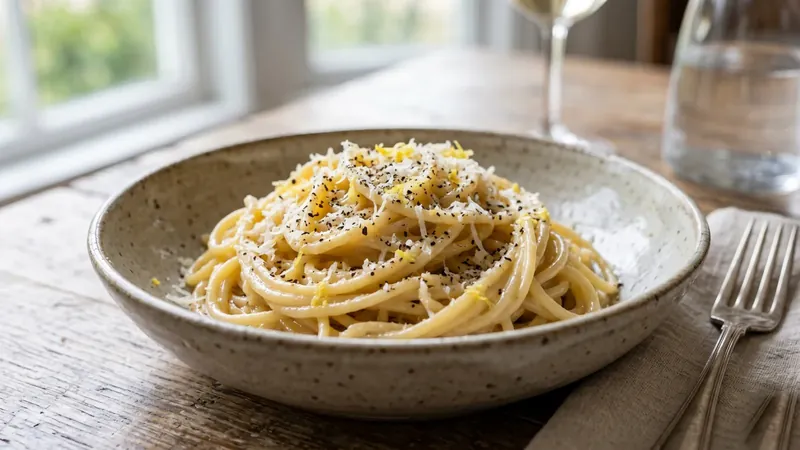
↓ Jump to recipeCacio e pepe is the ultimate test of restraint: pasta, sharp sheep’s cheese and black pepper, bound into a glossy sauce by nothing more than technique and starchy water. The twist is small and deliberate, toasting the peppercorns to wake their aroma and adding the barest whisper of lemon zest to brighten the cheese. Done well, it is one of the most satisfying plates of pasta there is, and it comes together in the time it takes the water to boil.
Cacio e Pepe with Toasted Pepper and a Whisper of Lemon
Ingredients
- 200 g tonnarelli or spaghetti
- 2 tsp whole black peppercorns
- 100 g Pecorino Romano, very finely grated
- 1/2 tsp finely grated lemon zest
- Sea salt for the pasta water
Method
- Bring a pan of water to the boil and salt it lightly; Pecorino is salty, so go easy.
- Crush the peppercorns coarsely in a mortar or under a heavy pan.
- Toast the crushed pepper in a dry wide frying pan over a medium heat for about a minute, until fragrant.
- Add a ladleful of the boiling pasta water to the pepper and let it bubble to make a fragrant base.
- Cook the pasta until just shy of al dente, reserving plenty of the starchy water before draining.
- Meanwhile, mix the grated Pecorino with a few tablespoons of cooled pasta water to a smooth, thick paste.
- Transfer the drained pasta to the pepper pan off the heat and toss, loosening with splashes of pasta water.
- Add the Pecorino paste and the lemon zest, tossing vigorously until a glossy, clinging sauce forms.
- Loosen with more pasta water if it tightens, then serve at once with extra pepper.
The Story
Cacio e pepe means simply “cheese and pepper”, and the name is the whole recipe. It belongs to the Roman tradition of cucina povera, the resourceful cooking of people who made memorable food from very little. With just three core ingredients and water, it was the kind of dish a shepherd or a trattoria cook could produce from a near-empty larder, which is part of its enduring romance. There is nowhere to hide in a plate this spare, and that is precisely what makes mastering it so rewarding.
The dish is often traced to the shepherds of the Lazio countryside, who moved their flocks across the region and carried dried pasta, aged Pecorino and peppercorns because all three keep well without refrigeration. Black pepper was more than a seasoning to them: it is warming, and folk tradition held that it helped ward off the chill of nights spent out with the animals. Whether or not that is true, the combination is a study in practicality, three shelf-stable ingredients transformed by nothing more than boiling water and a cook’s attention. Cacio e pepe sits alongside its close Roman cousins, gricia, amatriciana and carbonara, all built on the same handful of pantry staples and the same understanding of how starch, fat and cheese behave together.
The hero is Pecorino Romano, a hard cheese made from sheep’s milk that has carried a protected designation of origin since 1996 and has been produced in and around Rome and Sardinia for well over two thousand years; Roman writers of the first century recorded rations of it issued to legionaries. It is sharper and saltier than Parmesan, with a tang that defines the dish; substituting a milder cow’s-milk cheese changes the character entirely. Because it is so salty, the pasta water needs only the lightest seasoning, a detail that catches out first-timers who reach for their usual heavy hand with the salt.
The real challenge is the sauce, which is an emulsion rather than a melt. The starch released by the pasta into its cooking water is what allows the cheese to bind into a creamy coating instead of seizing into rubbery clumps. The two enemies of a good cacio e pepe are excess heat, which makes the cheese clump, and too little starchy water, which leaves it dry. Working off the heat and keeping plenty of that cloudy water to hand are the keys, which is why both feature so prominently in the method.
The twist respects the original rather than reinventing it. Toasting the crushed peppercorns in a dry pan before they meet any liquid coaxes out their volatile aromatic oils, giving the finished dish a warmer, more rounded heat than raw pepper provides. Freshly cracked pepper matters here more than in almost any other dish, because pepper is the second of only two dominant flavours; the pre-ground powder in a tub has lost most of its fragrance and will taste dusty rather than fragrant. Crush whole peppercorns coarsely just before you cook so the aroma is at its peak. The lemon zest is used with great discretion, just enough to sharpen the rich cheese and lift the whole plate without ever announcing itself; nobody should taste lemon and think the dish has strayed. Both touches are in keeping with the spirit of the original, which has always been about getting the most from the fewest possible things.
A word on the pasta itself. The traditional choice in Rome is tonnarelli, a square-cut, slightly rough strand whose texture grips the cheese, though good spaghetti makes a fine stand-in. Cooking it a touch short of al dente matters, because it finishes in the pan with the sauce and the starchy water, drinking in flavour as it does. Grate the Pecorino as finely as you can, since coarse shreds are far more likely to clump than a fine, almost powdery grate.
The science of the emulsion, step by step
It helps to understand what is actually happening when the sauce comes together, because once you can picture it the technique stops feeling like luck. Grated cheese on its own, dropped into a hot pan, will melt and then split: the fat pools out, the proteins tighten and squeak, and you are left with a stringy, greasy knot rather than a sauce. The starch is what prevents this. As pasta cooks it sheds amylose and amylopectin into the water, and those long starch molecules coat the fat droplets and hold them suspended in the liquid, stabilising the emulsion so the cheese stays creamy rather than seizing. This is why the water you cook the pasta in matters so much: the more concentrated and cloudy it is, the better it works. Some cooks deliberately use a little less water than usual, or add a spoonful of raw flour or cornflour to the cheese paste as insurance, and there is no shame in it.
Temperature is the other half of the equation. Pecorino proteins begin to seize above roughly 60°C, so the enemy is a pan that is too hot. The safest method, and the one in the steps above, is to make a cool cheese paste separately with a few tablespoons of cooled pasta water, then combine everything off the heat, tossing hard so the residual warmth of the pasta melts the cheese gently without ever letting it boil. If the sauce does split on you, do not panic: pull it off the heat, add a splash of cool pasta water, and toss vigorously; more often than not it comes back together.
What goes wrong, and how to fix it
The two classic failures are clumping and dryness. Clumping almost always means too much heat or too little starch, so lower the temperature and add more of that cloudy water. Dryness means you drained the pasta too thoroughly or served it too slowly; cacio e pepe waits for no one, tightening on the plate as it cools, so have your bowls warmed and eat it the instant it is glossy. Grating the cheese too coarsely is the third common culprit, as fat shreds trap air and clump where a fine dust dissolves smoothly. Keep a mugful of pasta water back even after you think you have plenty, because you will almost always want to loosen the sauce once or twice.
Substitutions and serving
Pecorino Romano is not easily replaced without changing the dish, but if you cannot find it, a mix of two parts Pecorino to one part Parmesan softens the sharpness while keeping the backbone. Vegetarians should look for a Pecorino-style cheese made with vegetarian rennet, as the traditional article uses animal rennet. The lemon is entirely optional and should stay a whisper; leave it out for a purist version. Serve cacio e pepe as a starter in small portions or as a light main with nothing more than a green salad alongside, and open something crisp and Roman if you are pouring wine. If you enjoy this kind of pared-back, technique-led cooking, the same discipline rewards you in a plate of potato gnocchi, where getting the dough right matters far more than any sauce, and a Dutch baby pancake with lemon shows how a bright hit of citrus can lift a rich, simple base. Master the emulsion here, and the rest is detail.
Related Content