Cacciucco alla Livornese: The Five-Fish Stew of the Tuscan Coast
Five fish, five Cs, one pan of red wine and chilli, and garlic bread underneath
Contents
↓ Jump to recipeFive fish for five Cs. That is the rule in Livorno, and it is the sort of rule that sounds like a tourist board invention until you meet someone from Livorno.
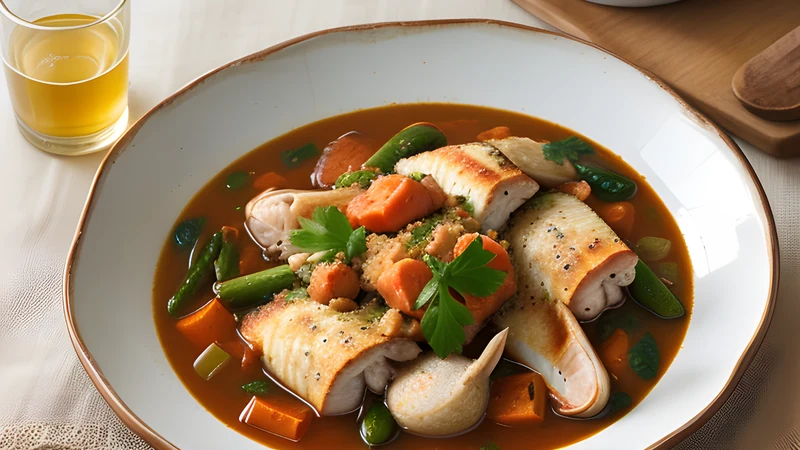
Cacciucco is the Tyrrhenian answer to bouillabaisse and it is angrier: red wine, dried chilli, tomato, and whatever the boats could not sell. There is garlic bread at the bottom of the bowl and it is the best part.
Cacciucco alla Livornese: The Five-Fish Stew of the Tuscan Coast
Ingredients
- 400g small octopus, cleaned, cut into 3cm pieces
- 300g cuttlefish or squid, cleaned, cut into 2cm strips
- 400g firm white fish on the bone (gurnard, monkfish, scorpion fish), cut into 4cm steaks
- 300g raw prawns, shell on
- 500g mussels, scrubbed and debearded
- 800g fish bones and heads (gills removed), rinsed
- 6 tbsp extra-virgin olive oil, plus more for the broth
- 1 onion, chopped
- 1 carrot, chopped
- 2 celery sticks, chopped
- 6 garlic cloves, 4 sliced and 2 whole
- 2 dried peperoncini, or 1 tsp chilli flakes
- 1 tsp fennel seeds
- 1 tbsp tomato purée
- 250ml robust red wine
- 800g tinned whole plum tomatoes, hand-crushed
- 2 tbsp red wine vinegar
- 1 small handful flat-leaf parsley, chopped
- 2 tsp fine sea salt
- 60g unsalted butter, softened
- 6 thick slices country bread
Method
- Steam the mussels in a covered pan with 100ml water over high heat for 3 minutes until they open. Discard any that stay shut. Pick most of the meat from the shells, keep 12 in the shell for serving, and strain the liquor through a fine sieve. Peel the prawns, reserving the shells and heads.
- Make the broth: heat 2 tbsp olive oil in a large pan, add the prawn shells and heads and the fish bones and heads, and fry hard for 5 minutes, pressing the heads with a spoon. Add 1.5 litres of water and the strained mussel liquor, bring to a bare simmer and cook for 25 minutes. Never boil. Strain through a fine sieve, pressing firmly, and keep hot.
- In a large wide casserole, warm 4 tbsp olive oil over medium-low heat. Add the onion, carrot, celery, sliced garlic, chilli and fennel seeds and cook for 12 minutes until soft and fragrant, with the fennel seeds smelling toasty.
- Stir in the tomato purée and cook for 2 minutes. Add the octopus and cuttlefish, stir to coat, and cook for 5 minutes.
- Pour in the red wine and let it bubble hard for 5 minutes until the raw alcohol smell has gone. Add the tomatoes, the salt and 800ml of the hot broth. Bring to a bare simmer, part-cover, and cook for 50 minutes, until the octopus gives no resistance to a knife tip.
- Add the white fish steaks and simmer for 6 minutes. Add the prawns and simmer for 3 minutes. Add all the mussels and the vinegar and cook for 2 minutes more. Take off the heat, stir through the parsley, and rest for 10 minutes.
- Make the shellfish butter: mash the softened butter with 2 tbsp of the reduced broth and a pinch of chilli. Toast or griddle the bread, rub each slice hard with a cut garlic clove, and smear with the butter. Put a slice in the base of each warm bowl and ladle the cacciucco over it.
Five Cs, and a Turkish word
Cacciucco is spelled with five Cs, and Livornese tradition holds that the stew must contain at least five different kinds of seafood, one for each of them. It is a mnemonic retrofitted to a spelling, and it has survived because five kinds of fish is a good rule whatever the reasoning behind it.
The word almost certainly comes from Turkish küçük, meaning small — which fits both the fish and the city. Livorno was made a free port by the Medici in the sixteenth century, and the Livornina laws of 1591 and 1593 invited Jews, Greeks, Armenians, Moors, Turks, English and Dutch to settle without religious interference. It became the most cosmopolitan city in Italy, and the food carries the fingerprints: the chilli, the aggressive spicing, the loanword.
The dish itself is fishermen’s leftovers, made from what the market rejected — bony scorpion fish, small octopus, cuttlefish, gurnard, weever. The rule that mattered was variety, since a single species makes a monotonous pot and the boats brought in whatever the sea gave. Livornese families still argue about tomato: the older versions had none, being red from wine and chilli alone, and tomato arrived in the nineteenth century and won.
The bread underneath is old and it is structural. Before rice or pasta was a normal weeknight thing, a slice of stale bread in the bottom of a bowl was how you turned soup into dinner. Here it soaks the broth and turns to something between pudding and toast.
The five, and how to choose them
The five need to do different jobs, and choosing five white fillets defeats the point.
Something that needs an hour. Octopus and cuttlefish are the base, and they go in at the start. They are dense with collagen and they need 50 minutes to turn tender; more usefully, they leach gelatine and a deep savoury sweetness into the broth for the whole cook. A cacciucco without one of them tastes thin.
Something on the bone. Gurnard, scorpion fish, monkfish, huss or conger, cut into steaks with the bone in. Bones mean gelatine and gelatine means body, and the flesh next to a bone stays moist while a fillet dries out. Ask the fishmonger for the heads and frames of whatever you buy; they are usually free and they are the broth.
Something with shells. Prawns and mussels, in at the very end. The shells go into the broth, and the meat needs three minutes and two minutes respectively.
Fish to avoid: oily fish — mackerel, sardines, salmon — which dominate everything and go grey. Delicate flat fish, which fall to shreds. And anything already cooked.
If your fishmonger has only three of these, make it with three and call it something else. It will be excellent.
Buying the fish, and talking to the fishmonger
This is a dish you shop for rather than plan, and the conversation at the counter decides what you cook.
Go with the five jobs in your head — one cephalopod, one bony white fish, prawns, mussels, and a fifth of whatever looks good — and let the slab tell you the rest. Ask what came in that morning. Ask what nobody is buying, because that is historically what cacciucco was made of and it is usually the best value on the counter. Gurnard is superb here and costs a fraction of monkfish. Huss, sometimes sold as rock salmon, is firm, cheap and holds together. Whole scorpion fish turns up occasionally at Italian and Turkish fishmongers and is the authentic choice.
Judge freshness at the head. Eyes should be domed and clear rather than sunken and milky; gills should be a wet crimson rather than brown; the flesh should spring back when pressed and the fish should smell of clean seawater. Fillets hide all of this, which is one more reason to buy on the bone.
Then ask for the frames. Every fishmonger has a bin of heads and bones behind the counter and most will hand them over for nothing or close to it, particularly if you are buying fish anyway. Eight hundred grams is what this recipe wants, and there is no downside to taking more and freezing it. Ask them to remove the gills while they are at it.
Mussels want to be closed, or to close when you tap them sharply on the counter. Any that stay open are dead and go in the bin. After steaming, any that stay shut go in the bin too. Prawns should be shell-on and raw — pre-peeled prawns give you no shells for the broth, which removes about a third of the flavour, and cooked prawns turn to rubber in a hot pot.
Buy it all the day you cook. Seafood is the one place where a day in the fridge is genuinely visible on the plate.
The broth is the dish
Everything else is assembly. If you skip this stage and use a stock cube, you have made tomato soup with fish in it.
Fry the bones, heads and prawn shells hard in oil for five minutes first. Prawn heads in particular contain the hepatopancreas — the brown, intensely flavoured organ that is basically prawn liver — and pressing the heads with a spoon in a hot pan releases it into the oil, along with astaxanthin, the pigment that turns the whole thing orange. This five minutes is worth more than the twenty-five that follow.
Then water, and a bare simmer for twenty-five minutes. Two rules and they are absolute. Never boil a fish stock. Fish bones are fine and their proteins denature fast; a rolling boil emulsifies fine particles into the liquid and gives you a cloudy, bitter, slightly muddy stock that no amount of straining fixes. Never go past thirty minutes. Fish bones give up everything they have in twenty-five, and after that they start releasing the compounds that make fish stock taste of the harbour at low tide. Beef stock rewards eight hours; fish stock punishes forty minutes.
Remove the gills before you start. They hold blood and grit and they are the most reliable source of bitterness in the pot. They are the dark red feathery arcs behind the head and they pull out with kitchen scissors.
Strain through a fine sieve and press. Keep the broth hot, and keep the surplus — a good cacciucco broth is worth its own risotto.
Chilli, wine, fennel and vinegar
Cacciucco is a stew rather than a soup, and what gives it the sharp edges is four things that no French fish soup would tolerate.
Chilli. Two dried peperoncini, whole or crumbled, in with the soffritto. Livorno uses more chilli than anywhere else in Tuscany and the heat should be present in the back of the throat rather than merely theoretical. Capsaicin is fat-soluble, so it goes in with the oil at the start where it has something to dissolve into.
Red wine. This is the choice that shocks people. Fish and red wine is supposed to be a crime, and here it is the whole character: a robust Tuscan red, bubbled hard for five minutes, gives the broth tannin, colour and a slightly bitter structure that white wine cannot. Sangiovese or anything with grip. Avoid heavily oaked wine.
Fennel seeds. One teaspoon, toasted in the oil with the soffritto. Anethole, the compound that makes fennel taste of aniseed, is a specific and old partner for oily fish and shellfish, and it bridges the gap between the sweetness of the prawns and the tannin of the wine.
Vinegar. Two tablespoons of red wine vinegar, added at the very end with the mussels. This is the twist and it is the one thing I would not skip. A pot containing forty-five minutes of reduced fish stock, tomato and red wine is enormously savoury and slightly heavy by the end. Acid added late stays sharp — the volatile acetic acid has no time to cook off — and it lands as a jolt of brightness that reintroduces every individual flavour you had stopped noticing. Added at the start it would simply disappear.
Timing the fish, which is the only hard part
The fish go in at four different moments and each one matters.
Octopus and cuttlefish: 55 minutes. Fish steaks: 6 minutes. Prawns: 3 minutes. Mussels: 2 minutes, and they are already cooked from the steaming, so this is only warming through.
The reason is protein. Fish muscle has almost no connective tissue and very short fibres, and it goes from raw to perfect to ruined across a range of about eight degrees. Monkfish at 55C is translucent and springy; at 63C it is opaque and flaking; at 70C it has expelled its water and turned to cotton wool. There is no long slow forgiveness the way there is with oxtail.
Cephalopods are the opposite and that is why they go in first. Octopus is dense with collagen and behaves like a braising cut: tough at 20 minutes, tougher at 30, and suddenly tender somewhere past 45 as the collagen converts. Test with a knife tip in the thickest part — it should meet no resistance at all.
Then rest the pot off the heat for ten minutes before serving. The residual heat finishes the white fish gently and everything settles.
Tips, swaps and the bread
The bread. Thick country bread, griddled until charred at the edges, rubbed hard with a raw garlic clove while still hot — the toast acts as a grater and the garlic melts into it. Then the twist: smear it with butter mashed with two spoons of the reduced broth and a pinch of chilli. It is shellfish butter with almost no effort, and it turns the bread from a sponge into the best mouthful in the bowl.
Make ahead. Make the broth and the base — through the 50-minute octopus stage — up to two days ahead. It improves. Add the fish, prawns and mussels only when you are serving. Never reheat a finished cacciucco.
Freezing. The base freezes for three months. Finished, it does not.
Wine to drink. Whatever went in the pot.
Cheating. No parmesan. Cacciucco takes no cheese and Livorno will hear no argument on the point.
For the Californian descendant of this exact idea, cioppino was made by Ligurian fishermen doing the same thing with Pacific fish, and halászlé is the freshwater version of the head-and-bones-into-broth argument. If you have broth left over, crni rizot is where it should go.
Related Content