Fluffy Buttermilk Pancakes with Brown Butter
Tall, tender American-style stacks
Contents
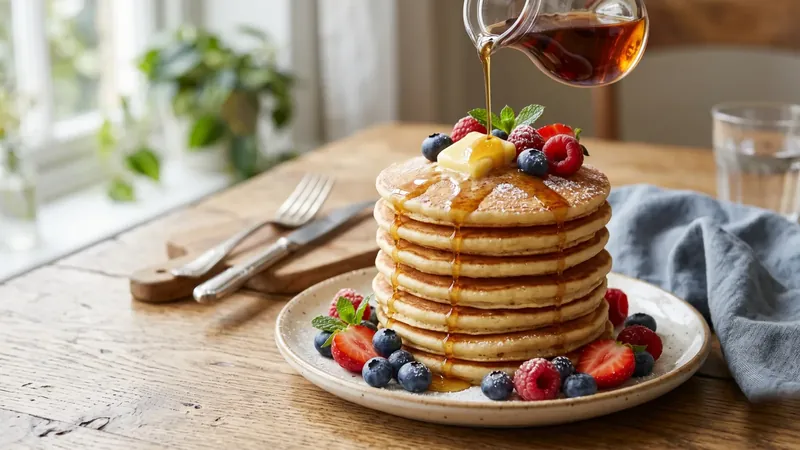
↓ Jump to recipeThere is fluffy, and then there is fluffy with depth. These tall buttermilk pancakes get their tang from cultured milk and their rise from a generous hit of raising agents, but the real twist is brown butter folded straight into the batter. That gentle, toffee-and-hazelnut note runs through every bite, turning a familiar weekend stack into something quietly special. Serve them warm, drenched in maple syrup, with the last spoonful of brown butter melting over the top.
Fluffy Buttermilk Pancakes with Brown Butter
Ingredients
- 75g unsalted butter
- 250g plain flour
- 2 tbsp caster sugar
- 2 tsp baking powder
- 1 tsp bicarbonate of soda
- 1/2 tsp fine salt
- 400ml buttermilk
- 2 large eggs
- 1 tsp vanilla extract
- A little flavourless oil, for the pan
Method
- Melt the butter in a small pan over a medium heat, swirling, until it foams, smells nutty and turns golden-brown. Tip into a bowl and leave to cool slightly.
- Whisk together the flour, sugar, baking powder, bicarbonate of soda and salt in a large bowl.
- In a jug, whisk the buttermilk, eggs and vanilla, then whisk in most of the brown butter, holding back a spoonful for serving.
- Pour the wet mixture into the dry and fold gently with a spatula until just combined. A few lumps are fine; do not overmix.
- Rest the batter for 10 minutes while you heat a non-stick frying pan over a medium-low heat. Wipe with a little oil.
- Ladle in roughly 60ml of batter per pancake, leaving space to spread.
- Cook for 2 to 3 minutes until bubbles appear on the surface and the edges look set.
- Flip and cook for a further 1 to 2 minutes until golden and cooked through.
- Keep warm in a low oven while you cook the rest, wiping the pan between batches.
- Serve in stacks, drizzled with the reserved brown butter and your topping of choice.
The Story
The American-style pancake is a creature of leavening. Where a French crêpe or a Yorkshire-batter pancake stays thin and lacy, the stack you find at a diner relies on chemical raising agents to puff up into something soft and cushiony. Buttermilk is central to that effect. It is acidic, and that acidity reacts with bicarbonate of soda to produce carbon dioxide, which inflates the batter as it hits the hot pan. The same tang also keeps the crumb tender, because acid interferes with the gluten that would otherwise toughen the flour.
Traditional buttermilk was the liquid left behind after churning cream into butter, faintly sour from the natural cultures in the cream. Most buttermilk sold today is made differently, by adding a culture to low-fat milk, but it behaves the same way in a batter. If you cannot find it, stirring a tablespoon of lemon juice into ordinary milk and leaving it for ten minutes makes a workable substitute.
The twist here is brown butter, known in French kitchens as beurre noisette, literally hazelnut butter, for the colour and aroma it takes on. When butter is heated past its melting point, the water cooks off and the milk solids it contains begin to toast. Those solids are mostly milk proteins and traces of sugar, and they brown through the same family of reactions that give toast, roast meat and coffee their savoury complexity. The result smells of nuts and caramel and tastes far richer than plain melted butter.
Folding brown butter into pancake batter is a small move with an outsized payoff. It seasons the whole stack from within rather than sitting on top, and it pairs naturally with maple syrup, which carries its own gentle caramel notes. The technique asks for only a little patience: the butter goes from golden to burnt quickly, so it pays to keep swirling the pan and to pull it off the heat the moment the foam subsides and the smell turns nutty, letting the residual heat finish it. It is the same trick behind a batch of brown butter scones and a tray of almond financiers.
The science of the rise
It is worth understanding why this particular combination of ingredients produces a tall, tender pancake, because once you do, the whole recipe becomes easy to troubleshoot. The lift comes from two raising agents working together. Baking powder is a self-contained system: it already carries its own acid, and most modern versions are double-acting, meaning they release some gas when they get wet and a second burst when they hit the heat of the pan. Bicarbonate of soda is pure alkali and needs an external acid to react, which is exactly what the buttermilk provides. That reaction is fast, producing carbon dioxide the moment the wet and dry mixtures meet, which is one reason you do not want to leave the batter sitting for hours; the best lift comes within the first half hour.
The soda does a second, less obvious job. Beyond its role in leavening, a small amount of alkali nudges the batter’s acidity toward neutral, and a slightly less acidic batter browns more readily in the pan through the same reactions that colour toast. Get the balance right and you are rewarded with pancakes that are pale gold rather than anaemic, with a faint tang still present underneath. Too much soda, though, and you can taste it: a soapy, metallic note that no amount of syrup will hide. The quantities here are measured to that balance, so it is worth using proper measuring spoons rather than eyeballing, especially for the bicarbonate.
The eggs contribute structure and richness. The whites set as they cook and help hold the aerated batter in shape, while the yolks add fat and emulsify the batter so the crumb stays tender. Some cooks separate the eggs and whisk the whites to a foam for an even lighter, more soufflé-like pancake; it works, but for a weekday stack the extra washing-up rarely feels worth it, and the buttermilk-and-soda route gives plenty of height on its own.
The flour choice matters less than people think, but it is worth a word. Plain flour gives a tender crumb because it has less gluten-forming protein than bread flour; if all you have is a stronger flour, be even gentler with the mixing to keep the pancakes soft. The sugar in the batter is modest, just enough to encourage browning and season the crumb, since the real sweetness arrives with the syrup on top. And the pinch of salt is not optional: without it the pancakes taste oddly flat, the tang of the buttermilk and the nuttiness of the brown butter both dulled. Weigh the flour rather than scooping it, as a heavy hand with the cup packs in more than the recipe expects and gives you dense, heavy stacks.
Why you shouldn’t overmix
The other half of a good pancake is restraint. Once flour meets liquid, the proteins in it start linking into gluten, and the more you stir, the stronger that network becomes, giving you a chewy, rubbery, flat pancake instead of a light one. Fold the wet into the dry just until no dry streaks remain and stop while the batter still looks lumpy; those lumps hydrate and vanish in the pan. The ten-minute rest afterwards does two jobs: it lets any last dry flour absorb liquid, and it gives the raising agents a head start so the batter is already gently bubbling when it hits the heat.
Heat matters too. A medium-low pan gives the inside time to set before the outside overbrowns, which is the usual cause of a pancake that is dark outside and raw within. Wait for bubbles to form and burst across the surface and the edges to look dry and set before you flip; flip once only, as pressing or turning repeatedly knocks the air out. A knob of butter left too hot in the pan will scorch and taste bitter, so keep the fat light, wiping the pan with oil between batches.
Variations, swaps and make-ahead
No buttermilk? Stir 1 tablespoon of lemon juice or white vinegar into 400ml of ordinary milk and leave it for 10 minutes until it thickens and curdles slightly; it behaves the same way with the soda. Fold 100g of blueberries into the batter, or drop them onto the pancakes just after ladling so they don’t bleed and turn everything grey. A handful is not a measurement I trust, so weigh them. For a spiced autumn version, add 1 teaspoon of ground cinnamon and a grating of nutmeg to the dry mix. The batter is best used fresh, as the raising agents lose lift over time, but cooked pancakes freeze well: cool them flat, stack with greaseproof between each, and reheat from frozen in a toaster or a low oven. Serve them the classic way with maple syrup and crisp streaky bacon, whose salt is the perfect foil for the sweetness, and the last spoonful of brown butter melting over the top. For a savoury weekend breakfast at the other end of the spectrum, the buckwheat crêpes with ham, Gruyère and a fried egg make a fine counterpart.
Related Content