Bündner Nusstorte: The Engadine Caramel Walnut Tart
A sealed shortcrust box of caramelised walnuts, invented for a valley that had no walnuts
Contents
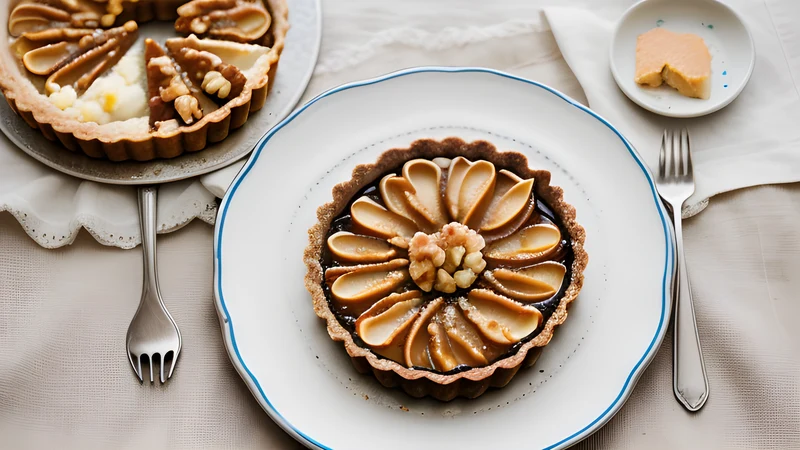
↓ Jump to recipeThe Bündner Nusstorte is a sealed box of pastry with caramelised walnuts inside it, and if you make one today you should not eat it until Thursday. That instruction is the most important part of the recipe and the hardest to follow.
It comes from the Engadine, the high valley in Graubünden that runs from the Maloja pass down to the Austrian border — St Moritz, Zuoz, Scuol, villages with sgraffito-decorated houses and a language, Romansh, spoken by perhaps 40,000 people. It is Switzerland’s most remote inhabited corner, sitting between 1,600 and 1,800 metres, and it is worth knowing that walnuts will not grow there. Juglans regia needs a growing season the Engadine does not have.
So the valley’s signature tart is made from imported nuts, which is the whole story in one sentence.
Bündner Nusstorte: The Engadine Caramel Walnut Tart
Ingredients
- 350g plain flour
- 125g icing sugar
- 1/2 tsp fine salt
- 250g cold unsalted butter, cubed
- 1 large egg
- 1 large egg yolk
- Finely grated zest of 1 lemon
- 300g walnut halves
- 300g caster sugar, for the caramel
- 250ml double cream, warmed
- 2 tbsp runny honey
- 30g unsalted butter, for the caramel
- 1/2 tsp fine salt, for the caramel
- 1 egg yolk beaten with 1 tbsp cream, for glazing
Method
- Rub the cold butter into the flour, icing sugar and salt until it resembles coarse breadcrumbs, then add the whole egg, the extra yolk and the lemon zest and bring together into a dough without kneading.
- Divide into two discs, one slightly larger than the other, wrap and chill for at least 2 hours.
- Toast the walnuts at 170C fan for 8 minutes, cool, then chop roughly into pieces about the size of a pea. Do not grind them.
- Make a dry caramel: spread the caster sugar in an even layer in a heavy pan over a medium heat and leave it alone until it begins to melt at the edges, then stir gently with a heatproof spatula until it is a uniform deep amber, about 8 minutes.
- Off the heat, pour in the warmed cream in three additions, standing back as it erupts, stirring until smooth. Return to a low heat and stir in the honey, butter and salt.
- Fold in the chopped walnuts, then tip the mixture onto a tray and cool completely to room temperature, at least 1 hour.
- Roll the larger dough disc to 4mm and line a 24cm loose-bottomed tart tin, letting the pastry overhang the rim by 1cm. Chill for 20 minutes.
- Spoon in the cooled walnut caramel and level it, keeping it 5mm below the rim.
- Roll the second disc to 4mm, lay it over the filling, press the two pastry edges together firmly all round and trim flush with the tin. Crimp the seal with a fork.
- Glaze the lid, prick it three times with a fork, and score a shallow pattern with a knife tip.
- Bake at 180C fan for 40-45 minutes until deep golden. Cool completely in the tin, then rest for 24 hours before cutting.
Engadiners who left, and came back with a tart
For four centuries the Engadine exported people. The valley could feed a certain number of families and no more, so younger sons left — a phenomenon so regular it has a name, the Randulins, the Romansh word for swallows, because they migrated and returned. They went to Venice, Milan, Marseille, Naples, and later to Paris, London, Odessa and as far as St Petersburg, and overwhelmingly they went into one trade: confectionery.
Engadine pastry cooks and café owners became a diaspora with real weight. There is a Swiss-run café tradition across Italy and the Habsburg lands that traces directly to this valley. The Caffè Florian’s competitors in Venice, the grand cafés of Milan and Trieste, half the chocolate houses of central Europe — Grisons names, over and over. Then in 1766 Venice expelled the Protestant Grisons confectioners in a burst of religious and commercial politics, and they scattered further still, taking their skills to places that had not previously known what a good pastry was.
When they came home they brought money, and they brought sugar, cream techniques and a taste for the nuts of the south. The sgraffito houses of Guarda and Ardez were largely built with money made selling sweets in foreign cities.
The tart itself is younger than that story and depends on it. The commonly cited origin is Fausto Pult, a confectioner in Samedan, who in the 1920s put together the sealed shortcrust and the caramelised walnut filling into the form we recognise. Other Engadine bakers claim it, and the truth is probably that several people were converging on the same idea. What made it stick is that it was designed to travel: a tart with no dairy exposed to the air, sealed inside a butter-heavy crust, will survive a week in a rucksack, and in the 1920s the Rhaetian Railway had just made the Engadine a tourist destination full of people who wanted to take something home. It has been Graubünden’s edible souvenir ever since, sold in a flat cardboard box in every village bakery.
That keeping quality is the same logic behind Linz’s lattice tart, which got famous because it could be posted, and Basel’s honey biscuit, which was rations for the Rhine trade. Alpine and Rhine food is full of things designed to outlast a journey.
The walnuts, and how you treat them
Three hundred grams is a lot of walnut and the tart is named after them, so they deserve some care.
Buy halves rather than pieces. Pieces are the broken remainder of the grading process, they have more surface area exposed to air, and walnut oil is roughly 70% polyunsaturated fat, which means it goes rancid faster than almost any other nut. A rancid walnut tastes of paint and there is nowhere for it to hide in this filling. Taste one before you commit — if there is any bitterness at the back of your tongue that is not the tannin in the skin, buy new ones. Keep walnuts in the freezer and they last a year; keep them in a warm cupboard and they last six weeks.
Toast them. Eight minutes at 170C, until they smell of walnut and the papery skins have darkened a shade. This drives off a little moisture, which matters because moisture in the filling will make it weep, and it develops the flavour enough to stand up to a dark caramel. Cool them completely — hot nuts stirred into caramel steam and soften.
Chop rather than grind. Pea-sized is the target, and the reason is texture: the entire pleasure of a Nusstorte is a dense chew of nut against a shattering crust, and a food processor turns that into paste in four seconds. Do it with a knife on a board, and accept a range of sizes. The small fragments distribute the caramel and the large ones give you something to bite.
Some Engadine bakers rub the toasted nuts in a tea towel to remove the skins, which reduces the bitterness. I leave them on. The skins carry the tannin that keeps 300g of nut in 300g of sugar from tasting merely sweet, and after four days in the tin that bitterness has softened into something closer to depth. Grisons purists will tell you the original used no skins at all; Grisons purists will also tell you the tart should be made in a square tin, and they cannot all be right.
Dry caramel, which is the only difficult part
Everything in this tart is easy except one pan of sugar, and that pan will punish inattention.
A dry caramel means sugar melted without water. It gives you more control over the final colour and a cleaner flavour, and it goes from amber to black in roughly fifteen seconds. Use a heavy-based pan — thin pans have hot spots and will burn one patch of sugar while another is still crystalline.
Spread the sugar in an even layer and then leave it. The urge to stir immediately is what causes crystallisation: agitating sugar that has not yet melted gives dissolved molecules something to nucleate around, and you get a pan of gritty lumps. Wait until the edges have gone liquid and gold, then start moving it gently with a spatula, pulling the melted sugar over the dry.
Take it to a deep amber — the colour of a copper coin, definitely darker than honey. A pale caramel in this tart tastes of nothing but sweetness. There is 300g of walnut in here and it needs a caramel with some bitterness to argue with.
Warm the cream first. Cold cream hitting 170C sugar will seize it into a solid lump and you will start again. Even warm, it will erupt violently and produce a great deal of steam, so pour it in three additions, off the heat, with your hand well clear, and stand back. If it does seize, keep the pan on a low heat and stir; nine times out of ten it melts back together.
The honey is doing chemistry. It is an invert sugar — fructose and glucose rather than sucrose — and invert sugars interfere with crystal formation, so two tablespoons keep the cooled filling soft and sliceable instead of setting into toffee. Skip it and you will need a hammer.
The salt is not optional either. Half a teaspoon in this quantity of caramel does what salt always does: it stops the sweetness from flattening everything else.
Cool the filling completely before it goes into the pastry. Warm caramel melts a raw pastry case from the inside and you get a soggy base and a filling that has leaked into the tin. An hour on a tray, spread thin, does it.
The seal, and why the lid matters
This is a closed tart and the seal is structural. Caramel that escapes during baking welds the tart to the tin and burns black on the outside, and you will lose the whole thing.
Roll both discs to a consistent 4mm — a lid that is thin in one place will blow out there. Let the base overhang by 1cm so there is material to seal against. Press the two edges together with your thumb the whole way round, then trim flush and crimp with a fork, which both locks the seal and gives the traditional rim.
Prick the lid three times. It needs somewhere for steam to go, and three small holes will vent without letting the filling climb out. Do not slash it.
Keep the filling 5mm below the rim. It expands.
The pastry itself is a Mürbeteig with a great deal of butter — 250g to 350g of flour — which makes it fragile and means you should expect to patch it. Patch freely; the lid hides the base and the crimp hides the join. Work fast and keep it cold, and if it becomes greasy and unmanageable, put the whole thing back in the fridge for fifteen minutes rather than fighting it.
Where it goes wrong
The caramel is grainy. You stirred it too early, or a sugar crystal from the pan wall fell in. Next time, resist the spatula until half the sugar has melted, and brush the pan walls down with a wet pastry brush if you see crystals forming.
The filling set like toffee. Not enough invert sugar, or the caramel went too dark. Include the honey.
Caramel leaked out of the side. Bad seal, or the filling was overfilled or still warm.
The base is pale and soft. A closed tart cannot be blind-baked, so it needs a hot oven and, ideally, a preheated baking sheet under the tin to drive heat into the base. 180C fan and a steel tray does it.
It shatters when sliced. You cut it too soon. Which brings us to the point.
Wait four days
A freshly baked Nusstorte is fine. A four-day-old one is a different tart entirely.
What happens in the tin is migration. The caramel is hygroscopic and slowly pulls moisture from the pastry immediately around it, which softens the inner surface of the crust and firms the filling to a clean, sliceable density. The walnut oils bleed into the pastry. The whole thing goes from two distinct things in a box to one integrated object. Cut it warm and the caramel runs and the pastry crumbles; cut it on day four and you get a clean wedge that holds its shape on a plate.
Store it at room temperature, wrapped in greaseproof and then foil, or in a tin. It is at its best somewhere between four and ten days, and it is entirely good at three weeks. Refrigeration is wrong — it makes the pastry hard and mutes the caramel. Freezing works, whole and well wrapped, for three months.
Serve it in thin slices with black coffee and nothing else. It is extremely rich, twelve slices is genuinely twelve portions, and a valley that spent four hundred years feeding sugar to Venice knew what it was doing.
Related Content