Bugnes Lyonnaises: The Carnival Fritters of Lyon
Thin, blistered, brown-butter dough for the last days before Lent
Contents
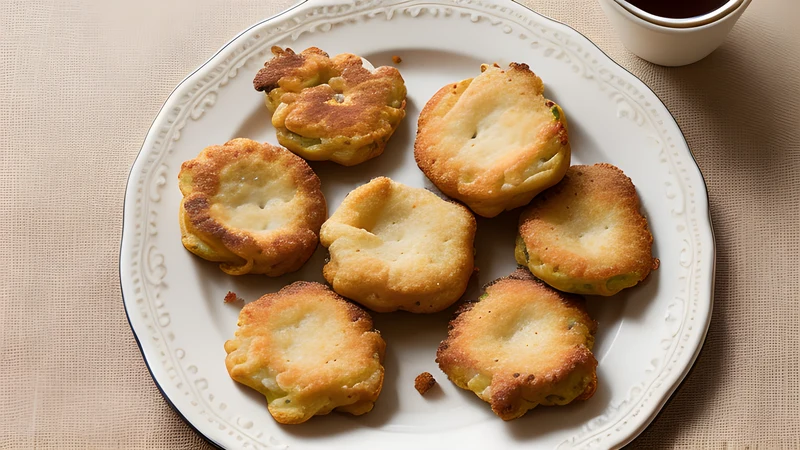
↓ Jump to recipeThe first bugne I ate came out of a paper cone in Lyon in February, in the kind of drizzle that gets into your collar. It shattered. That is the whole point of the thing and the whole difficulty of it: a bugne lyonnaise is supposed to be so thin that it collapses at the first bite, leaving blistered shards and a cloud of icing sugar down your front. Get it a millimetre too thick and you have made a doughnut. A perfectly nice doughnut, but you have missed.
This recipe is the classic Lyonnais dough with one deliberate change: the butter goes into the pan first and cooks until it browns. Bugnes carry very little fat compared with a brioche, so what fat is there has to work hard. Browning it turns a neutral richness into something toasted and hazelnutty that survives the fryer.
Bugnes Lyonnaises: The Carnival Fritters of Lyon
Ingredients
- 75 g unsalted butter
- 400 g plain flour, plus 30 g for dusting
- 60 g caster sugar
- 7 g fine sea salt
- 2 large eggs, at room temperature
- 1 large egg yolk
- 60 ml whole milk
- Finely grated zest of 1 unwaxed lemon
- 1 tbsp orange-flower water
- 1 tbsp dark rum
- 1.5 litres sunflower or groundnut oil, for frying
- 60 g icing sugar, for dusting
Method
- Melt the butter in a small pan over medium heat and keep cooking for 4-5 minutes, swirling, until the milk solids at the bottom turn hazelnut brown and it smells nutty. Pour into a bowl, scraping in every brown speck, and cool to room temperature.
- Whisk the flour, caster sugar and salt in a large bowl. Make a well and add the eggs, yolk, milk, lemon zest, orange-flower water, rum and the cooled brown butter.
- Mix with a wooden spoon until it clumps, then turn onto a work surface and knead for 6-8 minutes until smooth, elastic and slightly tacky. Do not add flour unless it sticks to your hands after 5 minutes.
- Wrap tightly and chill for at least 2 hours, or up to 24 hours. The dough must be cold to roll thin.
- Cut the dough into four pieces, keeping three chilled. Roll one piece on a lightly floured surface to 2 mm - thin enough to see the grain of the board through it.
- Cut into 4 cm by 10 cm rectangles with a knife or fluted wheel. Slit each one lengthways down the middle, leaving 1 cm at each end, and pull one end back through the slit to make a twist.
- Heat the oil to 175C in a deep, heavy pan, filling it no more than one-third full. Check with a probe thermometer.
- Fry 4-5 bugnes at a time for 45-60 seconds, turning once, until pale gold and blistered. They puff and float almost immediately.
- Lift onto a wire rack set over kitchen paper. Let the oil return to 175C between batches.
- Dust heavily with icing sugar while still warm and eat the same day.
What a bugne actually is
Bugnes belong to a family of fried carnival pastries that stretches across the Alps and back. The Italian chiacchiere, the Alsatian schankala, the Spanish orejas, the Swedish klenäter — the same idea, cut and named differently in each valley. Lyon’s version takes its name from the Franco-Provençal bugna, meaning a bump or a swelling, which tells you what the dough does when it hits the oil.
The tradition is tied to Mardi Gras and the days immediately before Lent. Households needed to use up eggs, butter and sugar before the fast, and frying is the fastest way to turn a lot of those into a lot of food. Lyon’s bakers still stack them in the windows from January onward, and the city argues about them the way it argues about everything else edible.
The argument is between two camps. The bugne lyonnaise proper is thin, dry and crisp — rolled to a whisker, fried in seconds, snapping when you break it. The bugne moelleuse, which travelled up from Saint-Étienne and the surrounding hills, is thicker, softer and closer to a raised doughnut, with a chew in the middle. Both are defensible. Lyonnais purists find the soft version an embarrassment, which is roughly how they feel about most things from Saint-Étienne. I am writing the thin one here because it is the harder and better of the two, and because a soft bugne is a solved problem.
Marcel E. Grancher, the Lyonnais writer, claimed the bugne was the only pastry that could be eaten while walking, arguing and gesturing at once. That is a good description of the texture as much as the culture.
The pastry is old enough to have a paper trail. Lyon’s records mention bugnes being sold at the pre-Lenten fairs well before the eighteenth century, and by the 1800s the city had a working guild distinction between the bakers who made bread and the ones who fried. The fritters were street food in the literal sense: fried in a cauldron at the edge of a market, sold by weight in a twist of newspaper, eaten before you got home. Nothing about that has changed except the paper. Walk through the Croix-Rousse in the weeks before Lent and the boulangeries still stack them in the window in drifts, sold by the hundred grams, with the thin and the soft versions labelled separately so nobody starts a fight.
Why brown butter and why so little of it
Look at the ratio: 75 g of butter to 400 g of flour. That is under 20%, less than a third of what goes into a brioche. Fat coats flour proteins and blocks gluten development, and gluten is exactly what you need here — a dough that will stretch to 2 mm without tearing, then set into a brittle lattice in the fryer. Load it with butter and it becomes short and crumbly, and short dough cannot be rolled that thin.
So the butter’s job is flavour rather than structure, which makes it the obvious candidate for browning. Cooking it drives off the water and toasts the milk proteins and lactose together — the Maillard reaction that turns whey solids into those brown specks at the bottom of the pan. Scrape every one of them into the dough. That sediment is where the flavour lives; the clear golden fat above it is comparatively dull.
Cool the butter properly before it meets the eggs. Warm brown butter will start to set the egg proteins on contact and you will find little cooked threads through the dough that never disappear.
The rolling, which is the actual recipe
Everything else is straightforward. The rolling is where bugnes are won or lost.
The dough must be genuinely cold — two hours minimum in the fridge, and I prefer overnight. Cold dough resists less as you roll because the gluten has had time to relax, and cold butter does not smear. Work with a quarter of the batch at a time and keep the rest chilled; a piece of dough left out on the bench for twenty minutes becomes soft, sticky and impossible to roll thin.
Roll on a lightly floured surface, turning the sheet 90 degrees every few passes so it stretches evenly. When you think you are done, roll it again. The test I use: lift the sheet and hold it against the window. You should see light through it and the shadow of your own fingers. 2 mm is the target and most people stop at 4 mm and wonder why their bugnes are bready.
If the dough springs back and refuses to stay put, the gluten is tight. Cover it, walk away for ten minutes, come back. Fighting it just tears it.
A pasta machine is a legitimate shortcut and I use one about half the time. Cut the dough into pieces small enough to feed through, start at the widest setting and work down to the second-thinnest — on most machines that lands almost exactly on 2 mm. The dough is stiff enough to take it without tearing, which is another argument for keeping the butter low. Flour the sheets lightly as they come out or they will weld to each other on the bench.
The twist — the slit down the middle with one end pulled through — is not decoration. It stops the centre from ballooning into a pillow, so the fritter fries flat and crisp instead of inflating into a sphere. If yours puff up like small footballs, your slit was too short or too near one end.
Frying: the temperature is the recipe
175C. Use a probe thermometer; the sizzle test will lie to you.
Too cool, and the dough sits in the oil absorbing it, and you get a heavy, greasy bugne that goes limp in fifteen minutes. Too hot — above about 190C — and the surface browns before the interior has dried out, which gives you a bugne that looks perfect and tastes of raw flour. The window between them is narrower than it sounds, and every batch you add drops the oil temperature by 10-15C, which is why you wait between batches.
They cook in under a minute. Have your rack, your tongs and your icing sugar ready before the first one goes in, because there is no time to fetch anything.
Use a neutral oil with a high smoke point — sunflower or groundnut. Olive oil is wrong here in both flavour and smoke point, and the Lyonnais themselves historically used beef dripping, which is superb and which your kitchen will smell of for two days.
Fill the pan no more than a third. Dough displaces oil, oil rises, and a pan filled halfway can overflow onto a gas ring. This is the one genuinely dangerous part of the recipe and it is worth being boring about.
The flour and the dough
Plain flour, around 10-11% protein, is what you want. Strong bread flour sounds like the right answer given how much stretch the dough needs, but it overshoots: the gluten becomes so tenacious that the sheet fights back at every pass and the fried result has a tough, jaw-working chew rather than a clean snap. Plain flour has enough protein to hold a 2 mm sheet together and little enough to shatter afterwards.
Knead properly — six to eight minutes, until the dough is smooth and slightly tacky and springs back slowly when you poke it. Underkneaded dough tears at 3 mm and you will never get it thinner. The urge to add flour during kneading is strong and mostly wrong; a bugne dough is meant to feel slightly sticky for the first few minutes and then stop being sticky as the gluten organises. Give it five minutes before you decide.
Room-temperature eggs matter more than they usually do. Cold eggs firm the brown butter back into flecks as they hit the bowl, and those flecks never distribute properly, so you get a marbled dough that fries unevenly.
Tips, variations and the storage question
Flavourings. Orange-flower water and rum are the traditional Lyonnais pairing and they work because both are volatile — they survive the fryer as aroma rather than taste. Swap the rum for Cognac, or the orange-flower water for a vanilla pod’s seeds. Some Lyon bakers use lemon alone. Do not use more than a tablespoon of orange-flower water; past that it turns soapy.
The soft version. If you want bugnes moelleuses, add 7 g of instant yeast to the flour, roll to 6 mm, prove the cut shapes for 30 minutes and fry at 170C for 90 seconds a side.
Sugar. Icing sugar, dusted while warm so it sticks. Caster sugar slides straight off and ends up on the floor.
Storage. There isn’t any. A thin bugne is at its best about ninety seconds out of the fryer and noticeably worse by the next morning, when the sugar has drawn moisture out of the air and softened the surface. Fry what you will eat. The dough, though, keeps beautifully wrapped in the fridge for 24 hours, and you can cut and fry a handful at a time over two evenings.
Rescuing greasy ones. If a batch came out heavy, your oil was too cool. Get it back to 175C and carry on; the greasy ones are still edible warm, they just will not keep.
If you like the genre, the Romanian papanași work the opposite way — soft curd dough, soured cream, jam — and the Icelandic kleinur use the same twisted-through-a-slit trick on a cardamom dough. For something with apples in it, the Dutch appelflappen are the New Year’s Eve equivalent.
Make them on a grey afternoon, eat them standing up, accept the icing sugar on your jumper.
Related Content