Budae Jjigae: Korean Army Base Stew
The red broth that turned ration tins into a national comfort dish
Contents
↓ Jump to recipeBudae jjigae means, bluntly, “army base stew,” and the name is not a marketing flourish. The dish was built in the early 1950s in Uijeongbu, a garrison town north of Seoul that hosted a US military base through the Korean War and its long aftermath. Rations from that base — tinned spam, hot dogs, tinned beans, slices of processed American cheese — moved into the local economy through the back gate, sold or bartered by base workers alongside whatever Korean cooks had on hand: gochujang, kimchi, tofu, scallions. The two halves met in one pot because that was the practical thing to do with a stew that needed bulking out and a pantry that suddenly had spam in it.
It is worth being precise about the period this comes from, because “war food” undersells how bad things were. South Korea in the mid-1950s was one of the poorest countries on earth, its agricultural base wrecked, and protein was scarce enough that a tin of pink meat represented real calories at a moment when real calories were not guaranteed. The stew that resulted was sometimes called buseo-tang, or “unofficial ration stew,” a title that makes the improvisation explicit. It was practical food, cooked from what came over the fence, and for years it carried a whiff of shame precisely because everyone understood where the meat had come from.
That association softened slowly. Through the 1960s and 70s, as the economy recovered and tinned meat stopped being scarce, budae jjigae kept its foothold in Uijeongbu and Songtan, the two towns most associated with US bases, largely as a working-class restaurant dish rather than a home one — cheap, filling, sociable, cooked tableside on a portable burner and shared from the one pot. It didn’t travel to Seoul’s mainstream restaurant scene in earnest until the 1980s, and even then it carried a slight association with hardship that took another generation to fully shake off. Today it sits comfortably alongside dishes with far older pedigrees on Korean menus, ordered as often for its specific flavour as for any nostalgia, though older diners in Uijeongbu will still tell you which restaurant served the “real” version back when it wasn’t a novelty.
Budae Jjigae: Korean Army Base Stew
Ingredients
- 200g tinned spam, sliced into 1cm batons
- 2 frankfurter sausages or hot dogs, sliced on the diagonal
- 200g kimchi, roughly chopped, plus 3 tbsp of its juice
- 150g firm tofu, cut into 1.5cm slabs
- 1/2 onion, sliced
- 1 portion instant ramyeon noodles (seasoning packet discarded)
- 100g tteok (rice cake sticks), separated if stuck together
- 2 tbsp gochujang
- 1 tbsp gochugaru
- 1 tbsp soy sauce
- 1 tsp minced garlic
- 1 tsp sugar
- 600ml chicken or anchovy stock
- 2 spring onions, cut into 4cm lengths
- 50g processed cheese slice (optional, laid on top at the end)
- 1 tbsp butter (optional, stirred in at the end)
Method
- Mix the gochujang, gochugaru, soy sauce, garlic and sugar with a splash of the stock into a smooth paste.
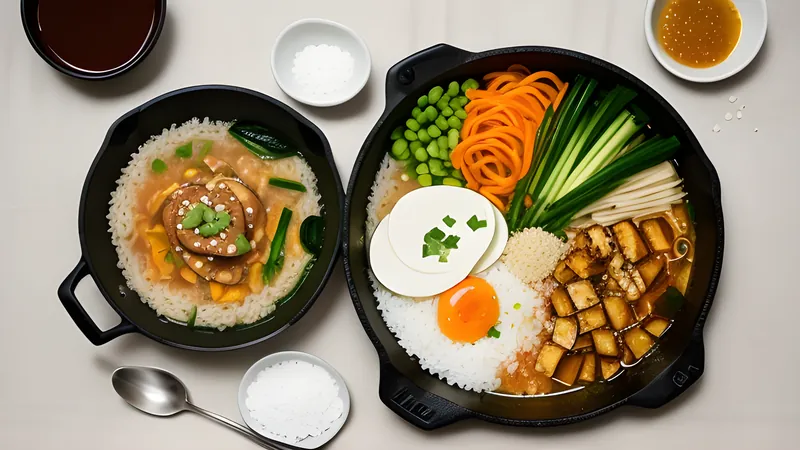
- Arrange the spam, sausage, kimchi, tofu and onion in loose clusters around a wide shallow pot or portable gas burner pan, keeping each ingredient visible rather than mixed in.
- Spoon the paste into the centre and pour the stock around the edges so it doesn't wash the paste away immediately.
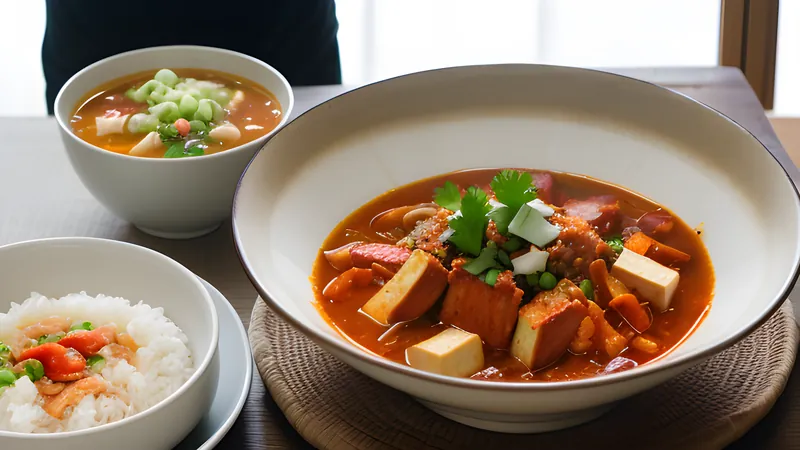
- Bring to a rolling boil uncovered over high heat for 8 minutes, then stir everything through once the broth is fully red and bubbling.
- Add the tteok and simmer for 5 minutes until softened but still chewy at the centre.
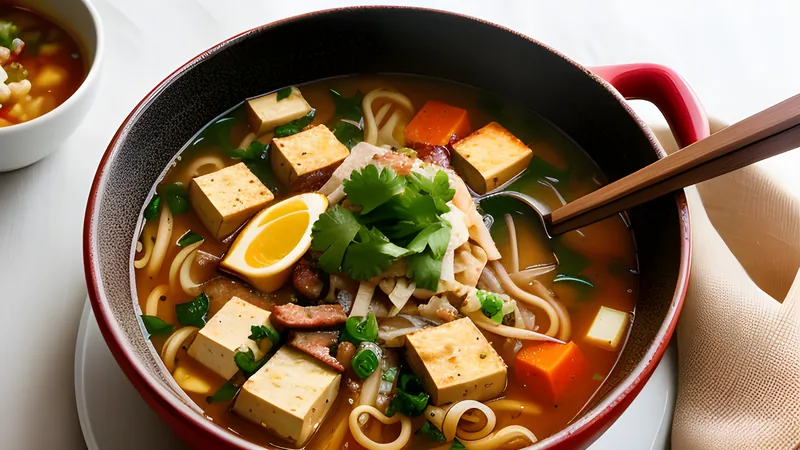
- Push the noodles into the broth, submerging them, and cook for 3-4 minutes until just tender.
- Scatter the spring onions over the top and lay the cheese slice across the noodles if using, letting it melt for a minute before serving straight from the pot.
Why it still works as a stew, not just a novelty
The genius of budae jjigae, and the reason it outlasted the scarcity that invented it, is structural rather than sentimental. Gochujang and gochugaru bring a broth base with real depth — fermented chilli paste has an umami backbone that plain chilli powder doesn’t, so the stew isn’t just “spicy,” it’s savoury-spicy in a way that can carry fatty, salty tinned meat without the whole pot tasting like one note. Kimchi does double duty: its juice acidifies the broth just enough to cut the richness of the spam, and the cabbage itself keeps some bite even after 20 minutes of simmering, because good kimchi doesn’t disintegrate the way fresh cabbage would.
The tofu is the quiet ingredient people skip and shouldn’t. It absorbs the broth without falling apart if you cut it into slabs rather than cubes — more surface area holds together better under a rolling boil than you’d expect, and the bland creaminess gives your palate a rest between spoonfuls of spam and sausage. Skip it and the stew tips towards monotonous, all salt and fat with nothing to break it up.
Modern versions, mine included, add ramyeon noodles and sliced rice cake, neither of which were part of the 1950s original — these came later, once the stew moved from base-town survival food into restaurant menus in the 1980s and 90s, where a bowl needed to read as a full meal rather than a side to rice. The noodles in particular changed the dish’s identity: budae jjigae restaurants today are as much about the moment the ramyeon goes in and the broth thickens slightly with starch as they are about the meat. Order it in Seoul now and the table ceremony is half the point — the pot arrives raw, is set to boil in front of you, and the noodles go in only once everyone’s had a first taste of the meat and kimchi.
Building the pot properly
Cook this in a wide, shallow pan if you have one — a proper jeongol pot or even a wide sauté pan works better than a deep saucepan, because you want everything visible and you want a large surface area boiling hard rather than a small deep pool simmering gently. This is not a slow-braised stew; it’s a fast, aggressive one, and the visual of spam, sausage, kimchi and tofu arranged in clusters before the broth goes in is part of the tradition, not just plating. Restaurants that specialise in the dish will bring the pan to the table looking almost like a still life, ingredients grouped by type, precisely so the boil can be watched.
Resist stirring the moment the paste and stock go in. Let the pot boil hard, uncovered, for a full 8 minutes before you touch it. This does two things: it lets the gochujang paste dissolve and distribute through the broth by convection rather than by your spoon (which tends to just push everything into one corner), and it drives off some of the raw, harsh edge that fermented chilli paste has straight out of the jar. A gochujang broth that’s only simmered for 5 minutes tastes flatter and more aggressive than one that’s had a proper hard boil; the extra minutes matter more than they look like they should.
Salt is not something you add separately here. Between the spam’s cure, the soy sauce, the kimchi juice and the gochujang, the broth is already well-seasoned by the time everything’s in — taste before reaching for more, because it’s easy to oversalt a dish this dense with cured and fermented components. If the broth does need lifting near the end, a squeeze of the kimchi juice you held back does the job better than salt, since it adds acidity as well as seasoning.
The cheese question
Processed cheese on top belongs to the modern restaurant version of the dish rather than the 1950s original, and I’d defend it as a worthwhile addition. A single slice of the mild, meltable kind — the individually wrapped squares, not a good cheddar — laid across the finished noodles and left for a minute does something specific: it mellows the top layer of broth into something almost carbonara-like where it pools, without changing the character of the stew underneath. If you want a version closer to the original, leave it off; the stew is complete without it. If you want the version most Seoul jjigae restaurants serve today, put it on.
A tablespoon of butter stirred in at the very end, off the heat, does something similar in a gentler way — it rounds off the chilli heat and adds a gloss to the broth’s surface. Use one or the other, not both, or the finished stew turns heavier than the dish’s brash, straightforward character wants it to be. Both additions are relatively recent, tracking the same decades that added the noodles, and both are optional enough that a purist can leave the pot exactly as the 1950s cooks would recognise it: spam, sausage, kimchi, gochujang broth, nothing melted on top.
Variations worth trying
Baked beans are a common addition in Korean home versions, closer to the base-scavenged original than the noodle-and-cheese restaurant style — a few spoonfuls stirred in with the stock adds a sweetness that plays surprisingly well against the gochujang. If you’re using them, cut back the sugar in the paste slightly since the beans bring their own.
Some cooks swap the anchovy or chicken stock for a light beef stock, which pushes the dish towards heartier and less bright — good on a genuinely cold night, less good if you want the kimchi’s acidity to stay forward. Instant noodles are the standard choice for the carb component, but thick udon works if you want something with more chew and less starch cloudiness in the broth. A handful of sliced button mushrooms or enoki, added with the tofu, is common in home kitchens looking to stretch the pot further without changing its identity.
Serving it the way the restaurants do
In Uijeongbu and Songtan, budae jjigae almost never arrives as a single portion. It’s cooked in a shared pan set over a portable burner at the table, and the etiquette around it is part of the appeal: everyone eats from the same pot with their own spoon, someone keeps an eye on the noodles so they don’t overcook, and the pace of eating slows to match the pace of the simmer. Trying to plate this into individual bowls before serving loses something real — the point is the shared pan bubbling gently in the middle of the table while people help themselves in stages, meat and kimchi first, noodles once they’re ready, broth spooned over rice at the very end.
If you’re cooking this at home without a tabletop burner, a heavy pan that holds heat well and a trivet will get you close enough — the goal is simply that the stew keeps gently cooking while people eat rather than cooling into a static dish the moment it leaves the hob. Refill the pot with a splash more stock if the broth reduces too far before everyone’s finished; it’s meant to run for the length of a meal, not a single serving.
Storage and leftovers
Budae jjigae is at its best the moment the noodles finish cooking — they keep absorbing broth and go soft if left sitting, so if you’re not eating immediately, hold the noodles back and add them to individual portions as you reheat. The broth itself, without noodles, keeps for up to three days in the fridge and reheats well; if anything, a day’s rest lets the kimchi and gochujang integrate further and the second-day pot can taste rounder than the first.
If you’re building a wider Korean spread, this stew sits well alongside kimchi jjigae as a study in how differently gochujang-and-kimchi broths can read depending on what else goes in the pot, and a side of freshly made quick kimchi gives you a bright, crunchy contrast to the stew’s soft, simmered textures. Steamed short-grain rice on the side is close to mandatory — the broth is built to be spooned over it once the pot’s contents are gone.
Related Content