Buchteln: Sweet Yeast Buns Baked Shoulder to Shoulder
Bohemian plum-filled buns that steam each other soft in a buttered dish
Contents
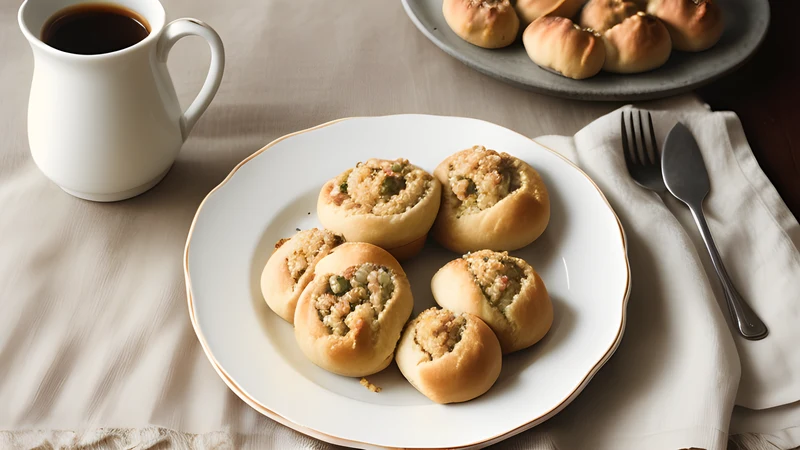
↓ Jump to recipeA Buchtel is a bun that has been deliberately denied a crust. You pack twelve of them into a dish so tightly that only their tops meet the oven air, and everything else — the sides, the bottoms, the places where they press against each other — cooks in trapped steam. Pull one out and it comes away with a soft pale flank, the texture of the inside of a brioche, all the way to the edge. Then you find the plum.
They are Bohemian, they are Austrian, and the argument about which is unresolvable in the usual central European way. The Czech name is buchta; the Viennese diminutive Buchteln stuck, and in parts of Bavaria and Austria they are Rohrnudeln or Wuchteln. The dish belongs to the whole old Habsburg middle, made in the same kitchens that produced Kaiserschmarrn and apricot dumplings and treated them all as legitimate dinner rather than pudding.
Buchteln: Sweet Yeast Buns Baked Shoulder to Shoulder
Ingredients
- 500g strong white bread flour
- 7g fast-action dried yeast
- 60g caster sugar
- 1 tsp fine salt
- 250ml whole milk, warmed to 35C
- 80g unsalted butter, melted and cooled
- 2 large egg yolks
- 1 tsp vanilla bean paste
- Finely grated zest of 1 lemon
- 250g powidl or thick plum butter
- 60g unsalted butter, melted, for coating
- Icing sugar, for dusting
- 300ml whole milk, for the sauce
- 100ml double cream, for the sauce
- 3 large egg yolks, for the sauce
- 40g caster sugar, for the sauce
- 1 vanilla pod, split
Method
- Whisk the flour, yeast, sugar and salt in a large bowl, keeping the salt away from the yeast until mixed.
- Combine the warm milk, 80g melted butter, 2 egg yolks, vanilla paste and lemon zest, then pour into the dry ingredients.
- Knead for 10 minutes by hand or 6 in a stand mixer on medium until the dough is smooth, glossy and pulls cleanly from the bowl.
- Cover and prove at room temperature for 60-90 minutes until doubled.
- Knock back and divide into 12 pieces of about 75g each. Flatten each into a disc roughly 9cm across.
- Place a heaped teaspoon of powidl in the centre of each disc, gather the edges over the filling and pinch firmly to seal. Roll into a ball with the seam underneath.
- Dip each ball in the 60g melted butter and pack them seam-down into a buttered 20 x 30cm dish, leaving about 1cm between them.
- Cover and prove for 40 minutes until the buns touch and fill the dish.
- Bake at 170C fan for 30-35 minutes until the tops are deep golden and the internal temperature reaches 94C.
- For the sauce, heat the milk, cream and split vanilla pod to a bare simmer. Whisk the 3 yolks with 40g sugar, temper with the hot milk, return to the pan and stir over a low heat until it coats a spoon at 82C.
- Rest the buns for 10 minutes, dust with icing sugar and serve warm with the vanilla sauce.
Mehlspeisen, and dinner made of flour
That last point deserves explaining, because it makes the whole category make sense. Austrian cuisine has a formal class of dish called Mehlspeisen — literally “flour foods” — and it covers everything sweet and starchy that a Habsburg household might eat as a main course. Dinner itself.
The reason is partly Catholic. Fast days meant no meat, and there were a lot of them: Fridays, Advent, Lent, various vigils. A Catholic empire needed a whole repertoire of meatless food substantial enough to feed people who had spent the day working, and flour, eggs, milk and fruit were what was available. Buchteln, Germknödel, Kaiserschmarrn and the strudels all come out of that constraint. They are sweet because sugar and fruit were the cheapest way to make a large quantity of dough taste of something.
The other reason is economic. Bohemia grew the wheat and the plums, and plum butter kept for a year in a stone crock. A Bohemian farmhouse in February had flour, eggs, milk and a jar of powidl, and Buchteln were what you made of it. Josef Lada’s illustrations of village Bohemia are full of them. Franz Kafka’s Prague was a city where you could buy them warm from a bakery in the afternoon.
They also have a small literary claim. In Johann Nestroy’s Viennese farces and later in the sentimental accounts of pre-war Vienna, Buchteln are shorthand for the comfortable domestic middle — the food of a Gasthaus with a garden. Café Hawelka in Vienna still sells them from about ten at night, made by the family, and the queue is real.
Powidl is the point, and it is not jam
The filling is powidl, and calling it plum jam undersells it badly. Powidl is Damson or Zwetschke plums cooked down for eight to twelve hours with no added sugar at all, until the fruit’s own sugars caramelise and it turns almost black and thick enough to stand a spoon in. The name comes from the Czech povidla. It tastes of dried fruit and caramel and something faintly savoury underneath, and it is sharper than any jam because nothing has been added to soften it.
You can buy it from central European delis and from most large supermarkets in Germany and Austria. If you cannot find it, make a rough version: 1kg stoned Zwetschke or damson plums, cooked uncovered over the lowest possible heat for four hours, stirred every twenty minutes, until reduced by two-thirds and dark. Add nothing. It will not be true powidl — that takes twice as long — but it will be closer than apricot jam.
Whatever you use, it must be thick. Loose filling boils inside the bun during baking, forces the seam apart and welds twelve buns into one caramelised slab. If your filling wobbles on the spoon, reduce it in a pan first and cool it completely before it goes anywhere near dough. Cold filling is easier to seal around, too.
Apricot jam is the common Viennese alternative and it is perfectly good. Some households use ground poppy seed with sugar and milk, which is properly Bohemian and much less sweet. Curd cheese with sultanas turns them into something close to Topfenstrudel in bun form.
The dough, and why it is enriched the way it is
This is a Germteig — an enriched yeast dough, closer to a light brioche than to bread. The proportions matter. Egg yolks rather than whole eggs, because yolks bring fat and lecithin without the water and drying protein of whites. Melted butter added with the liquid rather than rubbed in later, because at 80g to 500g of flour you are below the level where butter would meaningfully block gluten development.
Warm the milk to about 35C. Hotter than 50C and you start killing yeast; cold milk works but the first prove will take three hours. Knead for the full ten minutes. This dough should end up glossy and slightly tacky, pulling away from the bowl but leaving a faint film on your fingers — that tackiness is what becomes tenderness, and the urge to add flour until it feels like bread dough is the most common way people ruin it.
The gap between the balls before the second prove is deliberate. About 1cm, no more. They need to grow into each other and fuse at the sides, and that fusing is what creates the sealed steam pocket. Too far apart and each one browns individually, which makes you twelve small ordinary buns. Packed too tight and they have nowhere to rise except up, and the middle ones stay raw.
Dipping each ball in melted butter before it goes in the dish is the trick that makes Buchteln pull apart cleanly instead of tearing. The butter forms a barrier at every contact point, so the buns fuse enough to trap steam and separate along a clean seam when you lift one out.
Bake at 170C fan rather than anything hotter. The buns in the centre of the dish are effectively steaming, and steam conducts heat at 100C no matter what the oven says, so the middle takes as long as it takes. A probe reading 94C in the centre bun is the only reliable test — colour on top tells you nothing about what is happening two inches down.
Shaping, which is where beginners lose an hour
Twelve buns is enough repetition that a bad technique becomes obvious by the fourth one, so it is worth getting the sequence right at the start.
Weigh the dough and divide by twelve. It will be around 75g a piece; use scales rather than eyeballing, because an odd small bun in a packed dish bakes at a different rate to its neighbours and you will find it. Work with one piece at a time and keep the rest covered, since enriched dough skins over in about four minutes in a warm kitchen and a skinned surface will never seal.
Flatten each piece with your palm on an unfloured surface. Flour is the enemy of a seal — you want the dough slightly tacky so it grips itself. Aim for a disc about 9cm across, a little thinner at the edges than in the middle, which gives you enough margin to gather without ending up with a thick knot of raw dough at the base.
The filling goes in the centre and stays there. A heaped teaspoon looks stingy and is correct; powidl is intense and a tablespoon will burst the seam. Bring the edges up over it like a drawstring purse, working around the circle rather than folding two sides together, then pinch the gathered point hard between finger and thumb and twist a quarter turn.
Then roll it. Cup your palm over the ball, seam-down, on the work surface, and move your hand in a tight circle — the friction of the bare counter against the dough is what tensions the surface into a smooth skin. Six or seven circles is plenty. A ball with a taut skin rises upwards; a slack one spreads sideways and merges into its neighbour.
Check the seam one last time before it goes in the butter. Any gap at all will open in the oven, and the difference between a Buchtel and a sweet dough disaster is about two seconds of pinching.
The dish matters more than you would think, too. A 20 x 30cm ceramic or enamel roasting dish with straight sides about 5cm high is ideal. Glass works and lets you check the bottoms. A loose-bottomed tin leaks butter onto the oven floor and fills the kitchen with smoke. Whatever you use, butter it heavily and get right into the corners, because the outermost buns want to weld themselves to the sides.
Where it goes wrong
The middle buns are doughy. Underbaked, almost always. Trust the probe over the clock and over the colour, and if the tops are getting dark before the centre is done, cover the dish loosely with foil and keep going.
The filling escaped. Either the seal failed or the powidl was loose. Pinch the seam hard, roll the ball seam-down, and check the filling is cold and stiff.
The buns are dense and tight. Over-floured dough, or an under-proved second rise. The dough should feel slightly sticky when you divide it. Let the second prove run until the buns are touching and visibly puffed; the timer is a suggestion and the dish is the evidence.
They stale by the next morning. Enriched dough with this little sugar goes stale faster than you would like. Buchteln are a same-day food, and the fix is to reheat leftovers covered in foil at 150C for 10 minutes, which brings them almost all the way back.
Sauce, timing and making them ahead
The vanilla sauce is a thin crème anglaise, and the temperature is the whole game: pull it at 82C, and if you do not own a probe, take it off the heat the moment it coats the back of a spoon thickly enough to hold a drawn line. Scrambled custard cannot be fixed, though a stick blender and a sieve will disguise a mild case.
For timing, the shaped, filled buns can go into the dish and straight into the fridge overnight instead of their second prove. Take them out an hour before baking, let them come up and finish rising, then bake as normal. That turns Buchteln into something you can serve to people at eleven on a Sunday morning without getting up at seven.
Serve them warm, not hot, dusted heavily with icing sugar and with the sauce poured around rather than over — the pale sides are the best part of the bun and they deserve to be looked at before they get drowned. Twelve is the right number for four people, which tells you something about the dish.
Related Content