Brunede Kartofler: Caramelised Potatoes for Christmas
Small potatoes rolled in butter caramel, and the argument they start
Contents
↓ Jump to recipeEvery December I have the same conversation with someone British about this dish, and it always goes the same way. Potatoes. Boiled. Then rolled in caramel. Then served with roast pork and gravy, on the same plate, touching. And no, it is not a pudding.
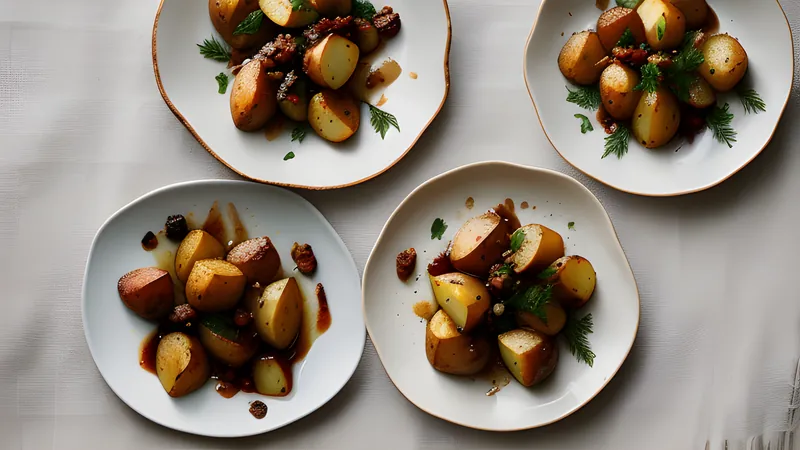
Brunede kartofler are the most divisive thing on a Danish Christmas table to anyone who did not grow up with them, and completely non-negotiable to anyone who did. Leave them off and the meal is incomplete in a way that gets mentioned. They are, when made properly, superb: a small potato with a lacquer on it, the sugar gone dark enough to be bitter at the edge, salt on top, sitting in the gravy from the pork. The trick is that the caramel has to go dark. Made pale they are a sweet horror. Made properly they taste of burnt sugar and butter, which is a savoury flavour.
Brunede Kartofler: Caramelised Potatoes for Christmas
Ingredients
- 1 kg small waxy potatoes, as even in size as you can find (about 3 cm across)
- 1 tsp fine sea salt, for the cooking water
- 100 g caster sugar
- 75 g unsalted butter, cut into 5 cubes
- 3 tbsp double cream or whole milk (optional, for a softer glaze)
- 0.5 tsp flaky sea salt, to finish
Method
- Scrub the potatoes and boil them whole in salted water for 15–18 minutes, until a knife goes in with slight resistance. Undercook them by a minute; they will finish in the caramel.
- Drain, and while still warm enough to handle but cool enough to hold, peel them. The skins should slip off under a thumb. This is tedious and there is no shortcut.
- Spread the peeled potatoes on a tray and leave them to cool completely, at least 1 hour and ideally overnight in the fridge. A cold, dry potato takes a glaze; a warm wet one sheds it.
- Scatter the sugar in an even layer across a wide heavy frying pan, 28 cm or more, and set over a medium heat. Do not stir.
- Wait 4–6 minutes. The sugar will melt at the edges first and go clear, then straw-coloured. Swirl the pan gently — never stir with a spoon — to move the unmelted sugar into the liquid.
- When the caramel is an even amber, the colour of dark honey, add the butter one cube at a time, swirling after each. It will bubble up violently. Keep swirling until it is a smooth glossy sauce.
- If using, add the cream now and swirl again. It will hiss and thicken.
- Add the cold potatoes in a single layer. The caramel will stiffen and clump around them — this is normal and it will loosen.
- Cook over a medium-low heat for 12–15 minutes, shaking the pan every minute or two and gently turning the potatoes, until every one is coated in a dark glossy glaze and heated through.
- Tip onto a warm serving dish, scrape every last thread of caramel over them, sprinkle with flaky salt and serve at once.
Why Denmark puts sugar on potatoes
The obvious answer — that Danes have a sweet tooth — is true and insufficient. The interesting part is the sequence of events.
The potato reached Denmark in the eighteenth century and was, at first, deeply unpopular. It was pushed by the Crown and planted seriously by the Potato Germans, the Hessian and Palatine settlers invited to farm the Jutland heath from 1759, who grew it because it worked in poor sandy soil where grain would not. For a generation it was food you ate because you had to.
Sugar arrived on a different ship. Denmark ran a colonial sugar trade through the Danish West Indies — St. Thomas, St. John and St. Croix — from the seventeenth century, and Copenhagen had refineries processing it by the hundreds of tonnes. Sugar was cheap in Denmark earlier and more thoroughly than in most of northern Europe, and it went into everything: pork, cabbage, herring, potatoes. What looks like an eccentricity is the residue of a trade route.
By the nineteenth century brunede kartofler had settled where it now lives, on the Christmas table beside flæskesteg and red cabbage, and the dish stopped being negotiable. It is served alongside plain boiled potatoes, not instead of them, which tells you the Danes know exactly how rich it is.
The potatoes, and the peeling
Use small waxy potatoes — Charlotte, Anya, Jersey Royals out of season, or anything sold as a salad potato. Floury varieties disintegrate in the caramel and turn the pan into a sweet mash. Around 3 cm across is the target, and evenness matters more than variety, because a pan of mixed sizes gives you some potatoes glazed and some raw in the middle.
The peeling is the labour. Danes boil them in their skins and peel them warm, because the skin slips off a hot waxy potato under thumb pressure and comes away cleanly. Peeling raw and then boiling gives you a waterlogged potato that will not take a glaze. There is no way around the twenty minutes of peeling and I have stopped looking for one; it is a job for a radio programme.
The step people skip is the cooling, and it is the one that decides everything. A warm potato is still steaming from the inside out, and that steam sits between the surface and the caramel as a cushion of water vapour. The glaze slides off and pools in the pan. A cold potato, ideally one that has sat uncovered in the fridge overnight, has a dry, slightly tacky surface that caramel grips. Boil them the day before. It also means the fifteen minutes of Christmas Day pan time is all you are doing.
Dry caramel, and how not to ruin it
This is a dry caramel — sugar alone in the pan, no water. Dry caramel is faster and it browns more evenly than wet, and the reason we use it here is that a wet caramel would have to boil off its water in a pan you then need at a moderate temperature.
The rules are short. Spread the sugar evenly. Set a medium heat. Do not touch it with a spoon. Sucrose crystallises around any nucleus it can find, and a spoon dragged through half-melted sugar gives it a hundred of them; the pan seizes into a gritty lump in seconds. Swirl the pan by the handle instead, which moves the sugar without giving it anything to build on.
Colour is your only instrument. Straw is too pale. Amber the colour of dark honey is correct. A shade past that, where it starts to smell nutty and slightly burnt, is where the good cooks go, because the bitterness is what makes the dish savoury rather than cloying. Black and acrid is thirty seconds beyond that, and there is no coming back — pour it out, wash the pan and start again with new sugar. Caramel goes from perfect to ruined faster than you can fetch the butter, which is why the butter should already be cubed and next to the hob.
The butter will make the pan erupt. This is water in the butter flashing to steam, and it is normal. Add it a cube at a time, swirling, and the emulsion comes together into something glossy.
When the cold potatoes go in, the caramel will seize around them into stiff clumps. Every year someone panics at this point. It is temperature shock, and it resolves: keep the heat medium-low, keep the pan moving, and within four or five minutes the caramel is fluid again and starting to cling.
Getting the glaze to stick
Three things decide this, and none of them is the caramel recipe.
The potatoes must be cold and dry, which is covered above. The pan must be wide enough for a single layer — 1 kg of potatoes needs 28 cm at least, and two batches in a small pan beats one crowded one. And the finishing time must be long enough: twelve to fifteen minutes of gentle rolling. What is happening in those minutes is that water leaves the caramel and the glaze reduces onto the potato surface. Rush it and the coating stays a sauce.
The optional cream is a modern touch and a defensible one. It makes the glaze softer, paler and more forgiving, and it will not shatter off the potato when the fork arrives. Purists leave it out and accept a harder lacquer. I use it when I am making them ahead.
What goes wrong
The caramel seized into a sandy lump before the butter went in. Something stirred it, or a stray sugar crystal from the side of the pan fell back in. You can sometimes rescue it by adding 2 tbsp of water and holding it over a low heat until the lumps redissolve, then carrying on — but only if it has not coloured yet.
The glaze slid off and pooled. Warm potatoes. This is the one mistake that accounts for most failures, and the fix is a night in the fridge.
It tastes like a pudding. The caramel was too pale. Take it further next time — past honey, to the point where it smells slightly scorched — and be generous with the flaky salt at the end.
The potatoes broke up. Floury variety, or they were boiled to full doneness before they went in the pan. Pull them a minute early; they get another fifteen in the caramel.
Half were glazed and half were not. Crowded pan. Do it in two batches and combine at the end.
Timing, storage and what to serve them with
Made properly they are best straight from the pan, but they will hold. Keep them in the pan off the heat for up to thirty minutes and warm through over a low flame for two minutes before serving. Leftovers keep three days in the fridge and reheat in a frying pan with a teaspoon of butter — the microwave turns the glaze to syrup and the potato to paste.
They belong with roast pork. On a Danish Christmas plate they sit next to plain boiled potatoes, braised red cabbage, and a gravy made from the pork’s own juices, and the sweetness is calibrated against that gravy. Serving them with something delicate makes no sense; they need fat and salt around them. Red cabbage is the companion that does most of the work, and if you have not made it before, German rotkohl with apple and clove is the same dish under a different flag.
For the rest of the year, they are astonishingly good with a slow-roast pork shoulder or with duck, and I have served them with roast goose in October to no complaints. If the sugar is a step too far but you want the same small-potato-with-a-crust satisfaction, crispy roast potatoes get there through starch and fat instead, and nobody at the table has to be talked into them.
Related Content