Brioche Feuilletée: The Laminated Brioche That Sits Between Bread and Pastry
enriched dough, folded the way you'd fold croissants
Contents
↓ Jump to recipeI held off making brioche feuilletée for years because the name alone sounded like a dare. Brioche I could do half-asleep; lamination I respected from a safe distance, the way you respect a wasp. Putting the two together felt like volunteering to fail at both at once. Then one cold Sunday I had nothing planned, a block of good butter, and the kind of stubbornness that only arrives with the second coffee. By the afternoon I had a loaf that pulled apart in buttery, ribboned sheets, and I have been quietly smug about it ever since.
Brioche Feuilletée: The Laminated Brioche That Sits Between Bread and Pastry
Ingredients
- 250 g (2 cups) strong white bread flour
- 30 g (2½ tbsp) caster sugar
- 5 g (1 tsp) fine salt
- 7 g (1 sachet) fast-action dried yeast
- 2 medium eggs, cold
- 60 ml (¼ cup) cold whole milk
- 40 g (3 tbsp) unsalted butter, softened, for the dough
- 150 g (⅔ cup) cold unsalted butter, for laminating
- 1 egg yolk plus 1 tbsp milk, to glaze
- Pearl sugar or flaked almonds, to finish (optional)
Method
- Mix flour, sugar, salt and yeast, then work in the eggs, milk and softened butter to a smooth, slightly tacky dough. Knead 8 minutes.
- Shape into a rough rectangle, wrap and chill at least 4 hours or overnight so it firms up.
- Beat the cold laminating butter between baking paper into a 12 cm square slab; keep cold.
- Roll the dough to a 24 cm square, place the butter in the centre at 45 degrees and fold the corners over to enclose it.
- Roll to a long rectangle and give one double (book) fold. Chill 30 minutes.
- Repeat with one more single fold, chilling 30 minutes between turns to keep the butter cold.
- Roll out, shape into a loaf or twist, and place in a lined 900 g tin. Prove 2–3 hours until puffy.
- Glaze, scatter pearl sugar if using, and bake at 190°C (170°C fan) for 30–35 minutes until deep gold.
- Cool in the tin 10 minutes, then on a rack. Resist for an hour so the layers set.
What it actually is
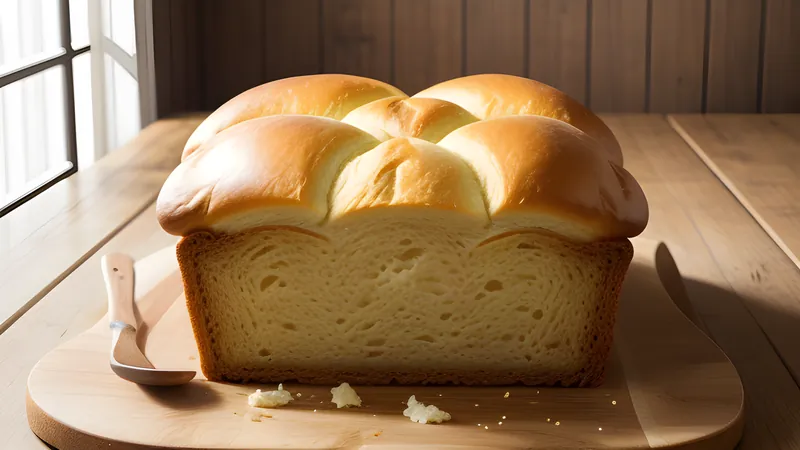
Brioche feuilletée is exactly what the translation promises: flaky brioche. You take an enriched, eggy, slightly sweet dough and laminate it the way you would a croissant, folding in a slab of butter and rolling it out so the finished loaf bakes up in dozens of thin, distinct layers. It sits in a happy no-man’s-land between the bread shelf and the pastry counter. Cut a slice and it has the open, tearable crumb of viennoiserie, but the richness and golden colour belong squarely to brioche.
The French have a knack for these in-between things, the laminated brioche being one of the most generous. It is the loaf you bring out when you want croissant glamour without rolling forty individual crescents, and it forgives a multitude of small sins because the dough is so rich to begin with. Where a croissant is exacting and unforgiving, punishing every degree of extra warmth with a puddle of leaked butter, brioche feuilletée has enough egg and fat in the base dough to paper over a wonky fold or a slightly warm bench. You are aiming for pretty, not perfect, and the gap between the two is smaller than the name suggests.
The other thing worth knowing is that this is a made-in-stages bake, not a marathon. The dough wants an overnight rest before you touch the butter, and each fold wants a half-hour in the fridge afterwards. That sounds like a lot until you realise almost none of it is active time: you mix, you wait, you fold, you wait. Spread across a lazy weekend it slots neatly around the rest of your day, and the finished loaf feels wildly out of proportion to the actual effort.
Brioche itself is old — the word is first recorded in French in 1404, derived from brier, a Norman dialect form of the verb “to knead”, and the enriched loaf has been a Norman and Parisian speciality ever since. Lamination, the technique of trapping butter between folded sheets of dough, reached its familiar modern form in the croissant, which Parisian bakers developed from the Austrian kipferl after August Zang opened his Viennese bakery in Paris in 1839. Brioche feuilletée is what happens when a baker points that same laminating technique at rich brioche dough rather than a leaner croissant dough. You’ll see it in French boulangeries today shaped into loaves, twists and buttery spirals. It reads as a modern fashion, but the idea of folding butter into an already-rich dough is not new; it’s just been quietly waiting for the rest of us to feel brave enough.
The one twist: keep everything cold and lazy
My twist here is not an ingredient, it is a temperament. The single thing that takes brioche feuilletée from intimidating to genuinely doable is committing to a cold, unhurried approach. Warm dough is the enemy. The moment the butter softens and merges into the dough, your layers vanish and you have, at best, very nice ordinary brioche.
So I chill aggressively and refuse to be rushed. The dough rests overnight before lamination, which firms it and lets the gluten relax so it rolls without fighting back. Between every fold it goes back in the fridge for half an hour, no negotiation. If the kitchen is warm, I work in even shorter bursts and put the rolling pin in the freezer for a few minutes. Laziness, in this one recipe, is a virtue. The breaks are doing the work.
Lamination without the fear
Beat the cold butter into a neat square between two sheets of baking paper, bashing and rolling until it is pliable but still cool. Roll your rested dough into a larger square, set the butter in the middle on the diagonal, and fold the four corners in like an envelope so the butter is fully sealed. From there it is just roll, fold, chill, repeat.
I keep it simple with one double fold (a book fold, where both ends meet in the middle and then close like a book) and one single fold (a straightforward fold into thirds). That gives plenty of layers without the dough becoming a project that eats your whole day. Keep your bench lightly floured, roll firmly but evenly, and if butter starts breaking through, dust the spot and get it back in the fridge. Nobody is grading the rectangles. The oven hides a lot.
The reason for all this fuss is worth understanding, because it tells you what you’re trying to achieve. Lamination works by keeping the butter as a continuous, unbroken sheet between distinct layers of dough. In the oven, the water in that butter turns to steam and pushes the layers apart, while the fat waterproofs each sheet so it holds its shape — that’s what gives you flakes rather than a solid loaf. The enemy at every stage is temperature. If the butter warms much past 18C it turns greasy and merges into the dough, and your separate layers become one; if it goes too cold and brittle it shatters when you roll, punching holes that let the layers weld together. The narrow band in between, where butter is cool but still pliable, is the whole game. That’s why the dough and the butter should ideally be at a similar firmness when you laminate: a rock-hard slab against soft dough will crack rather than roll out evenly.
Shaping and proving
Once laminated, roll the dough out one last time. For a loaf, fold or roll it into a tin; for something prettier, cut a long strip, twist it so the layers face up, and coil it into the tin so you get those open, swirled edges that crisp into lacy bits. Prove somewhere warm but not hot until visibly puffy and jiggly, two to three hours depending on your kitchen. This is enriched, laminated dough, so it proves more slowly than plain bread. Do not chase the clock; chase the wobble.
Glaze gently with yolk and milk so you do not deflate it, and if you want a bit of sparkle, pearl sugar or flaked almonds on top earn their keep.
A word on the prove, because it is where the impatient come unstuck. Enriched dough is heavy going for yeast: the sugar competes with it for water and the fat coats the flour and slows everything down, so a laminated brioche can take twice as long to prove as a plain white loaf. Somewhere warm but genuinely gentle is what you want, around 24 to 26C. A turned-off oven with the light on, or a bowl of just-boiled water sat beside the tin in a closed microwave, both do the job. Do not be tempted to speed it with real heat: anything above 28C or so starts to soften the laminated butter, and the whole point of the last few hours was to keep those layers distinct. If you see beads of butter weeping from the sides during the prove, the room is too warm.
What goes wrong, and why
Two failures account for almost every disappointing brioche feuilletée. The first is butter that has merged into the dough, which shows up as a loaf that is tasty but essentially one solid, if very rich, mass with no visible layers. The cause is always heat: either the butter was too soft when you laminated, or the dough spent too long out of the fridge between folds. The fix is discipline, not skill. The second is butter that has cracked and torn through the dough, leaving pale patches where the layers have welded shut. That happens when the butter is too cold and brittle relative to the dough. If you take the slab straight from the fridge and it snaps rather than bends, let it sit for five minutes before you start rolling. Matching the firmness of butter and dough is the single judgement that separates a neat, layered loaf from a scrappy one, and it comes quickly with practice.
Eating it, and getting away with it
Bake until deeply golden, then have the patience to let it cool. The layers need to set, and a hot slice will smear into something gorgeous but structurally hopeless. Once rested, it tears apart in buttery sheets that need nothing at all, though I will not stop you adding jam.
Day-old slices toast beautifully and turn into a frankly outrageous French toast; a stale slice of this is the best possible foundation for a brioche bread and butter pudding, soaking up custard the way only enriched, buttery bread can. If your appetite for lamination is now thoroughly whetted and you’d like to practise the folds on something less rich before coming back, rough puff pastry uses the same butter-and-fold logic with far lower stakes. Leftovers, if they exist, freeze well wrapped tightly. Make it once and the mystique evaporates entirely. It is fiddly, yes, but it is forgiving fiddly, the best kind, and the payoff is a loaf that makes people assume you trained somewhere expensive.
Related Content