Brik à l'Oeuf: The Tunisian Pastry with a Runny Yolk
A paper-thin pastry folded around an egg that must stay soft
Contents
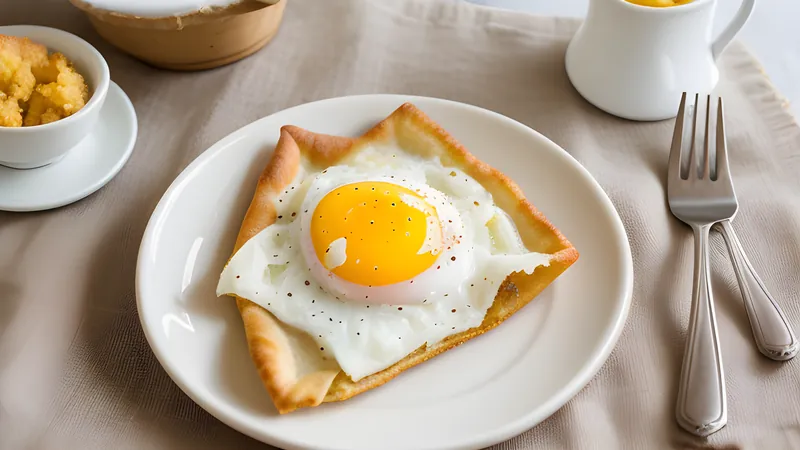
↓ Jump to recipeBrik à l’oeuf is a race against the yolk. The entire dish exists to deliver one specific sensory moment: biting into a shatteringly crisp, deep-fried pastry shell and having a fully liquid egg yolk break across the plate. Everything about the method — the paper-thin pastry, the quick assembly, the fast, hot fry — is designed to get the egg from raw to just-set without tipping into fully cooked, which would turn the whole point of the dish, that dramatic yolk-break, into a much less interesting mouthful of dry egg.
Brik à l'Oeuf: The Tunisian Pastry with a Runny Yolk
Ingredients
- 4 sheets malsouka or brik pastry (or large spring roll wrappers)
- 4 medium eggs
- 150g tuna in oil, drained and flaked
- 1 small onion, very finely chopped
- 2 tbsp capers, roughly chopped
- 2 tbsp chopped flat-leaf parsley
- 1 tsp harissa, plus extra to serve
- 50g grated hard cheese (such as a mild pecorino or parmesan)
- 1 tbsp olive oil, for the filling
- Salt and black pepper, to taste
- Vegetable oil, for shallow-frying
- 1 egg white or a little water, for sealing the pastry
- Lemon wedges, to serve
Method
- Mix the flaked tuna, chopped onion, capers, parsley, harissa, grated cheese and olive oil in a bowl. Season with salt and pepper.
- Lay one sheet of malsouka pastry flat and place a quarter of the tuna mixture just off-centre, spreading it into a small round nest to cradle the egg.
- Crack one egg directly into the centre of the tuna nest.
- Fold the pastry over the filling into a half-moon or triangle, sealing the edges with a little egg white or water, working quickly so the egg doesn't run out before sealing.
- Repeat with the remaining sheets, eggs and filling, working one at a time so each brik goes straight to the pan.
- Heat about 1cm of vegetable oil in a wide frying pan over medium-high heat until shimmering.
- Carefully slide each brik into the hot oil and fry for 1-2 minutes a side, until deep golden and crisp, keeping the heat high enough that the pastry crisps fast without overcooking the yolk.
- Lift out with a wide spatula, drain briefly on kitchen paper, and serve immediately with lemon wedges and extra harissa.
Malsouka: Tunisia’s answer to filo, but different
Malsouka (also spelled malsuqa or warqa depending on the region) is a very thin, semi-translucent pastry made from a wet dough dabbed repeatedly onto a hot inverted pan or plate until a paper-thin layer sets and is peeled off — a technique closer to crêpe-making than to rolling and stretching filo. It’s typically sold ready-made, frozen or fresh, at North African and Middle Eastern grocers, since making it from scratch is a specialised skill most home cooks, Tunisian or not, don’t bother with regularly.
If malsouka isn’t available, large spring roll wrappers are the closest workable substitute — they’re thinner and crisper than filo and fry up with a similar shattering texture, even if the flavour and exact crispness differ slightly from genuine malsouka. Filo pastry itself is a weaker substitute; it’s drier and flakier by design rather than crisp-and-thin, and tends to fall apart around the wet filling rather than sealing cleanly.
Speed is the entire technique
Everything about assembling brik à l’oeuf should move fast once the egg is cracked. The egg needs to go from shell to sealed pastry to hot oil in well under a minute, because a raw egg sitting inside unsealed pastry will run out through any gap, and a brik that sits assembled for too long before frying risks the pastry going soggy from contact with the wet egg white before it even reaches the oil. Working one brik at a time, from filling to frying, rather than assembling a batch and frying them in sequence, is the only reliable way to keep both pastry and yolk in the right state.
The tuna filling is arranged specifically as a shallow nest, not a flat layer, because the egg needs somewhere to sit without immediately spreading across the whole sheet and soaking the pastry evenly through — a contained pocket of egg gives you a cleaner fold and a more controlled cook.
Frying: hot oil, short time, no compromise
The fry needs real heat — oil hot enough that the pastry visibly bubbles and colours within seconds of contact. A too-cool pan means the pastry takes longer to crisp, and that extra time is exactly what overcooks the yolk past the point of runniness. One to two minutes a side in properly hot oil is enough to turn the malsouka a deep, blistered gold while leaving the yolk soft — timing tighter than that risks an undercooked pastry, and much longer guarantees a set yolk.
Flip carefully with a wide spatula rather than tongs, which can pierce the thin pastry and let the yolk escape mid-fry — a real risk if you’re not used to handling such delicate pastry in hot oil. If a brik does split slightly during frying, it’s not a disaster; the filling holds together well enough that a small tear rarely causes a full yolk leak, though it will look less pristine on the plate.
The tuna-caper filling, and why it’s not incidental
Tuna, caper, onion and parsley is the classic brik filling across Tunisia, though it’s flexible — some versions add potato, some skip the cheese, some swap capers for olives. What matters structurally is that the filling stays relatively dry and finely chopped; a wet or chunky filling makes it harder to seal the pastry cleanly and increases the risk of the whole parcel splitting in the oil. Draining the tuna thoroughly and chopping the capers and onion finely both serve this practical purpose alongside their obvious flavour contribution.
Harissa worked into the filling, rather than only served alongside, gives a low, consistent heat throughout rather than concentrated spikes — a teaspoon is a moderate starting point that most people find balanced, with extra harissa on the side for anyone wanting more.
Substitutions and variations
A vegetarian brik swaps the tuna for finely diced cooked potato mixed with the same onion, caper, parsley and harissa base — potato brik is at least as traditional as the tuna version and common during Ramadan, when it appears frequently as an iftar starter. Minced lamb, cooked through and well-seasoned before folding into the pastry, is another traditional filling, giving a heartier, more substantial brik that’s closer to a meal than a starter.
Brik à l’oeuf sits naturally alongside other Tunisian and Maghrebi dishes built on a similar contrast of crisp exterior and soft, rich interior. It’s a natural starter before ojja merguez, another Tunisian egg dish, though the two rarely appear at the same meal since both are already egg-forward; a lighter option is pairing brik with a simple zaalouk-style vegetable salad to round out a starter course.
Serving and what not to do
Serve brik à l’oeuf the moment it comes out of the oil — it does not wait well, and the crisp shell softens within minutes as residual steam from the egg works against the pastry from the inside. Lemon wedges squeezed over just before eating cut through the richness of both the yolk and the frying oil. Never attempt to reheat a cooked brik; the yolk will fully set and the pastry will turn tough and chewy rather than crisp, losing everything that makes the dish worth making in the first place.
A dish with a Ramadan role and a street-food life
Brik à l’oeuf occupies two distinct places in Tunisian food culture, and the dish behaves slightly differently in each. As a Ramadan iftar starter, it’s usually made carefully at home, one at a time, plated neatly and eaten as the opening course before heavier mains — the drama of the runny yolk is part of what makes it a satisfying way to break a day’s fast, rich and immediately gratifying. As street food, sold from carts and small stalls particularly around Tunis and coastal towns, it’s a faster, rougher affair, often served wrapped in paper to eat standing up, with less concern for a pristine presentation and more for getting a hot, crisp, cheap parcel into a customer’s hands quickly.
Both contexts share the same core technique and the same non-negotiable goal — a soft yolk inside a crisp shell — but the street-food version leans harder into speed and volume, sometimes using slightly larger, less delicately folded parcels than a home cook would produce for a sit-down iftar table.
Sealing technique in more detail
Sealing the pastry properly is the step most likely to go wrong for anyone making brik for the first time. After folding the malsouka over the filling and egg, run a fingertip dipped in beaten egg white or plain water along the open edge, then press firmly to seal — the moisture acts as a glue between the two pastry layers, similar to sealing a dumpling or a pierogi. Press from the centre outward along the seal line rather than starting at the corners, which helps push any trapped air out ahead of the seal rather than leaving a pocket that could force the seam open in hot oil.
A half-moon fold (one round sheet, filling on one half, folded over) is simpler for beginners than a triangle fold (a square sheet folded corner to corner, then folded again), which requires more precise handling but produces a smaller, thicker parcel that some cooks find holds the egg more securely through frying. Either fold works; choose based on the shape of pastry you have and your comfort handling the wet filling.
A note on egg size and freshness
Use eggs no larger than medium for this recipe — a large or extra-large egg can be too much liquid for the pastry to seal around cleanly, increasing the odds of a leak during frying. Fresher eggs also help considerably: an older egg’s white has thinned and spreads more readily inside the parcel, working against the tight seal you’re trying to achieve, while a fresh egg’s white stays closer together around the yolk, easier to contain within the folded pastry.
Troubleshooting
If the yolk comes out fully set rather than runny, the most likely cause is oil that wasn’t hot enough, extending the cooking time past the point where the yolk stays liquid — check your oil temperature is genuinely hot before the first brik goes in, and don’t be tempted to compensate for a cooler pan by simply frying longer, since that guarantees an overcooked yolk rather than fixing the underlying heat problem.
If the pastry tears and the filling escapes into the oil, the seal likely wasn’t pressed firmly enough, or too much filling was packed in, stretching the pastry past what the fold could contain. Use a modest amount of filling — a shallow nest rather than a mounded pile — and err toward pressing the seal harder rather than softer.
Related Content