Brandade de Morue: The Salt Cod Purée of Nîmes
Salt cod beaten with warm oil and milk to an emulsion, finished with charred lemon
Contents
↓ Jump to recipeSalt cod has no business being in Nîmes. The city sits inland in the Gard, a long way from any sea that ever held a cod, and the fish itself is a North Atlantic animal that never swam south of Biscay. Brandade exists because of salt — specifically because the salt pans of the Camargue produced a commodity that Breton and Norman cod boats needed, and the barter that resulted ran cod down the Rhône in exchange for salt going back up it. By the eighteenth century Nîmes was a salt cod town, and the cooks there did what cooks do with a strange ingredient: they beat it into submission.
The name comes from the Provençal brandar, to stir or agitate. That’s the whole dish in one verb. There’s no mystery technique. You take a preserved fish and you stir it with oil until physics does something surprising.
Brandade de Morue: The Salt Cod Purée of Nîmes
Ingredients
- 500 g salt cod, thick loin pieces, skin on
- 600 ml whole milk
- 4 garlic cloves, peeled, 2 whole and 2 finely grated
- 3 bay leaves
- 1 sprig thyme
- 10 black peppercorns
- 200 ml good olive oil, fruity rather than peppery
- 150 g floury potato, such as Maris Piper, peeled
- 0.25 tsp freshly grated nutmeg
- 0.5 tsp freshly ground white pepper
- 2 lemons, halved
- 1 tbsp olive oil, for charring the lemons
- 2 tbsp double cream, if needed to loosen
- Fine salt, to taste — start with none and check at the end
- 1 sourdough loaf, sliced 1 cm thick and toasted, to serve
Method
- Rinse the salt cod under cold running water for 2 minutes to wash off surface salt. Put it in a large bowl of cold water, skin side up, cover and refrigerate.
- Change the water every 8 hours for 48 hours for thin pieces, or 72 hours for thick loins. The cod is ready when a corner tastes seasoned rather than salty. Do not skip the tasting — brands vary enormously.
- Boil the potato in unsalted water for 15 minutes until a knife slides through. Drain, return to the dry pan over low heat for 1 minute to steam off, then push through a ricer. Set aside.
- Put the drained cod in a wide pan with the milk, the 2 whole garlic cloves, bay, thyme and peppercorns. Bring to 80C — the surface should tremble and never bubble. Hold for 8 minutes.
- Lift the cod out with a slotted spoon. Strain the milk and keep it warm. Flake the cod while it is hot, discarding skin and every bone. Run your fingers over each flake; pin bones hide.
- Warm the olive oil to 50C in a small pan — warm to the fingertip, nowhere near frying temperature.
- Put the hot cod and the grated garlic in a stand mixer with the paddle. Beat on medium for 2 minutes to break the flakes into threads.
- With the mixer running, add the warm oil in a thin stream over 4 minutes, then alternate splashes of the warm milk, about 200 ml in total, until the mixture turns pale, thick and glossy. Stop the moment it looks like a purée.
- Fold in the riced potato by hand, along with the nutmeg and white pepper. Taste for salt now, and probably add none.
- Rub the cut faces of the lemons with olive oil and press them into a smoking-hot dry frying pan for 3 minutes until blackened. Squeeze one charred half into the brandade and beat briefly.
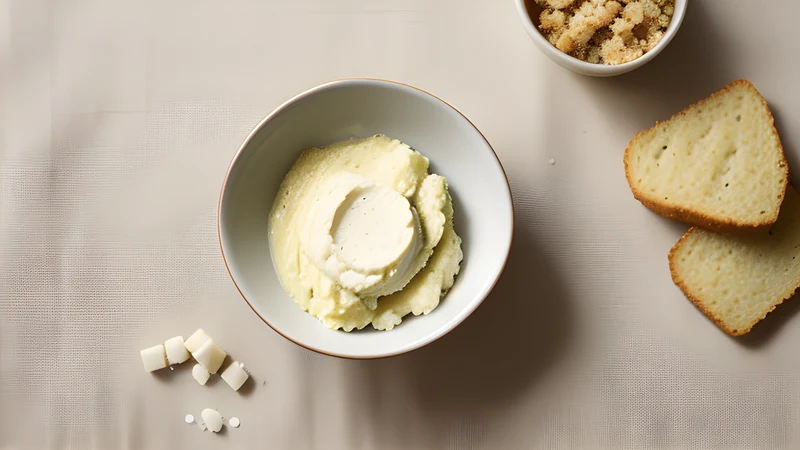
- Spread into a gratin dish, fork the surface into ridges, and grill 12 cm from the element for 6 minutes until the ridges brown. Serve with toast and the remaining charred lemon halves.
What is actually happening in the bowl
Brandade is an emulsion, and it’s a genuinely odd one. Most emulsions need a dedicated emulsifier — egg yolk in mayonnaise, mustard in a vinaigrette, garlic and its own mucilage in aioli. Brandade has none of those. The emulsifier is the cod.
Salting cod draws water out of the muscle and concentrates the proteins. Rehydrate it and poach it gently and those proteins — myosin especially — stay intact as long threads rather than clumping. Beat those threads and they unwind into a tangled mesh. Drip oil into the mesh and the threads coat each droplet and hold it suspended. That’s an emulsion built out of fish protein, which is not something many other dishes do.
This explains the two rules that people break. The cod must be hot when you beat it. Cold protein is stiff and won’t unwind; you’ll get shreds in oil rather than a purée. The oil must be warm. Cold oil hitting warm protein shocks it and the emulsion splits, exactly the way a mayonnaise splits when you add fridge-cold oil to a yolk.
Soaking: the part nobody wants to hear
Two to three days. Water changed every eight hours. There is no shortcut and every shortcut produces a dish nobody finishes.
Thick loin pieces need 72 hours. Thin tail pieces need 48. The variable is thickness, because desalting is diffusion and diffusion through 4 cm of fish takes roughly four times as long as through 2 cm. Buy loins if you can — they flake into long threads and the thin bits shred into fluff.
Change the water on a schedule and always into fresh cold water, in the fridge. At room temperature, salt cod at hour 40 has lost enough salt to stop being preserved, and it will start to smell exactly as bad as you’d expect. Skin side up in the bowl, because the salt sinks and you want it falling away from the flesh rather than through it.
Taste before you commit. Tear off a corner of the thickest piece and eat it raw. It should taste like seasoned fish. If it tastes like the sea, give it another eight hours. Different producers salt to wildly different levels — Portuguese bacalhau is often harder-cured than French morue — so the clock is a suggestion and your tongue is the instrument.
The charred lemon
Here’s my twist, and it addresses a real flaw in the traditional dish.
Brandade is 200 ml of olive oil and 500 g of oily emulsified fish. It is heavy. Traditional Nîmes brandade contains no lemon at all — purists are firm on this — and after four spoonfuls, the richness stops being a pleasure and starts being a job.
Raw lemon juice fixes the richness and creates a new problem: it’s shrill against something this soft, and the acidity reads as a correction rather than part of the dish. Char the lemon first and the picture changes. Three minutes cut-side down in a dry, screaming-hot pan caramelises the surface sugars and drives off some water, so the juice comes out rounder, slightly bitter at the edge and faintly smoky. It cuts the fat without announcing itself.
Squeeze one charred half in during the beating and put the other halves on the table so people can adjust. The smoke also does something flattering to salt cod specifically, which spent its whole preserved life in the company of wood smoke in the drying sheds.
Potato: how much, and why
Purists in Nîmes will tell you brandade contains no potato whatsoever, and they’re historically correct. Potato arrived later, from Marseille, and it was originally a way of stretching expensive fish.
I use 150 g to 500 g of cod, which is a small ratio, and I include it for texture rather than economy. Riced potato adds starch, and the starch grains sit in the emulsion and make it more forgiving — a brandade with a little potato in it will survive being reheated, and a pure one will split. If you’re eating it straight from the bowl within the hour, leave the potato out and enjoy the intensity. If it’s going into a gratin dish and under a grill, put it in.
Rice it, never mash it and never blend it. A food processor smashes potato cells open and releases free starch, and the brandade turns to wallpaper paste in about four seconds. This is the same failure that ruins gratin dauphinois when people get impatient, and it is irreversible.
Buying the fish
The label matters more than the price. Morue or bacalhau means salted and dried, and it is what you want: stiff boards of fish, pale straw coloured, that clatter when you knock them together. Morue verte is salted but not dried, sold damp and floppy in a plastic tray, and it needs only 24 hours of soaking but gives a softer, less threaded flake. It makes an acceptable brandade and a slightly dull one.
Avoid anything grey, anything with a yellow-brown tinge at the edges, and anything that smells sharp rather than clean and mineral. Yellowing means the fat has oxidised, which happens to cod that has sat in a warm warehouse, and no amount of soaking removes rancidity.
Loin pieces cost more per kilo and are worth it. You are paying for thickness, and thickness is what gives you the long muscle threads the emulsion depends on. A bag of cheap offcuts will desalt faster and beat into something closer to paste.
If you cannot find salt cod at all, you can cure your own. Bury 500 g of skin-on cod loin in 500 g of coarse sea salt in a non-reactive dish, refrigerate for 48 hours, then rinse and air-dry uncovered on a rack in the fridge for a further 48. It won’t have the concentrated, faintly aged character of commercial morue, which is cured for weeks, but it emulsifies beautifully and it takes four days rather than a trip to three shops.
Fixing a split brandade
It happens. The mixture goes from glossy to grainy and you can see oil weeping at the edges. The cause is almost always oil added too fast, or oil that was too cold.
The fix is the mayonnaise fix. Take a clean bowl. Put in 2 tablespoons of warm milk. Beat in the split mixture a spoonful at a time, letting each spoonful come together before the next. It will re-emulsify. If it refuses, add a tablespoon of the riced potato and keep going — the starch will hold it.
If the brandade is stiff rather than split, it just needs liquid: warm milk a splash at a time, or double cream if you want it richer. Judge it warm and slightly loose, because it firms considerably as it cools.
Garlic, and how much is too much
Four cloves for 500 g of fish, and I split them deliberately: two go whole into the poaching milk, two go raw and grated into the mixer.
The poached cloves lose their bite entirely and contribute a soft, sweet background. The raw grated garlic keeps its heat, because nothing in the beating stage gets hot enough to cook it. That combination gives you garlic at two intensities in the same spoonful, which is more interesting than either alone.
Grate the raw cloves on a microplane rather than crushing them. A press bursts the cells unevenly and leaves fibrous shreds that show up as hot spots. A microplane reduces them to a purée that disperses through the emulsion evenly.
Nîmes traditionally uses considerably more garlic than this — some recipes call for a whole head. That version is magnificent and it will follow you around for two days. Four cloves is the amount I can serve to people I intend to see again.
Serving, storage and what else to do with it
The classic service is a gratin dish, forked into ridges, grilled until the ridges catch. The ridges matter — flat brandade browns unevenly and the peaks give you the contrast of crisp against soft that makes the second spoonful as good as the first.
Toast is the right vehicle. Sourdough, cut 1 cm, grilled dry. Some tables in Nîmes serve it with croutons fried in olive oil, which is more oil on top of a great deal of oil, and I’d rather have the dryness of plain toast.
It keeps three days in the fridge, tightly covered — it takes on other flavours enthusiastically. Reheat it in a 160C oven for 20 minutes, covered, and beat in a splash of warm milk afterwards to bring it back. It does not freeze; the emulsion breaks and the potato goes grainy.
Leftovers have a second life. Roll cold brandade into 40 g balls, coat in flour, egg and breadcrumbs, and deep-fry at 180C for 3 minutes for croquettes de brandade, which is what Nîmes bars serve at six in the evening. Or spread it thickly on toast, top with a poached egg, and eat it for lunch standing up, which is what I actually do with most of it. The relationship between salt cod, potato and egg is one that Portugal worked out independently in bacalhau à brás, and it holds up in every language.
Related Content