Bragioli: Malta's Beef Olives in a Slow Gravy
Thin beef, a bacon and egg stuffing, and a strip of orange peel
Contents
↓ Jump to recipeBragioli is Maltese for beef olives, and there are no olives in it, which is a thing British cooks will already be at peace with. The word “olive” here describes the shape — a small oval bundle — and the English name for the same construction dates back to at least the seventeenth century. Malta’s version has been on the island long enough that nobody there thinks of it as borrowed.
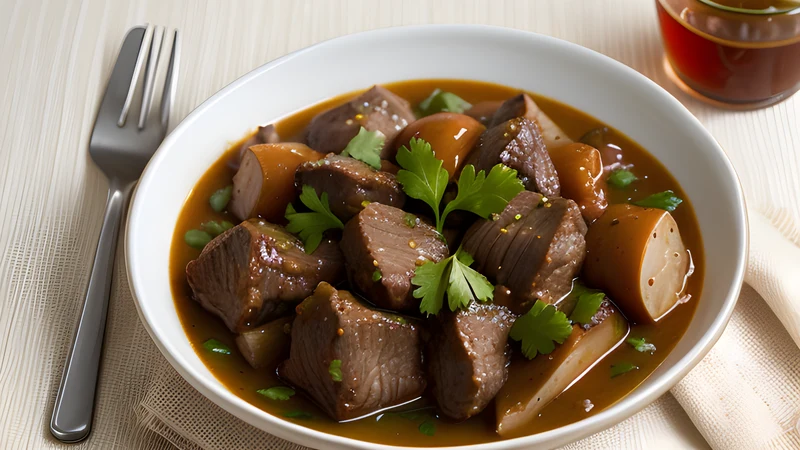
What it is: a thin slice of beef, wrapped around a stuffing of bacon, hard-boiled egg and breadcrumbs, tied, browned, and then braised in wine and tomato until the beef surrenders. What it produces: a spiral cross-section of meat and egg and bacon, sitting in a gravy that has been reducing for three hours and tastes accordingly.
Bragioli: Malta's Beef Olives in a Slow Gravy
Ingredients
- 8 slices beef topside or silverside, about 100 g each, beaten to 4 mm
- 150 g smoked streaky bacon, finely chopped
- 3 hard-boiled eggs, roughly chopped
- 80 g fresh white breadcrumbs
- 1 small onion, very finely chopped
- 3 tbsp chopped flat-leaf parsley
- 40 g grated pecorino or kefalotyri
- 1/2 tsp coarsely ground black pepper
- 3 tbsp olive oil
- 1 large onion, sliced
- 3 garlic cloves, sliced
- 250 ml dry red wine
- 400 g tin chopped tomatoes
- 2 tbsp tomato purée
- 400 ml beef stock
- 2 bay leaves
- 1 strip orange peel, pared with a peeler, about 8 cm
- 1 tsp fine salt
Method
- Lay each beef slice between two sheets of cling film and beat with a rolling pin until 4 mm thick and roughly 12 x 16 cm. Trim any ragged edges.
- Fry the chopped bacon in a dry pan over medium heat for 6 minutes until the fat renders and the pieces crisp at the edges. Tip into a bowl, leaving the fat in the pan.
- Soften the finely chopped small onion in the bacon fat for 5 minutes until translucent. Add to the bowl.
- Mix the bacon and onion with the chopped eggs, breadcrumbs, parsley, cheese and pepper. Press a spoonful together — it should hold.
- Divide the stuffing between the beef slices, leaving a 1.5 cm border. Roll each up tightly from a short edge and tie with two loops of kitchen string, or secure with cocktail sticks.
- Heat the olive oil in a heavy casserole over high heat. Brown the rolls in two batches, 5-6 minutes each, turning to colour all sides. Set aside.
- Lower the heat to medium. Soften the sliced onion for 8 minutes, then add the garlic and cook 1 minute more.
- Pour in the wine and boil hard for 3 minutes, scraping the base clean. Add the tomatoes, purée, stock, bay leaves, orange peel and salt.
- Return the rolls to the pan, cover, and cook at the barest simmer for 2 hours 30 minutes, turning them once at the halfway point.
- Lift out the rolls. Remove the orange peel and bay. Boil the gravy hard for 10-15 minutes until it thickens enough to coat a spoon.
- Return the rolls to warm through for 5 minutes. Snip the strings and serve whole or sliced across to show the stuffing.
Where it fits on the island
Bragioli are Sunday food, and in Malta that is a specific and serious category. The Sunday table also holds timpana, fenkata (rabbit, which the Maltese eat with a devotion bordering on the political), and ross il-forn. All of them share a structure: something rich, something slow, something you begin the day before.
The island’s food is more Sicilian than anything, filtered through 268 years of the Knights of St John and then 164 years of British administration. Bragioli sit exactly on that seam. The construction is Italian — involtini by another route — but the braising liquid, heavy on tomato and beef stock, and the willingness to call the result gravy, are British instincts. Maltese cooks were making Sunday roasts for garrison families for a century and a half, and the traffic ran both ways.
The stuffing is where households differ. Some use minced pork instead of bacon. Some add sultanas, which is a Sicilian ghost. Some skip the egg. The egg is the version I care about, because a slice through a bragiol with egg in it is a genuinely beautiful thing: white and yellow suspended in the pink spiral.
The twist: a strip of orange peel
One pared strip of orange peel, 8 cm long, goes into the braise with the bay leaves and comes out at the end. That is the whole intervention and it does more than it should.
Orange peel is mostly limonene, and limonene is volatile — it will not survive a long braise as citrus. What survives is the bitter fraction in the pith-adjacent layer and the heavier terpenes, and those do something specific to a tomato-and-red-wine gravy. Tomato reduced for three hours goes sweet and slightly flat. Orange peel puts a faint bitter frame around it and stops the sweetness pooling. It reads as complexity rather than as orange. Nobody tastes fruit.
I borrowed this from Provençal daube, where the standard practice is a strip of dried orange peel and where the same problem of over-reduced sweetness arises. It happens to solve the Maltese version too. Pare it with a vegetable peeler so you take the zest and almost none of the white pith; a thick strip with pith attached will turn the gravy properly bitter over three hours.
Pull it out before the final reduction. Left in while you boil the gravy hard, it will over-extract.
The stuffing, and the argument about it
Every Maltese family has a bragioli stuffing and every one of them is correct, which is a diplomatic way of saying the filling is where the recipe is actually decided.
The base is always breadcrumbs, and they must be fresh. Fresh crumbs from a day-old white loaf hold roughly their own weight in moisture and stay soft; dried crumbs from a packet absorb three or four times that and turn the stuffing into a dense paste that squeaks. Tear the crumb of a loaf and blitz it briefly. Eighty grams is about a third of a small loaf.
The bacon is the flavour engine. Smoked streaky is what I use, chopped small and rendered until the edges catch. Some households use bigilla-adjacent seasonings, some use chopped ham, and a good number use minced pork, which gives a softer, more sausage-like filling. The bacon version is sharper and, over three hours in a tomato gravy, it is the one that still tastes of something.
The hard-boiled eggs are the divisive part outside Malta and the non-negotiable part within it. Chop them roughly — 1 cm pieces, no smaller. Finely chopped egg disperses into the crumb and you lose the visual entirely; whole eggs, which some recipes suggest laying along the length of the roll, look spectacular in cross-section and make the roll almost impossible to tie without splitting. Roughly chopped is the working compromise, and it still gives you a spiral shot through with yellow and white.
The cheese is pecorino or kefalotyri, both hard and salty. Parmesan works. Cheddar does not — it melts into fat and grease at braising temperature and slicks the stuffing.
Sultanas: Sicilian ghost, sweet against the salt bacon, and a genuinely good addition if your household will tolerate it. Forty grams, no more.
The parts that determine success
Beat the beef thin, and beat it evenly. Four millimetres. Thicker and it will not roll tightly; thinner and it tears when you tie it. Cling film on both sides stops the meat shredding under the pin. Topside and silverside both work — they are lean, tough cuts that turn silky over a long braise, which is exactly what you want. A tender cut would go stringy.
Render the bacon before it goes in the stuffing. Raw bacon in a roll that spends 150 minutes at a simmer will render its fat inside the beef, and the stuffing goes greasy and loose. Crisped first, the fat is already out and available for softening the onion, and the bacon keeps some bite.
Tie tightly, but not so tightly you strangle it. Two loops of string. The roll expands slightly as the stuffing sets. If the string cuts in, the roll bulges between the loops and splits.
Brown properly, in two batches. Five to six minutes per batch on high heat. This is where the gravy’s colour comes from — the fond on the base of the pan is the difference between a dark, savoury gravy and a thin red one.
The barest simmer. A bubble every second or two. A rolling boil for two and a half hours will squeeze the muscle fibres and give you tight, dry beef sitting in perfectly good gravy. Low and slow, and the collagen converts to gelatine without the meat seizing.
Problems
Rolls unravelling. Stuffing too far to the edges, or the border was too small. Leave 1.5 cm.
Stuffing falling out when sliced. It needed more breadcrumbs, or the eggs were chopped too coarsely. Use fresh crumbs; dried ones absorb too much and go pasty.
Gravy thin at the end. Lift out the rolls and boil it hard. There is no other honest answer; flour would flatten it.
Beef still tough at 2.5 hours. Give it another 30 minutes covered. Lean cuts have a wide window.
Gravy tastes flat despite three hours. You did not brown the rolls hard enough, or you deglazed before scraping. The fond is where the depth lives; if the base of the pan was clean after browning, there was nothing to deglaze.
Gravy tastes harsh. The wine was too tannic or too cheap. It concentrates fourfold over three hours, so a rough wine gets rougher.
Why string beats cocktail sticks
I have made these both ways more times than I would like to admit and the string wins, for reasons worth spelling out.
A cocktail stick secures one point. The roll is a cylinder of thin meat under tension from a stuffing that expands as its eggs and breadcrumbs heat, and a single point of restraint means the roll bulges everywhere else and eventually splits along the seam. Two loops of string, placed a third of the way in from each end, distribute the load along the whole roll and keep the seam closed.
Sticks also make browning awkward — they hold the roll off the pan surface at the exact points you most want in contact with the hot metal — and they have an unhelpful tendency to char and snap during the three hours, at which point you are fishing splinters out of a gravy.
Tie them the way a butcher does: a loop, a single knot, snug enough that the string dents the meat slightly without cutting into it. Snip them off after the braise, before the gravy reduces, so the rolls can be lifted cleanly.
If you have neither string nor sticks, roll each bragiol tightly in a rectangle of muslin, tie the ends like a cracker, and poach them in the gravy. It works, it is a genuine old technique, and it is more effort than string.
Make-ahead, serving, leftovers
Bragioli are better the next day by a clear margin — the gravy penetrates the beef overnight and the stuffing firms up. Cook them fully, cool, refrigerate in the gravy, and reheat gently for 25 minutes at 150C. They freeze for three months.
Serve with something starchy that can take gravy: mashed potato, or roast potatoes cooked in the oven while the pan does its work. A sharp green salad afterwards.
For the immediate neighbours: rindsrouladen is the German construction of the same idea with pickle and mustard doing the sharpening, and daube provençale is where the orange peel trick comes from. Pastizzi is what you eat on the Maltese street while the bragioli are still in the oven.
A note on quantity. Eight rolls at 100 g of beef each feeds four people two apiece, which is right for a main course with mash. They scale badly upward in a domestic pan — sixteen rolls will not fit in a single layer in most casseroles, and stacking them means the ones on top steam rather than braise and the ones on the bottom compress. If you need to feed eight, use two pans, or make them in two batches on consecutive days, which is easier than it sounds given they improve overnight anyway.
Start the day before. That is genuinely the recipe.
Related Content