Bougatsa: Thessaloniki's Breakfast in Filo
Semolina custard, filo, icing sugar, cinnamon, and a pastry cut up with a scraper
Contents
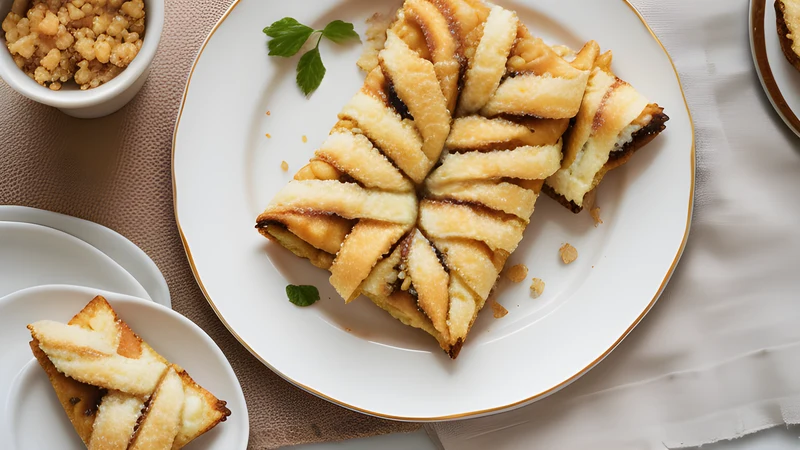
↓ Jump to recipeIn Thessaloniki, breakfast is a pastry the size of a paperback, cut into rough squares with a metal scraper by a man who has done it ten thousand times, put in a paper bag, and dusted through the opening with a snowdrift of icing sugar and cinnamon. You eat it walking. This is bougatsa, and the city treats it with the seriousness other cities reserve for coffee.
The recipe below is the sweet custard one, bougatsa me krema. The single change from the shops is that the semolina is toasted dry in a pan before it meets the milk.
Bougatsa: Thessaloniki's Breakfast in Filo
Ingredients
- 100 g fine semolina
- 900 ml whole milk
- 100 ml double cream
- 140 g caster sugar
- 3 large eggs
- 1 tsp vanilla extract
- Finely grated zest of 1/2 lemon
- 1/4 tsp fine sea salt
- 40 g unsalted butter, for the custard
- 350 g filo pastry (about 10 sheets), thawed
- 150 g unsalted butter, melted and cooled slightly, for brushing
- 2 tbsp icing sugar, plus plenty more to serve
- 2 tsp ground cinnamon, to serve
Method
- Put the dry semolina in a wide, dry frying pan over a medium heat. Stir it constantly for 5-6 minutes, until it is the colour of pale sand and smells of toast and biscuit. Tip it straight out onto a cold plate to stop it cooking.
- Pour the milk, cream and sugar into a large heavy pan and bring to a bare simmer over a medium heat, stirring until the sugar dissolves.
- Rain in the toasted semolina in a thin stream, whisking constantly. Keep whisking over a medium-low heat for 5 minutes, until it thickens to a loose, pourable custard that just coats the whisk. It should be noticeably slacker than a pastry cream.
- Take off the heat. Beat in the 40 g butter, vanilla, lemon zest and salt. Cool for 10 minutes, stirring now and then, until warm rather than hot.
- Beat the eggs smooth in a bowl. Whisk two ladlefuls of the warm semolina mixture into the eggs, then pour it all back into the pan and whisk hard for 30 seconds. Keep it off the heat. Cover the surface with cling film and cool to room temperature, about 30 minutes.
- Heat the oven to 180C fan / 200C conventional. Butter a 30 x 20 cm baking dish.
- Lay 6 filo sheets into the dish one at a time, brushing each with melted butter, letting them overhang the sides generously. Rotate them so all four edges are covered.
- Pour in the cooled custard and level it.
- Fold the overhang back over the top and brush with butter.
- Lay the remaining 4 sheets on top, buttering each, and tuck the edges down the inside of the dish.
- Brush the top with the last of the butter and flick a teaspoon of cold water over the surface with your fingertips.
- Bake for 40-45 minutes, until the top is deep gold, blistered and audibly crisp when tapped, and the custard barely trembles at the centre.
- Rest for 20 minutes in the dish. Cut into 8 squares with a serrated knife using a light sawing motion, or with a dough scraper pressed straight down.
- Dust each piece heavily with icing sugar and ground cinnamon at the table, immediately before eating.
The city, and the people who brought it
Bougatsa is Thessaloniki’s, and Thessaloniki got it from Constantinople, and the mechanism was the population exchange of 1923.
After the Greco-Turkish war, the Treaty of Lausanne ordered a compulsory exchange of populations: roughly 1.2 million Orthodox Christians moved from Anatolia to Greece, and around 400,000 Muslims moved the other way. Thessaloniki absorbed an enormous share of the incomers. They arrived with almost nothing and a great deal of skill, and the food of the city changed permanently within a decade. The refugees from Constantinople and Cappadocia brought filo work of a sophistication the mainland did not have, and bougatsa is one of the things they brought with them.
The families who built the trade are still named on the shopfronts. Bantis, in the Ano Poli, opened in 1969 and traces its craft to Serres and before that to Asia Minor. The old Serres connection matters — that town, north-east of Thessaloniki, is where a great many bougatsa families passed through, and Serraiki bougatsa is a name you still see over shop doors.
The word itself is a long journey. Greek bougatsa from Turkish pogaça from Italian focaccia from Latin panis focacius — bread baked in the ashes of a hearth. The word has travelled from a Roman flatbread to a Byzantine pastry to a Greek breakfast, changing what it named at every stop, and the modern object shares nothing with the Latin one except lineage.
Bougatsa and galaktoboureko: two custards, two textures
They look related and they are, and the difference is instructive. Galaktoboureko has a firm, sliceable custard drowned in cold sugar syrup. Bougatsa has a loose, almost pourable custard, finished with dry icing sugar and cinnamon at the table.
That drives the ratios. Galaktoboureko runs 120 g of semolina to a litre of milk; bougatsa here is 100 g to a litre of milk-and-cream, and the resulting filling is softer by a clear margin. When you cut a square of bougatsa the custard should sag slightly at the cut face and stop. It should never run, and it should never stand up straight either.
The absence of syrup changes the assembly too. There is no liquid arriving later to be absorbed, so the filo stays crisper for longer, and the sugar goes on at the last possible second — dusted bougatsa left standing for ten minutes has icing sugar that has dissolved into wet grey patches. Shops dust into the bag as they hand it over for precisely this reason.
Toasting the semolina
Here is my change. Six minutes in a dry pan, stirring, until it smells like a biscuit.
Toasting does two things. The obvious one is flavour: dry heat browns the trace proteins and starches in durum semolina and produces nutty, malty compounds that a milk-boiled semolina never develops, because a wet system cannot exceed 100C and Maillard chemistry needs more than that. The custard tastes fuller and slightly of toast, which is exactly right for something eaten at eight in the morning.
The less obvious one is texture. Dry heat partially dextrinises the outer starch, so the granule hydrates more slowly and swells less violently. Toasted semolina custard is smoother and much less prone to going gluey — the same principle behind toasting orzo before it goes in a braise.
Take it to pale sand and stop. Golden brown semolina tastes bitter and refuses to thicken properly, because you have destroyed too much of the starch that does the thickening. Tip it onto a cold plate the moment it is there; a hot pan keeps working after the heat is off.
Cooling the custard, and why it matters here
Galaktoboureko takes its custard into the pastry warm. Bougatsa should not. This filling is looser, and a warm loose custard poured onto filo begins dissolving the bottom sheets before the dish reaches the oven — you can watch it happen. Cooled to room temperature under cling film, it is viscous enough to sit on top of the pastry until the oven sets it.
The cling film against the surface is the standard custard precaution and it earns its place. A skin forming on the surface will not redisperse and will appear in the finished pastry as rubbery threads.
Filo, butter and the bake
Ten sheets, six under and four over, each one buttered. Work fast and keep the stack covered — filo dries to brittle uselessness in about four minutes of open air.
Butter cooled to hand temperature, brushed rather than poured. Hot butter is thin, soaks in, and welds the layers into a single sheet of pastry. The whole point of filo is that hundreds of thin layers, separated by fat, each puff independently.
The water flick before it goes in produces steam under the top sheets and blisters them apart. It is worth the two seconds.
Thessaloniki bakes bougatsa in wide, shallow trays in very hot ovens, in a pastry that is much thinner than this one, and gets a ratio of about one part custard to one part crisp. A domestic oven cannot do that, so the dish above is a home compromise with a thicker custard layer and a longer, slightly cooler bake. It is honest about being a home version.
Filo: the shop stuff, and the stuff they actually use
The bougatsa masters of Thessaloniki do not open a packet. They make a dough of flour, water, a little vinegar and oil, rest it, and then throw and stretch it by hand across a floured table until it covers the whole surface and you can read a newspaper through it. The technique is the same one behind Viennese strudel dough, and the shared ancestry is real: both descend from Ottoman yufka work, which travelled up through the Balkans with the empire and arrived in Vienna in the seventeenth century.
Stretched filo and rolled filo differ in a way you can taste. Hand-stretched sheets are irregular in thickness, and those variations puff differently, which is what gives shop bougatsa its uneven, blistered, almost crumpled top. Machine-rolled filo is uniform to within a fraction of a millimetre and bakes to a flatter, tidier, slightly duller crust.
Buying it is entirely legitimate and I do it. Two notes. First, the thickness grade matters: the standard supermarket filo in Britain is around 0.5 mm and is fine here. The very thin kataifi-adjacent grades sold in Greek shops need more sheets and more butter. Second, and non-negotiably: thaw it in the refrigerator overnight, in its packet, and then let the sealed packet come to room temperature for an hour before you open it. Filo thawed fast on a counter sweats inside the plastic, and the sheets weld into a single laminated brick that tears into confetti when you try to separate them. This ruins more filo than any other single error.
Once open, the clock is running. Keep the stack covered with a barely damp tea towel between sheets. Four minutes of open air is enough to make a sheet crack rather than fold.
How Thessaloniki eats it
There is a protocol and it is worth copying, because it explains several of the decisions above.
You order by weight and by cut. The scraper comes down through the tray, the piece goes into a paper bag or a shallow box, and the sugar and cinnamon are shaken over it at the last second, often through the open top of the bag. Then you fold the bag over, and you eat it on the pavement or in the car, with your fingers, in about ninety seconds, and it is far too hot.
The heat is part of the thing. Bougatsa in the shop comes out of an oven roughly every twenty minutes and the trays are timed to sell out before the pastry has a chance to soften. The whole business model is built around the fact that this pastry has a useful life measured in tens of minutes, which is also the honest answer to “can I make it in advance”. You cannot. Bake it, rest it twenty minutes so the custard sets enough to hold a cut, and put it on the table.
The drink is a freddo espresso in summer and a Greek coffee in winter. Both are unsweetened, and both are correct, because 140 g of sugar in the custard and a blizzard of icing sugar on top mean the coffee’s job is to be bitter.
The cinnamon is heavier than a British hand would apply. Two teaspoons across eight pieces, dusted on top of the icing sugar so it sits visibly in brown streaks across the white. Thessaloniki uses a shaker and does not aim.
Cutting, savoury variants, faults
Cut it with a scraper. This is a real technique — bougatsa shops use a straight metal blade pressed vertically down through the whole pastry in one motion, which shears the filo instead of dragging it. A serrated knife with a very light sawing action is the second-best option. A sharp chef’s knife pushed through will compress the layers and squeeze the custard out sideways.
Savoury versions are equally traditional and more common at breakfast in some quarters: bougatsa me tyri with a mix of feta and mizithra, and bougatsa me kima with spiced minced beef, cinnamon and onion. Both use the same pastry and no sugar. The cheese version sits close to spanakopita with charred spring onion and dill in construction.
The custard leaked out. Poured in warm, or the overhang folded badly leaving a gap.
It went soggy overnight. It does. Bougatsa is a same-day pastry and preferably a same-hour one; the refrigerator turns the filo to leather within a few hours. If you must, revive it at 180C for 8 minutes, dust again, accept a lesser thing.
Coffee alongside. In Thessaloniki that means a freddo espresso and a pavement.
Related Content