Boterkoek: The Dutch Butter Cake
Four ingredients, one tin, deliberately underbaked
Contents
↓ Jump to recipeBoterkoek is what happens when a nation decides a cake should mostly be butter and then declines to pretend otherwise. Two hundred and twenty-five grams of it against 250 g of flour, which is a shortbread ratio pushed further than shortbread usually goes, plus enough sugar to make it a cake and one egg yolk to hold the whole thing together. It bakes in 25 minutes. It has four real ingredients. And the single technique that defines it is knowing when to take it out, which is roughly ten minutes before your instincts say so.
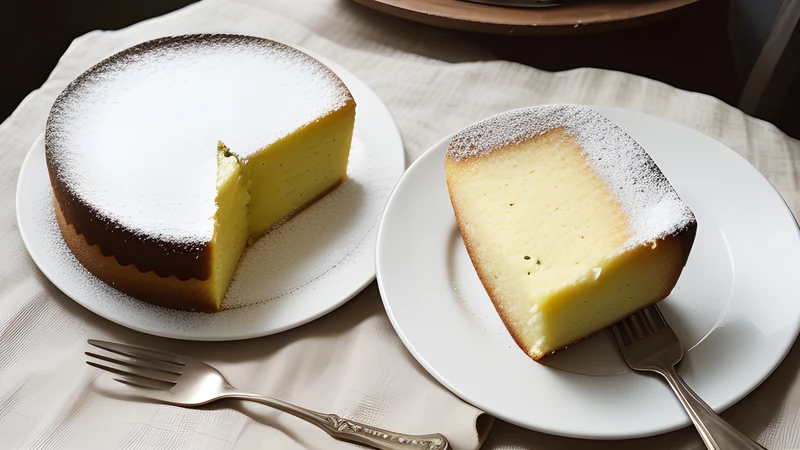
The name is literal — butter cake — and the Dutch use it without irony. Every bakery in the Netherlands sells a round of it, scored into diamonds, sold by the wedge, eaten with coffee. It sits somewhere between shortbread and a very dense blondie: a crisp gold rim, a chewy middle band, and a centre that is soft enough to leave a fingerprint. The gradient across a single wedge is the whole point.
Boterkoek: The Dutch Butter Cake
Ingredients
- 250 g plain flour
- 225 g unsalted butter, softened to about 20C
- 200 g caster sugar
- 1 large egg, separated
- 1/2 tsp fine salt
- Finely grated zest of 1 unwaxed lemon
- 1/2 tsp almond extract (optional but traditional)
- 1 tsp baking powder
- 20 g flaked almonds (optional)
Method
- Butter a 22 cm round tin with a removable base and line the base with parchment.
- Beat the softened butter, sugar, salt, lemon zest and almond extract together for 2 minutes until pale and smooth. Do not aerate it into a fluffy sponge batter.
- Beat in the egg yolk only. Reserve the white.
- Sift in the flour and baking powder and fold until a thick, sticky dough forms with no dry patches. Stop mixing immediately.
- Press the dough into the tin with damp hands or the back of a spoon, levelling it to an even 2 cm depth.
- Beat the reserved egg white with a fork until loose and brush a thin layer over the surface.
- Score a diamond lattice into the top with a knife, cutting about 3 mm deep. Scatter the flaked almonds if using and press them in lightly.
- Bake at 180C fan for 22-25 minutes. The edges should be deep gold and the centre 2 cm should still look pale and feel soft when pressed.
- Cool in the tin for a full 2 hours. It sets as it cools and will fall apart if cut warm.
- Release from the tin and cut into 10 wedges.
The Frisian claim and the butter economy
Boterkoek is usually pinned to Friesland, the northern province where the dairy is, and the geography is doing real work here. The Frisian coastal clay and reclaimed polders produce grass that supports very high-yield dairy cattle — the Holstein- Friesian breed is named after the region and has been exported worldwide since the nineteenth century precisely because of what it does on that grass. Dutch butter was a serious export commodity by the seventeenth century, and by 1900 the Netherlands had industrialised its dairy trade to the point where butter was cheap at home in a way it simply was not in most of Europe.
A cake that is 40% butter by weight is an economic statement before it is a recipe. So is one that uses a single egg. Eggs were the expensive ingredient in a Dutch farmhouse kitchen; butter was the thing you had a surplus of, churned from milk that would otherwise spoil. Boterkoek is what a baker makes when butter is the cheapest thing on the shelf, and the flavour reflects that with total honesty. There is nowhere for a mediocre butter to hide in this recipe. Use a good European-style one with 82% fat or higher, and if you can find a cultured butter, use that — the diacetyl from the lactic fermentation is precisely the flavour people mean when they say something tastes buttery.
Some Frisian versions are flavoured with a strip of orange zest or a spoonful of ginger syrup, which points at the same colonial spice trade that produced gevulde speculaas. The almond extract in most modern recipes is a nod towards the almond paste tradition without the expense of the paste itself.
Underbaking as a technique
This is the part that separates a real boterkoek from a large flat biscuit. The cake is pulled while the centre is visibly undercooked — pale, soft, slightly domed, and giving under a finger. It then sets over the next two hours as it cools. What is happening is straightforward: the starch in the flour gelatinises during baking, absorbing water and swelling, and then retrogrades as it cools, forming a set structure. Meanwhile the butter, which is entirely liquid at oven temperature, recrystallises below about 25C and locks the crumb in place. If you bake until the centre looks done, both processes complete in the oven and continue on the bench, and you end up with something dry and sandy that snaps.
Twenty-five minutes at 180C fan in a 22 cm tin is the number. Go to 28 and you have lost it. The visual cue is a 2-3 cm ring of deep gold around the edge with the middle still pale, and a top that has just stopped looking wet. Trust the clock over the skewer test — a skewer will come out with crumbs on it and that is correct.
The two-hour cool is equally non-negotiable. Cut it at 20 minutes and the middle is a puddle; cut it at 45 and it tears. At two hours it slices cleanly and the centre is chewy and dense.
Mixing: the counterintuitive part
Do not cream the butter and sugar the way you would for a sponge. Two minutes, until smooth and just pale, and stop. Creaming works by driving air into the fat crystal network; that air becomes the bubbles a sponge rises on. Boterkoek has no business rising. If you beat for eight minutes you get a cakier, lighter, drier result that has lost the dense chew it exists for.
The same logic applies to the flour. Fold it in and stop the moment the dry patches disappear. This dough has enough butter to inhibit most gluten development — fat coats the flour proteins and physically blocks them from linking up — but not enough to make it impossible, and a two-minute beat after the flour goes in will still toughen it.
The teaspoon of baking powder is a modern addition and a small one. It gives just enough lift to stop the cake from being a solid brick, without pushing it towards sponge. Leave it out and you get something closer to Scottish shortbread in texture, which is a legitimate choice.
The tin, the depth and the diamonds
Depth is a variable people ignore and it changes the cake completely. This dough should sit at 2 cm — a 22 cm round tin takes the full quantity to almost exactly that. Press it into a 20 cm tin and you are at 2.5 cm, which needs another five minutes and loses the soft centre because the edges will be dark by the time the middle catches up. Spread it into a 24 cm tin and you are at 1.7 cm, and the whole thing bakes through into a biscuit with no gradient at all. If your tin is the wrong size, adjust the recipe rather than the timing: scale by area, so a 20 cm tin wants about 82% of everything.
Use a loose-based tin. Boterkoek sets hard against the sides and a fixed tin means running a knife round a cake that is still fragile at the edges. Butter the sides properly even so, and line the base.
Press the dough in with damp hands. It is sticky enough to climb a spoon and cling to dry fingers, and a wet palm slides across it without dragging. Level it as carefully as you can — this cake shows every dip, because there is no rise to even out an uneven surface. A small offset spatula, dipped in water, is the tidiest tool for the job.
The diamond lattice is decorative and also functional. Scoring 3 mm deep gives the surface somewhere to move as the butter melts and the dough spreads slightly, which reduces the chance of a random crack across the top. Cut the lines with a sharp knife in single strokes, wiping the blade between each, and cut them before the egg wash sets rather than after.
What goes wrong
It’s greasy and the butter pooled. Your butter was too warm going in — above about 24C the fat crystal network breaks down and the emulsion never forms, so the butter leaks out during baking. Soften to 20C, which is cool to the touch and takes a thumbprint without smearing.
It’s dry and crumbly. Overbaked, almost certainly, and probably by only three or four minutes. This cake has a very narrow window.
It sank in the middle. Too much baking powder, or you creamed too long and the air structure collapsed. Neither is fatal; it will still taste right.
The top is pale and matte. The egg-white wash is what gives boterkoek its lacquer. Beat the white until it is loose and liquid, and brush thinly — a thick layer bakes to a rubbery skin.
Variations and the honest case against
The most common Dutch variation puts a layer of almond paste through the middle, which turns it into something much closer to a speculaas slab. A ginger version studs the dough with 60 g of chopped stem ginger. In Zeeland you find it made with salted butter and no added salt, which is worth trying if your butter is good.
The honest objection to boterkoek is that it is a one-idea cake, and the idea is butter. There is no acidity in it beyond a scrap of lemon zest, no textural contrast beyond the almonds you may or may not have scattered on top, and after two wedges the richness stops being a pleasure and starts being a fact. It is also genuinely heavy — a 22 cm round contains most of a 250 g block of butter, and the portion sizes Dutch bakeries use are small for good reason.
If you want a Dutch bake with fruit and acid doing the work, the fritters in appelflappen are the better answer. For butter deployed with more architecture, the laminated kouign-amann from Brittany uses a similar quantity to entirely different effect, and the caramelised layers give you the contrast boterkoek lacks. And for the Dutch caramel register, stroopwafels remain the country’s best argument.
Serving
Small wedges, black coffee, mid-morning. Ten pieces from a 22 cm round is the Dutch portion and it is calibrated correctly. A wedge served slightly warm — twenty minutes out of a 150C oven, no more — softens the centre back towards the texture it had on the day it was baked, though the edges lose some of their snap.
It takes almost nothing alongside. A spoonful of crème fraîche or a few sharp raspberries give the acidity the cake itself has none of, and both are improvements rather than embellishments. Cheese also works: a hard aged Gouda, cut thin, is a genuinely Dutch pairing and the salt does something interesting against all that sugar.
Storage
Boterkoek keeps for five days in an airtight tin at room temperature and is at its best on days two and three, once the crumb has fully equalised. Refrigeration ruins it — the butter hardens and the chew turns waxy — so keep it on the counter. It freezes for three months wrapped tightly; thaw at room temperature for three hours and do not attempt to speed that up in an oven, which will melt the butter back out of a structure that has already set once.
Related Content