Bollito Misto: The Boiled Meats of Piedmont
Seven cuts, seven sauces, one trolley, and a great deal of patience
Contents
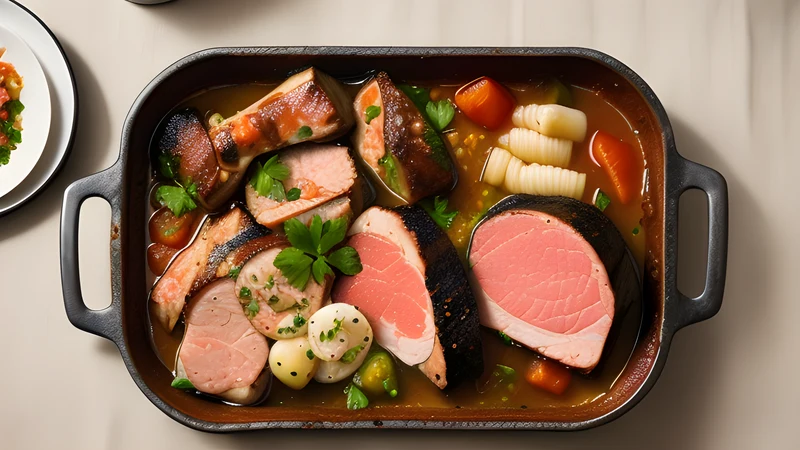
↓ Jump to recipeA proper bollito misto arrives on a trolley. The waiter wheels it to the table, lifts the lid, and steam and the smell of beef fill the room, and inside are seven pieces of meat sitting in their own hot broth. He asks what you want. You say all of it, because that is the correct answer, and he carves onto a hot plate and points at the sauces.
This is one of the great restaurant theatres of northern Italy and it is entirely reproducible at home, minus the trolley. What it needs is a big afternoon, a lot of pot space, and one piece of understanding: the broth is a by-product here. Everything about the method is arranged to keep the flavour inside the meat.
Bollito Misto: The Boiled Meats of Piedmont
Ingredients
- 1.2 kg beef brisket or short rib, in one piece
- 800 g beef shin, in one piece
- 1 whole ox tongue, about 1.2 kg
- 1 free-range chicken, about 1.4 kg
- 1 cotechino sausage, about 500 g
- 600 g veal breast, rolled and tied
- 3 onions, halved, skin on
- 3 carrots, halved
- 3 celery sticks
- 1 leek, split and washed
- 6 black peppercorns
- 3 bay leaves
- 1 bunch flat-leaf parsley stalks
- 40 g coarse sea salt, plus more to taste
- 80 g flat-leaf parsley leaves
- 40 g stale white bread, crusts off
- 3 tbsp red wine vinegar
- 2 salted anchovy fillets
- 2 tbsp capers, rinsed
- 1 garlic clove
- 1 hard-boiled egg yolk
- 150 ml extra virgin olive oil
- 1 jar mostarda di Cremona, to serve
- 2 tbsp coarse salt, to serve
Method
- Put the tongue in a large pot, cover with cold water, bring to the boil and simmer for 10 minutes. Drain, rinse and set aside. This removes the scum that would otherwise cloud everything.
- Return the tongue to a clean pot with 4 litres of cold water, 1 onion, 1 carrot, 1 celery stick, 2 bay leaves and 2 peppercorns. Bring to a bare simmer and cook for 3 hours, until a skewer slides into the thickest part with no resistance.
- Meanwhile, put the brisket and shin in a second large pot. Cover with 4 litres of cold water and bring slowly to the boil, skimming the grey foam off the surface repeatedly for the first 20 minutes.
- Add the remaining onions, carrots, celery, leek, bay, peppercorns, parsley stalks and 40 g salt. Drop to a bare simmer - a bubble every few seconds - and cook for 2 hours 30 minutes.
- Add the veal breast to the beef pot and cook for a further 1 hour.
- Add the chicken to the beef pot for the final 50 minutes, submerged.
- Cook the cotechino in its own separate pot of gently simmering water for 2 hours. Do not put it near the other pots - it will grease everything.
- For the salsa verde, soak the bread in the vinegar for 5 minutes and squeeze lightly. Chop the parsley, anchovies, capers and garlic together very finely by hand, then mash in the bread and the egg yolk. Stir in the olive oil in a thin stream. Season and rest for 30 minutes.
- Peel the tongue while it is hot enough to handle with a cloth - the skin pulls away in sheets. Trim the root end. Return it to its broth to keep warm.
- Rest all the meats in their broths, off the heat, for 15 minutes.
- Slice everything across the grain, 1 cm thick, and arrange on a warm platter. Ladle a little hot broth over to stop it drying.
- Serve with the salsa verde, mostarda, coarse salt and a bowl of the strained beef broth on the side.
The seven and the seven
Piedmontese tradition is specific and slightly obsessive. The canonical bollito misto is sette tagli, sette ammennicoli, sette bagnetti — seven cuts, seven extras, seven sauces.
The seven cuts are tenerone (brisket or top rib), scaramella (short rib), muscolo (shin), fiocco di punta, cappello del prete, stinco and culatta. The seven extras are the offcuts and oddities: tongue, head, tail, trotter, cotechino, hen and calf’s foot. The seven sauces run bagnet verd (green), bagnet ross (a tomato and pepper one), mostarda, honey and walnuts, cugnà, horseradish and mustard.
Nobody makes twenty-one components at home and nobody sensible expects you to. The version above takes six pieces of meat and one really good green sauce, which is where a normal kitchen lands and where most Piedmontese families land too. But the structure of the tradition tells you what the dish is about: contrast. Every cut has a different texture, every sauce a different attack, and the pleasure is in mixing them across a plate.
The dish belongs to the Po valley — Piedmont, Lombardy and Emilia all claim versions — and it belongs to winter. It is court food gone domestic: the House of Savoy ate it, Cavour is supposed to have negotiated over it, and it filtered down into the trattorie of Turin and stayed there. Under the AOP-style Piedmontese framework, the beef should be Fassona, the local breed, which is lean and finely grained and behaves well in water.
The one rule that matters: cold water, bare simmer
Almost every mistake in bollito misto is a temperature mistake.
Start the beef in cold water and bring it up slowly. This sounds backwards — the received wisdom for stock is cold water, for boiled meat is hot — and Piedmont splits the difference for a reason. Cold-start extraction pulls the scum out where you can skim it, and the slow climb lets muscle proteins denature gradually rather than seizing. The trade-off is that you lose some flavour into the water, and the compensation is the salt: 40 g in 4 litres brings the broth close enough to the meat’s own salinity that the osmotic drain slows down.
Then never, ever boil it. A bare simmer — a bubble breaking somewhere every few seconds, around 85-90C — is the whole technique. A rolling boil does two destructive things at once. It agitates the meat, tearing fibres apart and shedding them into the water as scum, so the broth turns cloudy and grey. And it drives the internal temperature past the point where collagen converts gently to gelatine, squeezing the muscle fibres hard so they expel their water. Boiled beef that is actually boiled is dry, stringy and grey — the reason the whole category has a bad reputation in Britain.
Held at 85C, the same brisket goes silky. Collagen starts converting around 70C and does it slowly; three hours in that window turns connective tissue into gelatine while the fibres stay relaxed and full of water.
If the surface goes above a lazy simmer, pull the pot half off the ring. Use a probe if you have one.
Why separate pots
The tongue gets its own pot and the cotechino gets its own pot, and both rules are non-negotiable.
Tongue is covered in a thick, waxy skin that has to come off after cooking, and it sheds a huge amount of grey scum in the first ten minutes. Blanching it separately first, then discarding that water, keeps the rest clean. Peel it hot — hold it in a cloth and pull; the skin comes away in sheets, and if it fights you, it needs another twenty minutes. Cold tongue does not peel.
Cotechino is a fresh pork sausage with a high proportion of rind and fat, and it renders enormously. Put it in the main pot and you will have four litres of grease with beef in it. Its own small pot, two hours, gently, and slice it thick.
The chicken goes in for the last 50 minutes only. It is done long before the beef, and a hen that has sat in a pot for three hours has given everything it has to the water.
The twist: rest them in the broth
Here is the change I make and it is the one that most improves the result.
When each meat is done, take the pot off the heat and leave the meat in its own broth for fifteen minutes before slicing. Do not lift it out onto a board.
Muscle fibres contract under heat and hold their water under pressure. Slice into that immediately and the juice runs out onto the board — the same phenomenon as a rested steak, but worse, because there is nowhere for a boiled cut to reabsorb from. Left in the hot liquid as it cools slightly, the fibres relax and pull broth back in. The difference is dramatic on lean cuts like shin and tongue: fifteen minutes of resting in broth is the gap between adequate and very good.
It also solves the serving problem. Everything can rest in its own pot while you carve, and each cut goes onto the platter hot and wet rather than steaming itself dry on a board.
The salsa verde, which is half the dish
Bagnet verd does the heavy lifting. It supplies the acid and the salt that make three hours of poached beef interesting, and a bad one wastes the whole afternoon.
Chop by hand. A blender turns parsley into a bitter green sludge — the blades bruise the leaves and oxidise them, and the emulsion goes thick and dull. Hand-chopped salsa verde is loose, bright and speckled, and it tastes of parsley instead of tasting of chlorophyll.
The soaked bread is structural: it absorbs the vinegar and the oil and holds them in suspension so the sauce clings to a slice of brisket. The hard-boiled yolk does the same job with more richness. Both are traditional and both are usually skipped in modern recipes, to their cost.
Make it 30 minutes ahead, no more than three hours. It dulls overnight.
The other sauces, briefly
Two more are worth the effort if you have the time, and both keep for weeks.
Bagnet ross. The red one. Cook 500 g of chopped ripe tomatoes with a red pepper, an onion, a carrot, a celery stick, a chilli and a crushed garlic clove for 45 minutes until collapsed, pass it through a food mill, then return it to the pan with 2 tbsp red wine vinegar, 1 tbsp sugar and 3 tbsp olive oil and reduce for another 20 minutes until it mounds on a spoon. It is sweet-sour and it belongs with the tongue specifically.
Cugnà. The Piedmontese grape mustard, made at the vendemmia by boiling down unfermented grape must with quinces, pears, figs and hazelnuts for four or five hours. It is closer to a chutney than a sauce and it is what happens when a wine region has too much must. Shop-bought is fine; it is a two-day project otherwise.
Mostarda di Cremona — candied fruit suspended in a mustard-oil syrup — comes out of a jar and should. It is the sharpest thing on the table and a single cherry with a slice of brisket does more work than a spoonful of anything else. Buy the version with whole fruit rather than the chopped kind.
The point of having several is that you eat differently across the platter. Tongue takes the red sauce, brisket takes the green, cotechino takes the mostarda, chicken takes salt and a little broth. Nobody enforces this and everybody has opinions about it.
Serving, broth and leftovers
Warm the platter. Slice across the grain at 1 cm. Ladle broth over to keep it moist. Put the coarse salt, the salsa verde and the mostarda within everyone’s reach and let people build their own plates.
The broth. Strain it, chill it, lift the fat off. It is exceptional and it is the reason to make bollito misto on a Saturday: on Sunday it becomes soup, or the base for a risotto, or the liquid for tortellini.
Leftovers. Piedmont has a whole second dish for them: chopped bollito fried in a pan with onions until crisp at the edges, which locals eat more happily than the original. Cold sliced tongue in a sandwich with salsa verde is superb.
Storage. Keep the meats submerged in a container of their broth in the fridge for up to four days; out of the liquid they dry within hours. Reheat by warming them in the broth, never in a microwave.
Scaling down. Three components make a respectable bollito for four: brisket, tongue and cotechino. That is one afternoon, two pots and no compromise on the idea. Adding the chicken costs you fifty minutes of attention and is probably worth it. The full six is a dinner party.
Timings. Work backwards from when you want to eat and add thirty minutes of slack, because the doneness test is a skewer rather than a clock. Brisket and shin want 2 hours 30 to 3 hours; the skewer should meet no resistance and slide back out without lifting the meat. Tongue is the slowest and the most variable — 3 hours is a minimum and a large one can take 3 hours 30. Veal breast wants 90 minutes, chicken 50. Undercooked bollito is chewy and there is no fixing it on the platter; overcooked is dry and stringy. The skewer is the only honest arbiter.
What can go wrong. Cloudy grey broth means it boiled. Dry meat means it boiled, or you sliced it straight out of the pot. Tongue you cannot peel means it needs longer. Greasy everything means the cotechino got into the main pot.
If you like this territory, Vienna’s Tafelspitz is the same idea narrowed to one cut and one sauce, salsa verde Italian-style with capers is worth making on its own, and Czech svíčková na smetaně shows what central Europe does with a similar piece of beef and a great deal more cream.
Related Content