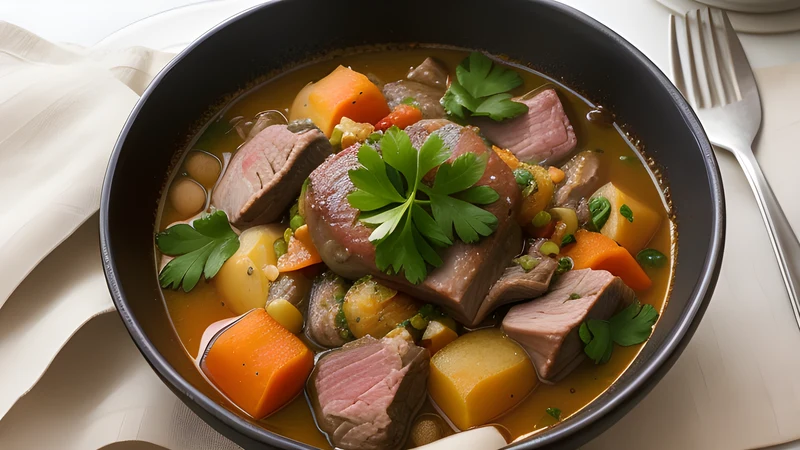
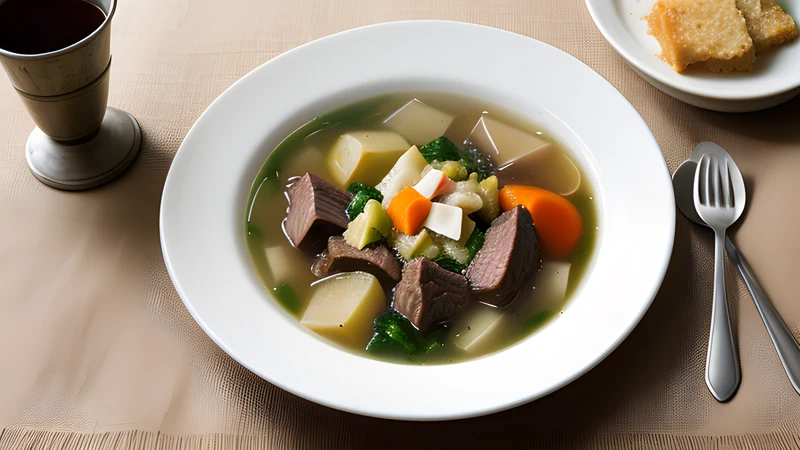
Blanquette de Veau à l'Ancienne: The White Veal Stew
The stew with no colour in it, finished with verjuice and tarragon
Contents
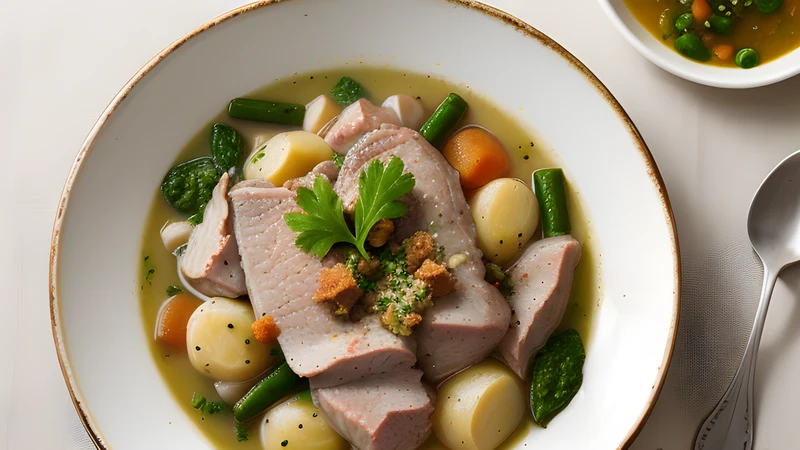
↓ Jump to recipeBlanquette de veau is defined by an absence. There is no browning in it anywhere — no seared meat, no golden onions, no roux allowed to take colour. Every reflex a cook has about building flavour is forbidden, and what comes out is one of the best things in the French repertoire.
That is the interesting part. We are taught that flavour comes from the Maillard reaction, and mostly it does. Blanquette makes its case entirely through the other route: long gentle extraction, gelatine, dairy, and a sauce built from the meat’s own cooking liquid. The flavour is quieter and deeper, and it tastes of veal in a way that a browned veal stew never quite manages, because browning puts a layer of roasted flavour over the top of the meat rather than drawing the meat out.
Blanquette de Veau à l'Ancienne: The White Veal Stew
Ingredients
- 1.4kg veal shoulder or breast, in 5cm cubes
- 1 onion, peeled and studded with 3 cloves
- 2 carrots, peeled and halved
- 1 leek, white part, halved
- 2 celery sticks
- 1 bouquet garni: 4 parsley stalks, 3 thyme sprigs, 2 bay leaves, tied
- 1 tsp white peppercorns
- 12g fine salt
- 250g button mushrooms, small, wiped
- 250g pearl or button onions, peeled
- 30g unsalted butter, plus 10g for the mushrooms
- 1 tsp caster sugar
- For the velouté: 50g unsalted butter
- 50g plain flour
- 1.2 litres of the reserved cooking broth
- For the liaison: 3 egg yolks
- 150ml double cream
- 2 tbsp verjuice (or 1 tbsp lemon juice)
- 3 tbsp tarragon leaves, roughly torn
- Nutmeg, to grate
Method
- Blanch the veal. Put the cubes in a large pan, cover with cold water by 5cm, and bring slowly to a bare simmer over medium-low heat. As the grey scum rises, do nothing but wait — after about 8 minutes it will have stopped. Drain the meat into a colander and rinse each piece under cold running water, rubbing off any clinging scum. Wash the pan.
- Return the clean veal to the clean pan. Add 2 litres of fresh cold water, the clove-studded onion, carrots, leek, celery, bouquet garni, white peppercorns and the salt. Bring slowly to a bare simmer — one bubble breaking every couple of seconds — and hold it there, uncovered, for 75 to 90 minutes, until a skewer meets no resistance. Never let it boil.
- While it cooks, glaze the onions. Put the peeled onions in a small pan with the 30g butter, the sugar, a pinch of salt and just enough water to come halfway up. Cover with a disc of baking paper and simmer 15 minutes, then uncover and cook until the water has gone and the onions are tender and still pale. Do not let them colour.
- Cook the mushrooms. Melt the 10g butter in a frying pan over medium heat, add the mushrooms and a pinch of salt with 2 tbsp water, cover, and cook 5 minutes until just tender. Keep them pale.
- Lift the veal out with a slotted spoon into a bowl and cover. Strain the broth through a fine sieve, discarding the vegetables and herbs. Measure out 1.2 litres and keep it hot; boil the rest down and save it.
- Make the velouté. Melt the 50g butter in the washed pan over medium-low heat, stir in the flour and cook, stirring, for 3 minutes without letting it take any colour — this is a white roux. Add the hot broth a ladleful at a time, whisking smooth after each, then simmer gently for 15 minutes, stirring often, until it coats a spoon and no longer tastes of flour.
- Return the veal, the glazed onions and the mushrooms to the velouté and warm through for 5 minutes over low heat.
- Make the liaison. Whisk the yolks and cream together in a bowl. Whisk in two ladlefuls of the hot sauce, one at a time, to temper them. Pour the mixture back into the pan, off the heat, stirring constantly.
- Return the pan to the lowest possible heat and stir for 2 to 3 minutes until the sauce thickens very slightly and reaches 80C. It must not boil, or the yolks will scramble.
- Off the heat, stir in the verjuice, the tarragon and a grating of nutmeg. Taste and add salt. Serve immediately with plain rice or steamed potatoes.
À l’ancienne
The name comes from blanc, white, and the dish is old enough that the word “stew” undersells its status. It appears in French cookbooks from the eighteenth century onwards, and by Escoffier’s time it was codified: veal, a white stock, a velouté, a liaison of egg yolk and cream, garnished with glazed onions and mushrooms. The tag à l’ancienne — in the old style — signals the full version with the garnish and the liaison, as against a plainer weekday one.
It was originally a way of using up leftover roast veal, which explains why the meat is never browned; it was already cooked. Over time the leftovers dropped away and the dish became something you started from raw, but the no-colour rule stayed, and it stayed because it turned out to be the whole point.
Along with pot-au-feu and blanquette’s cousin the fricassée, this is domestic French cooking rather than restaurant cooking, and French people are sentimental about it in the way the English are about a roast. It is a Sunday dish. Veal shoulder was cheap.
The verjuice and the tarragon
My change is at the very end: two tablespoons of verjuice and a good handful of torn tarragon, stirred in off the heat.
The honest weakness of a blanquette is that it is a pale, rich, dairy-heavy dish with no acid and no top note in it. Traditional recipes reach for a squeeze of lemon, and lemon works, but it lands as a bright citrus stripe across the top of the sauce and announces itself. Verjuice — the pressed juice of unripe grapes, a medieval French souring agent that has been quietly coming back — brings a rounder, greener acidity that sits inside the sauce instead of on top of it. It has malic and tartaric acid rather than citric, and it reads as freshness rather than as lemon.
Tarragon does the aromatic half. Its anise note comes largely from estragole, and it has a specific affinity with cream and with veal; it is already the herb in a béarnaise for good reason. Torn in at the end, off the heat, it perfumes the dish without cooking to hay.
If you cannot find verjuice, a tablespoon of lemon juice or a dry white vermouth reduced to a spoonful will both do the job. Add whichever off the heat, after the liaison, and taste as you go — you are looking for the point where the sauce stops feeling heavy and starts feeling alive, which is usually about one teaspoon before you think.
Which cut, and why it matters more here
Veal shoulder is the default and the right answer. It has enough connective tissue to give the broth body over ninety minutes, and enough fat to survive the cooking without drying. Breast is the other traditional cut and it is better still if your butcher has it — more gelatine, more flavour, slightly more trimming.
What to avoid is anything lean and prime. Veal loin or leg, cut into cubes and simmered for an hour and a half, produces dry grey blocks in a nice sauce, because there is no collagen to convert and nothing to keep the fibres lubricated. This is the same rule that governs every stew, and it bites harder in a blanquette because there is no browning and no wine to distract from the meat.
Cut the cubes large — 5cm, bigger than feels right. Long, gentle cooking shrinks them by about a third, and small cubes end up as shreds. Ask for the pieces off the bone but keep any bones the butcher will give you and drop them in the pot; they are free gelatine and they come out at the straining stage.
If veal is a problem, ethically or practically, this recipe works almost unchanged with pork shoulder, which has a similar collagen load and a similar mildness. It stops being a blanquette de veau and remains a very good dinner.
Blanching, and why you throw the water away
The first step looks wasteful. Cover the veal in cold water, bring it slowly up, let it throw its scum, then tip the lot away and start again with fresh water.
It is the step that makes the dish white. Veal, especially shoulder and breast, releases a great deal of denatured albumin and residual blood in the first ten minutes of heating, and that material is grey. Cook it in the water you intend to keep and it disperses through your broth, and no amount of straining recovers the colour. Blanch it away first and the second pot stays clean.
Rinse each piece under the tap afterwards. The scum clings to the meat in little grey flecks and they will end up in your sauce otherwise. It feels fussy for about ninety seconds and then it is done.
Start from cold water both times. A slow rise coagulates the proteins into rafts that lift out; hot water disperses them instantly, which is the opposite of what you want.
Never boil it, twice over
There are two places where heat will ruin this dish.
The long simmer must stay at a bare simmer, 85 to 95C. Boiling agitates the fat and protein into an emulsion and clouds the broth, and since the broth becomes the sauce, cloudy broth means a dull grey blanquette. Boiling also squeezes the veal fibres and turns silky meat stringy — collagen becomes gelatine happily at 80C given ninety minutes, and the muscle around it does not survive a rolling boil.
The liaison must stay below 85C. Egg yolks begin setting around 65C and scramble outright by about 85C, and the moment they do, your velvet sauce becomes a sauce with lumps of sweet omelette in it, which nothing will fix. Temper the yolks with hot sauce first, return the pan to the lowest heat you have, stir constantly, and pull it off at 80C. If you have a probe thermometer, this is a good place to use it.
The white roux
Cook the flour in the butter for three minutes and no longer, over medium-low heat, stirring. You are cooking out the raw starch taste while keeping the roux blond-free. Take it further and you have the beginnings of a velouté blond, which tastes fine and is the wrong colour.
Add the broth hot and a ladle at a time, whisking each addition smooth before the next. Then simmer the sauce for a full fifteen minutes. This is the step people cut, and cutting it leaves a faint chalkiness that the cream cannot hide — flour needs time at temperature to hydrate fully and stop tasting of itself.
The garnish, kept pale
Glazed onions and button mushrooms are the à l’ancienne garnish, and both are cooked separately precisely so they can be kept white. The onions go in a covered pan with butter, a little sugar, salt and water, and steam-braise until the liquid has gone; the sugar gives them gloss without colour. The mushrooms get butter, salt and a splash of water under a lid, which stews them pale instead of frying them brown.
The temptation to caramelise both is strong and it is the wrong dish. Brown garnish in a blanquette looks like a mistake and tastes like a different stew.
Reading the sauce
The finished sauce should coat the back of a spoon and hold a line when you draw a finger through it, and it should be ivory rather than white — the yolks bring a faint warmth of colour that tells you the liaison went in.
If it is too thin, the usual cause is broth that never reduced. Lift the meat and garnish out, simmer the velouté down for a few minutes before the liaison goes in, and try again. Never thicken a blanquette after the liaison; you cannot boil it to reduce it without scrambling the yolks.
If it is too thick, loosen it with the extra reduced broth you saved. This is why the recipe tells you to keep it rather than tip it away.
The seasoning wants attention at the very end. Salt, then nutmeg — a small grating, which is traditional and does something specific with cream and veal — then the verjuice, tasting between each. White pepper rather than black, throughout, for the obvious reason.
Serving, and the day after
Rice is the classic accompaniment — plain long-grain, steamed, nothing else — because the sauce is the event and it wants a blank surface. Steamed new potatoes work equally well. Skip the crusty bread; there is enough going on.
Made ahead, blanquette is awkward. The stew base reheats beautifully, but the liaison does not: reheating a finished blanquette risks taking the yolks past 85C and splitting the sauce. So make the velouté and the veal a day ahead, refrigerate, and add the liaison, verjuice and tarragon when you reheat, gently, on the day. It will be better than it would have been fresh, because the veal keeps drinking the sauce overnight.
Lamb, chicken and rabbit all take the same treatment; a chicken version is a fricassée in all but name and takes 45 minutes instead of 90.
For the same gentle-simmer logic applied elsewhere, pot-au-feu is the dish this one is arguing with, and waterzooi is Ghent’s version of the identical idea, right down to the egg-and-cream liaison. Coq au vin shares the glazed onion and mushroom garnish while going the other way entirely on colour, and if it is veal you are after, Wiener schnitzel is the opposite argument in a pan.
Related Content