Bisi Bele Bath: Karnataka Rice, Lentils and Spice
Hot lentil rice built on its own roasted spice blend, finished with ghee and fried cashews
Contents
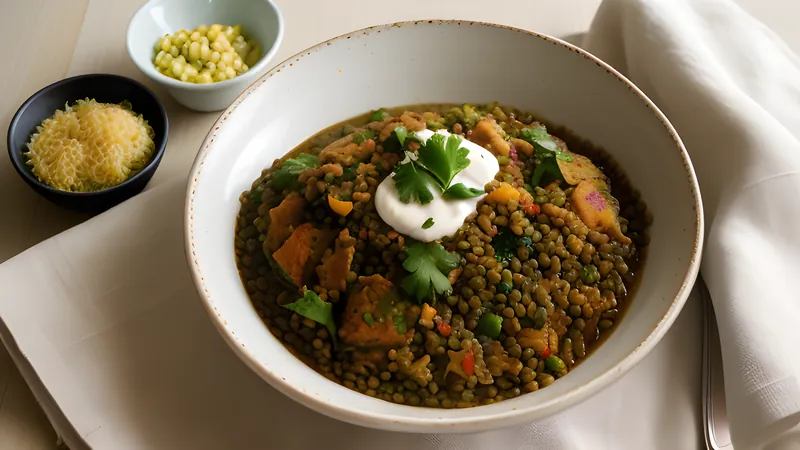
↓ Jump to recipeBisi bele bath translates, roughly, as “hot lentil rice” in Kannada, and the name tells you almost everything you need to know except the one detail that makes it worth cooking: the spice blend. Rice and toor dal cook down together with vegetables and tamarind into something closer to a thick, savoury porridge than a pilaf, but what separates a good bisi bele bath from a merely competent one is a roasted, ground spice mix unique to the dish — its own specific combination of coriander, lentils, dried chilli and coconut, toasted together and ground fresh, quite distinct from a standard garam masala or sambar powder.
The dish belongs to Karnataka, and specifically to the Mysore and Bangalore region, where it is strongly associated with the Iyengar Brahmin community’s vegetarian cooking tradition and with the Mysore Palace kitchens historically credited with refining it. It has since become one of Karnataka’s most recognisable exports, served everywhere from wedding buffets to school tiffins to the well-known MTR restaurant chain in Bangalore, whose packaged bisi bele bath powder introduced the dish to households far outside the state.
Bisi Bele Bath: Karnataka Rice, Lentils and Spice
Ingredients
- 200 g short-grain rice, rinsed
- 100 g toor dal (split pigeon peas), rinsed
- 1 carrot, diced
- 100 g green beans, chopped
- 1 small aubergine, diced
- 80 g green peas
- 1 small potato, diced
- 1 tbsp tamarind pulp, dissolved in 100 ml warm water
- 1 tsp ground turmeric
- 900 ml water, plus more as needed
- 1.5 tsp fine salt, to taste
- 2 tbsp coriander seeds
- 1 tbsp chana dal
- 1 tbsp urad dal
- 8 dried red chillies
- 1 tsp cumin seeds
- 1 tsp black peppercorns
- 0.5 tsp fenugreek seeds
- 3 tbsp desiccated coconut
- 1 cinnamon stick and 3 cloves, for the spice blend
- 4 tbsp ghee
- 1 tsp mustard seeds
- 10 curry leaves
- 3 tbsp cashews, halved
- 3 tbsp boondi, to serve
Method
- Toast the coriander seeds, chana dal, urad dal, dried red chillies, cumin seeds, peppercorns, fenugreek seeds, cinnamon and cloves in a dry pan over a low heat for 4-5 minutes until fragrant and a shade darker. Add the desiccated coconut for the final minute. Cool and grind to a fine powder.
- Cook the rice and toor dal together with the turmeric and 900 ml water in a large, heavy pot, covered, for 20 minutes until both are completely soft and starting to break down.
- Add the carrot, beans, aubergine, peas and potato, along with the tamarind water and salt. Simmer for 15 minutes until the vegetables are tender.
- Stir in 3-4 tbsp of the ground spice blend (reserve the rest for future batches) and cook for a further 5 minutes, adding hot water to loosen the mixture to a thick, porridge-like consistency.
- Heat 2 tbsp ghee in a small pan and fry the mustard seeds until they pop, then add the curry leaves and cashews and fry until the cashews are golden.
- Pour the tempering over the bisi bele bath and stir through. Finish with the remaining ghee, and serve hot topped with boondi.
The spice blend that defines it
The bisi bele bath powder is what separates this dish from a plain sambar rice, and it is worth making a batch larger than one recipe needs, since it keeps for weeks in an airtight jar and the toasting is the most labour-intensive single step in the whole process. Coriander seeds form the bulk of it, backed by chana dal and urad dal — both lentils toasted until golden, which add body and a faint nuttiness rather than heat — with dried red chillies, cumin, peppercorns and a little fenugreek for warmth and bitterness. Desiccated coconut goes in only at the very end of toasting, since it burns within seconds once the pan is hot enough to properly colour the harder spices, and a small amount of cinnamon and clove rounds the blend into something with genuine depth rather than straightforward heat.
Toast everything over a low heat, not a medium one — the coriander seeds in particular need several minutes to properly darken and release their oil, and a hotter pan will scorch the outside of each seed before the inside has had a chance to toast through, leaving the finished powder tasting raw and slightly bitter. Grind while the spices are still faintly warm rather than after they have fully cooled, which produces a finer, more even powder than grinding cold, brittle spices.
Cooking rice and dal to collapse, not separate
Unlike a pilaf or biryani, where rice and each other ingredient are meant to stay distinct, bisi bele bath wants the rice and toor dal cooked well past the point most rice dishes stop — both should be soft enough to lose their individual shape entirely and merge into a single, cohesive, faintly sticky mass. This is a deliberate departure from the fluffy, separate-grain rice most Indian cooking prizes, and it is what gives the dish its porridge-like body rather than a soupy, thin one.
Short-grain rice suits this better than a long-grain basmati, since it breaks down more readily and releases more starch as it cooks, thickening the final dish naturally rather than needing a flour slurry or other thickener. If the dish looks too thick once the vegetables and spice powder go in, loosen it with a splash of hot water rather than cold, which keeps the temperature from dropping and slowing the simmer right when the vegetables need to finish cooking.
The tempering at the end
The final tempering — mustard seeds popped in ghee, then curry leaves and fried cashews — is not a garnish so much as the last cooking step, added at the table or just before serving so the ghee stays fragrant rather than being simmered into the pot and losing its aroma. Ghee specifically, rather than a neutral oil, is traditional here and worth using: its slightly nutty, cooked-milk flavour is part of what makes bisi bele bath taste rich rather than merely filling, and a spoonful stirred through each bowl at the table is a common finishing touch beyond what goes into the tempering itself.
Boondi — tiny fried gram-flour pearls, the same ones used in Rajasthani sweets and raitas — adds a textural crunch against the soft rice and dal that nothing else in the dish provides, and it is worth seeking out from an Indian grocer rather than skipping if you can, though a scatter of crushed papad makes a reasonable stand-in. A pressure cooker, if you have one, shortens the rice-and-dal stage considerably and is how most Karnataka households actually cook this on a weekday, though the stovetop method here gives you more control over exactly how far the grains break down.
MTR and the packaged powder
Bisi bele bath’s spread beyond Karnataka owes a great deal to Mavalli Tiffin Rooms, the Bangalore restaurant known as MTR, whose packaged bisi bele bath powder became one of the first widely distributed regional Indian spice mixes to reach households across the country and, eventually, Indian grocers abroad. Founded in 1924, MTR’s version of the dish is often cited as the benchmark against which home cooks measure their own, and the restaurant’s packaged powder remains a genuine shortcut worth keeping in the cupboard on a night when grinding your own blend from scratch is one step too many. That said, a freshly toasted batch, even a small one, tastes noticeably more fragrant than anything that has sat in a packet for months, and the difference is worth the twenty minutes it takes.
Home cooks across Karnataka each defend a slightly different ratio of chilli to coriander to lentil in their own version of the powder, and there is no single, universally agreed recipe — this is as much a dish defined by household variation as by a fixed formula, in the way a family bolognese or curry might vary from kitchen to kitchen while still being recognisably the same dish. Some households lean the blend hotter with more dried red chilli; others favour a milder, more coconut-forward mix. The version here sits toward the middle of that range and is a reasonable starting point to adjust from once you have made it a few times and know which direction your own palate wants to push it.
A dish built for the tiffin box
Bisi bele bath travels unusually well for a wet, spiced rice dish, which is part of why it became such a fixture of Karnataka’s school and office tiffin culture. Unlike a curry that needs rice served separately and risks the two arriving at different temperatures, bisi bele bath is already one cohesive dish by the time it leaves the pot, thick enough that it does not slosh in a tiffin tin and forgiving of the extra thirty minutes it might sit before lunch. It reheats acceptably even without much added liquid, though it is always better with a splash stirred through, and this practical durability is a large part of why it remains a staple lunch dish rather than only a special-occasion one, despite the genuine effort the spice blend represents.
What can go wrong
The most common problem is a bisi bele bath that tastes flat despite a properly toasted spice blend, which is almost always down to insufficient tamarind or salt rather than a fault in the spices themselves — taste and adjust both at the very end, since the rice and dal absorb a surprising amount of seasoning as they cook and a dish that tasted balanced ten minutes ago can taste muted once it has thickened further.
The second common failure is vegetables cooked to mush before the rice and dal have finished, or the reverse — rice and dal still firm while the vegetables have collapsed. Dice harder vegetables like carrot and potato smaller than softer ones like aubergine and peas, and add them all at the same stage as described here rather than staggering them, trusting the dice size rather than the timing to even things out.
Getting the consistency right
The texture bisi bele bath is aiming for sits somewhere between a very thick soup and a loose risotto, thick enough to hold its shape briefly on a spoon but never so stiff that it needs cutting. This is trickier to judge than it sounds, because the dish continues thickening for several minutes after it comes off the heat as the rice starch keeps absorbing liquid, so it should look slightly looser than you want the final result to be right at the point you take it off the stove. Cooks new to the dish often stop too early, worried about a soupy appearance, only to find the pot has set into something closer to a solid block by the time it reaches the table.
Serving, substitutions and storage
Bisi bele bath is a complete meal on its own, though a side of crisp potato chips (locally called bataka chips) or a plain raita is the traditional accompaniment, cutting the richness of the ghee with something cool. It shares a table well with other South Indian comfort dishes; a bowl of ven pongal makes a gentler companion for a smaller appetite, while rasam alongside brings the same tamarind sourness in a thinner, more restorative form.
Any vegetables you have to hand work here — French beans, carrot, potato and peas are traditional, but pumpkin, drumstick or even cauliflower are common substitutions depending on the season. The dish keeps for up to three days in the fridge, though it thickens considerably once cold; reheat gently with a generous splash of water, stirring frequently, since the starch in the rice scorches easily on a dry pan without enough added liquid. Keep the leftover spice powder in a sealed jar away from direct light, where it stays fragrant for a good four to six weeks — long enough for at least two more batches of this exact dish, or a spoonful stirred into a plain vegetable stir-fry when you want a shortcut to the same warmth without the full pot. It also freezes reasonably well for up to a month, though the texture softens slightly on thawing, which few people who love this dish for its already-soft texture will mind at all.
Related Content