Bindaetteok: Mung Bean Pancakes
The market pancake ground from soaked beans, not flour
Contents
↓ Jump to recipeBindaetteok is ground from soaked mung beans rather than flour, which puts it in a different category from most pancakes people know. The beans are soaked for the better part of a day until soft enough to split with a fingernail, then blended into a coarse, savoury paste that becomes the pancake’s entire structure — there’s no wheat flour batter binding things together, just the beans themselves, thickened with a little water and loaded with pork, kimchi and bean sprouts before frying. The result is denser, nuttier and considerably more filling than a wheat-and-rice-flour pancake like pajeon, and it holds its shape differently too — less crackling lace at the edges, more a substantial, almost fritter-like disc with a crisp crust and a soft, slightly grainy interior.
Bindaetteok: Mung Bean Pancakes
Ingredients
- 300g dried, split, skinned mung beans
- 150g minced pork
- 100g kimchi, chopped, plus 1 tbsp of its juice
- 80g mung bean sprouts, roughly chopped
- 3 spring onions, sliced
- 1 tsp minced garlic
- 1 tsp soy sauce
- 1/2 tsp salt
- 1/4 tsp black pepper
- 100ml water, plus more as needed
- 5 tbsp neutral oil, for frying
- 3 tbsp soy sauce (for dipping sauce)
- 1 tbsp rice vinegar (for dipping sauce)
- 1 tsp gochugaru (for dipping sauce)
- 1/2 tsp sesame oil (for dipping sauce)
Method
- Soak the mung beans in plenty of cold water for at least 8 hours or overnight, until they've roughly doubled in size and split apart easily between your fingers.
- Drain the beans and rub them between your palms under running water to loosen and remove any remaining skins, then drain again.
- Blend the beans with the 100ml water to a coarse, gritty paste, thicker than a smooth batter, adding a splash more water only if the blender is struggling.
- Mix the pork, kimchi and its juice, bean sprouts, spring onions, garlic, soy sauce, salt and pepper into the bean paste until evenly combined.
- Heat 1-2 tablespoons of oil in a heavy pan over medium heat and ladle in a portion of batter, spreading it into a disc about 1.5cm thick.
- Fry for 4-5 minutes per side, pressing gently with a spatula, until both sides are a deep golden brown with a firm, set centre.
- Drain briefly on kitchen paper, keep warm in a low oven while frying the remaining batter, and top up the oil between batches.
- Mix the dipping sauce ingredients and serve alongside the hot pancakes.
Gwangjang Market and the dish’s public identity
Bindaetteok’s modern reputation is tied closely to Gwangjang Market in central Seoul, which opened in 1905 as one of Korea’s first modern marketplaces and has run a dedicated row of bindaetteok stalls for decades, women frying pancakes to order over open woks while customers eat standing at the counter. The market’s stalls have become something of a pilgrimage site for the dish specifically, and it’s one of the few Korean street foods where a single location is so strongly associated with it that visiting Seoul and skipping Gwangjang Market’s pancake row is treated, by many Koreans, as a genuine oversight.
The name itself likely traces back through the Pyongan dialect of what is now North Korea, where refugees fleeing south after the Korean War brought regional dishes and vocabulary with them into Seoul’s markets. Some food historians connect “bindae” to a Chinese term for a coarse or humble cake, which fits the dish’s history as unpretentious market and peasant food rather than anything with royal court origins — this was food sold cheap and eaten standing up, not a dish that ever passed through aristocratic kitchens. The dish crossed further into the mainstream after the 1950s division of Korea, when refugees from the north settled in the south bringing regional Pyongan cooking with them, cementing bindaetteok’s place in Seoul markets specifically as displaced-community food that then spread outward into the wider city’s food culture.
Why the bean has to be prepared this way
Split, skinned mung beans — sold dried in most Korean or Asian grocers, sometimes labelled peeled mung beans or moong dal — are essential here rather than whole beans with skins on, because the skins don’t break down in a blender and leave the batter gritty in an unpleasant way rather than the pleasant coarse texture the dish is supposed to have. If you can only get whole beans, soak them the same length of time and then rub them vigorously between your palms under running water; the skins loosen and float off, and you can skim them away before draining.
The soak itself isn’t optional and isn’t something you can shortcut with hot water or a pressure-soak method the way you might with chickpeas. Mung beans need the full soaking time at room temperature to soften enough that a standard blender can turn them into a paste rather than leaving hard fragments throughout — under-soaked beans give you a batter with a distracting crunch in all the wrong places. Beans that have soaked properly should be soft enough to squash between two fingers with only light pressure.
Blend to a coarse paste, not a completely smooth purée. You want visible texture, some bean fragments still holding a bit of bite, because a fully smooth batter fries up closer to a dense cake than the pancake this dish is supposed to be. Most Korean cooks blend for a shorter time than instinct suggests, checking the texture by eye rather than blending until it looks perfectly uniform.
Building the batter beyond the beans
Pork, kimchi and bean sprouts are the standard fillings, and each earns its place. The pork brings fat and savouriness that the bean paste, being fairly lean and vegetal on its own, needs. Kimchi contributes acidity and a fermented depth that plain cabbage wouldn’t, plus its juice helps loosen the batter slightly without diluting the bean flavour the way plain water would if you added more of it. Bean sprouts add crunch and a fresh, slightly grassy note that keeps the pancake from tasting one-dimensionally rich.
Some versions swap in or add pork belly cut into small dice rather than minced pork, for a chewier bite and more rendered fat through the batter, and a version popular in the north before the war’s division used pheasant or wild game rather than pork — hard to replicate today but worth knowing as part of the dish’s older history, before pork became the default protein across most of the peninsula.
Frying technique
Because the batter is thick — properly thick, more like a rösti mixture than a crepe batter — bindaetteok needs a slightly gentler, longer fry than a thin pancake like pajeon. Medium heat, not high, is correct: high heat will brown the outside before the centre, which stays raw bean paste, has had time to cook through. Four to five minutes per side is typical for a pancake around 1.5cm thick, and pressing gently with a spatula partway through helps even contact between the batter and the pan without flattening it so much that it loses its substantial character.
Keep the oil topped up between batches. The bean paste soaks up more oil than a flour-based batter would, and a pan running dry halfway through frying gives you a pancake with a pale, sticking bottom rather than the deep, evenly browned crust bindaetteok is meant to have. Restaurant versions at Gwangjang Market fry in shallow pools of oil, closer to shallow-frying than sautéing, and the crust that results is a large part of the appeal. Restaurant cooks at Gwangjang Market judge doneness by sound as much as sight, listening for the fry to quieten as the surface moisture cooks off before they attempt the flip.
Serving and the dipping sauce
Bindaetteok is traditionally eaten hot, straight from the pan, cut or torn into pieces and dipped into a simple soy-vinegar-gochugaru sauce that mirrors the one served with most Korean savoury pancakes. The sauce’s job is the same here as with pajeon — cutting through the richness of the fried bean paste and pork with acidity and a little heat — though because bindaetteok itself carries more inherent savouriness from the beans and pork than a wheat-flour pancake does, some cooks skip the sauce altogether and eat it plain, especially at the market stalls where speed matters more than ceremony.
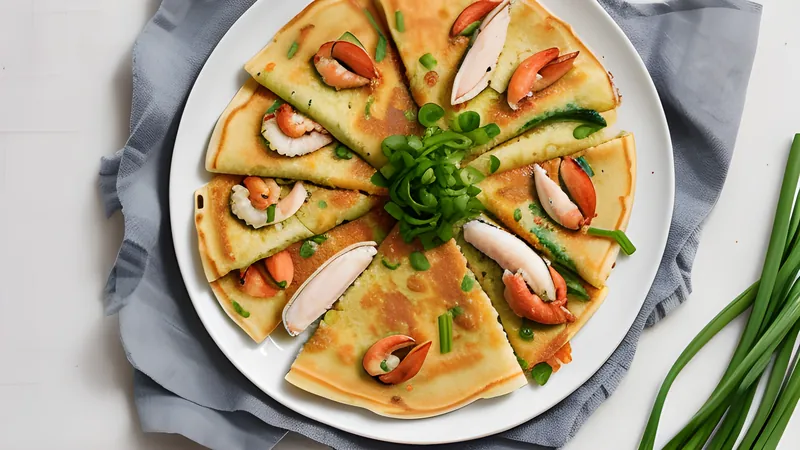
It pairs naturally with other Korean pancakes and small plates on a shared table. Serving it alongside haemul pajeon gives a genuinely useful side-by-side comparison of two completely different pancake traditions within the same cuisine — one built on ground legumes, one on a thin wheat-and-rice batter — and a bowl of quick kimchi on the side echoes the fermented cabbage already inside the pancake without repeating it exactly.
Common mistakes worth naming
Under-soaking the beans is the single most frequent problem, and it’s easy to miss because the beans can look plump and ready well before they actually are. Test by pressing one between two fingers — it should give with almost no resistance. If there’s still a firm core, give the beans another hour or two; a blender pushed to compensate for under-soaked beans will overheat and produce a warm, slightly cooked-tasting paste rather than a clean one.
Batter that’s too wet is the second common issue, usually from adding water to make blending easier rather than to hit a specific consistency. The bean paste should hold its shape in a spoon rather than pour freely — if it’s runny, the pancake spreads too thin in the pan and loses the substantial, almost fritter-like texture that defines bindaetteok. Add water in small increments only, and stop as soon as the blender can turn over the mixture at all.
Overcrowding the pan is worth naming too. Bindaetteok needs room to hold its disc shape and enough contact with hot oil across its whole surface — a pan with two pancakes touching or crammed at the edges cooks unevenly and makes flipping harder than it needs to be. Fry one or two at a time in a properly sized pan rather than trying to rush the batch.
Variations across the country
Away from Gwangjang Market, home versions of bindaetteok vary more than the market stalls suggest. Some cooks fold in a spoonful of gochugaru directly into the batter rather than relying entirely on the dipping sauce for heat, giving the pancake itself a faint red tint and a background warmth. Others add a small amount of glutinous rice flour to the blended bean paste to firm up the structure slightly, useful if your beans didn’t soak quite long enough and the paste is looser than you’d like.
A vegetarian version, dropping the pork entirely and doubling the bean sprouts and kimchi, is common in Buddhist temple cooking and in home kitchens during periods of meat scarcity historically — it loses some richness but keeps the essential character of the dish intact, since the beans themselves are doing most of the structural and flavour work regardless of what’s folded in around them. Whichever direction you take it, the bean paste itself should remain the dominant flavour — additions are there to support it, not compete with the specific nutty, slightly sweet taste that properly soaked and blended mung beans give the finished pancake.
Storage and make-ahead
The raw batter keeps in the fridge for up to two days, covered, and if anything develops slightly more flavour as the bean paste sits and the kimchi’s juices work through it further — just give it a stir before frying since it separates a little. Cooked pancakes are best eaten the day they’re made; refrigerate leftovers for up to two days and reheat in a dry pan over medium heat rather than a microwave, which leaves the crust soft and slightly damp instead of restoring the crisp exterior the dish depends on.
Related Content