Bienenstich: The Bee Sting Cake With Almond Caramel
Yeast dough, a caramel lid, and a cardamom custard that earns its keep
Contents
↓ Jump to recipeThere are two stories about the name and both of them are almost certainly nonsense, which has never stopped anyone from telling them.
The first says that in 1474 the free city of Andernach was attacked by soldiers from Linz, and two apprentice bakers, having nothing else to hand, hurled beehives down from the walls. The attackers fled. The town baked a cake to celebrate. The second, more modest, says a baker was stung by a bee that came for the honey glistening on top of his tray. Neither is recorded anywhere near the fifteenth century; the name Bienenstich first shows up in print around 1900, roughly 425 years after the beehive incident it supposedly commemorates. What actually happened is that somebody made a very good cake and somebody else invented a story to sell it, and the story has outlived every baker involved.
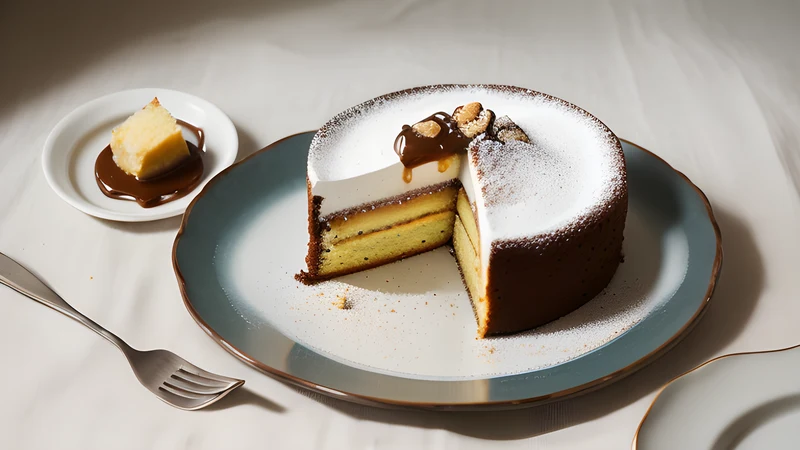
The cake deserves both. It is a strange, specific object — an enriched yeast dough, closer to a brioche than a sponge, baked with a honey-almond caramel poured directly onto the risen dough so that the two fuse in the oven, then split and filled with several centimetres of vanilla custard. Three completely different textures in a single slice, and none of them shares a technique with the others.
Bienenstich: The Bee Sting Cake With Almond Caramel
Ingredients
- 375 g strong white bread flour
- 7 g fast-action dried yeast
- 50 g caster sugar
- 1 tsp fine salt
- 160 ml whole milk, warmed to 37°C
- 1 large egg
- 70 g unsalted butter, soft, in small pieces
- 90 g unsalted butter, for the topping
- 90 g caster sugar, for the topping
- 60 g runny honey
- 60 ml double cream
- 1 pinch fine salt, for the topping
- 150 g flaked almonds
- 500 ml whole milk, for the custard
- 12 green cardamom pods, cracked
- 1 vanilla pod, split
- 6 large egg yolks
- 120 g caster sugar, for the custard
- 45 g cornflour
- 40 g unsalted butter, cold, for the custard
- 300 ml double cream, very cold
Method
- Make the custard first. Bring the 500 ml milk, cracked cardamom pods and split vanilla pod to a bare simmer, take off the heat, cover, and infuse for 30 minutes. Strain out the pods.
- Whisk the yolks, 120 g sugar and cornflour to a smooth paste. Reheat the infused milk to a simmer and pour a third of it onto the yolks, whisking hard, then return everything to the pan.
- Cook over medium heat, whisking constantly, until it thickens and then bubbles lazily — about 3 minutes. Keep whisking through 90 seconds of bubbling to cook out the cornflour. Off the heat, beat in the 40 g cold butter. Push through a sieve into a shallow dish, press clingfilm onto the surface, and chill for at least 4 hours.
- Mix the flour, yeast, 50 g sugar and 1 tsp salt in a stand mixer bowl. Add the 160 ml warm milk and the egg and knead with a dough hook for 5 minutes. Add the 70 g soft butter a piece at a time and knead for a further 8 minutes, until the dough is smooth, glossy and pulls cleanly from the bowl.
- Prove in a covered bowl at room temperature for 75 minutes, until roughly doubled. Line the base of a 26 cm springform tin and butter the sides. Press the dough evenly into the tin, cover, and prove a second time for 40 minutes.
- For the topping, melt the 90 g butter with the 90 g sugar, honey, cream and pinch of salt in a small pan. Bring to the boil and cook for 4 minutes, stirring, until it reaches 110°C and turns pale gold. Off the heat, stir in the flaked almonds. Cool for 10 minutes.
- Heat the oven to 180°C. Spoon the warm almond mixture over the proved dough and spread gently to the edges with a wet spoon, without deflating it.
- Bake for 28–30 minutes, until the topping is deep amber and set. Cool in the tin for 15 minutes, release the sides, and cool completely on a rack.
- Cut the cold cake into 12 wedges, then split each wedge horizontally with a serrated knife. Whip the 300 ml cream to firm peaks. Beat the chilled custard smooth with a spatula, then fold the cream through it in three additions.
- Pipe or spoon a 2 cm layer of the cream onto each bottom wedge and replace the caramel lids. Chill for 1 hour before serving.
The three components and why they fight
Understanding Bienenstich means understanding that you are baking three things at once with incompatible requirements.
The dough wants a long, gentle prove and a moderate oven. The caramel wants high heat to reach amber. The two are on top of each other, so the topping is doing its browning in the same 30 minutes that the dough is doing its rise and set. This is why the topping is pre-cooked to 110°C on the hob before it goes on: it arrives in the oven already most of the way there, and only needs to finish. Spoon a raw butter-sugar-almond mixture onto raw dough and you will pull out a pale, wet lid over an overbaked base.
The custard, meanwhile, cannot go anywhere near heat and must be made hours ahead. So the order is fixed: custard first, then dough, then topping, then assembly. Trying to run these in parallel is how a Sunday afternoon disappears.
The dough
This is a Hefeteig — German enriched yeast dough — and the butter is the complication. Seventy grams into 375 g of flour is enough to coat the gluten strands and slow their development considerably, which is why the butter goes in after five minutes of kneading rather than at the start. Build the gluten network first, then enrich it. Add the butter at the beginning and you will still be kneading in twenty minutes.
The dough should end up smooth, slack and slightly tacky, and it should pull away from the bowl in one piece while still sticking lightly to the base. If it is dry, add milk a tablespoon at a time; flour absorbency varies more than any recipe admits.
Press it into the tin rather than rolling it. Rolling degasses the first prove and toughens the crumb, and this dough is soft enough to push into the corners with your fingertips in about a minute. Get it even — a base that is thicker at the edges bakes into a rim you cannot split cleanly.
The second prove is only 40 minutes and it should be visibly puffy without being fully doubled. It has more rising to do in the oven, and a fully proved base collapses under the weight of 300 g of hot caramel.
The caramel lid
Butter, sugar, honey, cream, salt, boiled to 110°C, almonds folded in. That temperature is the number to trust, and it is worth a thermometer.
Below about 105°C there is too much water left in the mixture and it will soak into the dough during baking, leaving a soggy seam. Above 115°C the sugar has concentrated too far and the topping sets hard as glass once cold — it will shatter under a knife and take the cake with it. At 110°C you land in soft-ball territory, and after 30 minutes in the oven the lid is firm enough to lift as a single piece and yielding enough to bite through.
The honey is a functional ingredient rather than a flavouring. It is roughly 40% fructose, and fructose browns at a lower temperature than sucrose and stays hygroscopic as it cools, so it keeps the topping pliable and drives the colour. Golden syrup is the closest substitute and it will taste flatter; the floral notes of a decent honey are the loudest thing in the finished cake.
Cool the mixture for ten minutes before it goes on the dough. Straight off the boil it will kill the yeast on contact and melt the surface of the prove into a crater.
The cardamom, which is my addition
Traditional Bienenstich custard is vanilla, full stop. I infuse the milk with twelve cracked cardamom pods alongside the vanilla, and I would not go back.
The logic is that the topping is already carrying honey and almond — both floral, both aromatic, both leaning sweet — and a plain vanilla custard underneath simply agrees with them. Cardamom brings 1,8-cineole and terpinyl acetate, which read as camphor and citrus, and they cut across the honey at an angle. The custard stops being the soft neutral layer and starts being an argument. Northern Europe has known this pairing for centuries — the entire Scandinavian bun tradition is built on cardamom against sweet dough — and Germany, for reasons of pure convention, left it out of this cake.
Twelve pods, cracked with the flat of a knife, thirty minutes off the heat. Do not grind them; ground cardamom in a custard tastes dusty and it will not strain out.
Diplomat cream, which beats plain custard
The filling here is a diplomat: pastry cream beaten smooth and folded with an equal-ish volume of whipped double cream. Many German recipes use straight Konditorcreme, and the diplomat is better for a specific reason.
Pastry cream stiffened with 45 g of cornflour is stable and sliceable and it is also dense, and a 2 cm layer of it makes a heavy slice. Folding in whipped cream lightens the texture without losing structure, because the cornflour matrix is still doing the load-bearing. You get a filling that holds a clean edge when cut and eats like something much lighter than it is.
The order matters. Beat the cold pastry cream smooth on its own first — it will have set to a rubbery block in the fridge and it will look ruined; thirty seconds with a spatula brings it back to a glossy paste. Fold the whipped cream in after that. Whisk them together at the same time and you will knock the air straight out.
Failure modes
The topping slides off in one sheet. The dough was over-proved, so the surface was too fragile to bond. The caramel needs to sink slightly into the dough during baking to anchor.
The custard is grainy. The eggs scrambled. Temper properly — a third of the hot milk into the yolks while whisking hard — and push the finished cream through a sieve regardless. The sieve is not an admission of failure; every pastry kitchen does it.
The custard is loose. You stopped when it thickened. Cornflour needs to actually boil to reach full viscosity and to destroy the alpha-amylase in the egg yolks, which otherwise digests the starch as it sits and turns your set custard to soup overnight. Ninety seconds of visible bubbling. Whisk continuously through it.
Splitting tears the base. Cut the cake into wedges before splitting them, and split each wedge individually with a serrated knife. Trying to halve a whole 26 cm cake horizontally, with a brittle caramel lid on top, is a fight you will lose.
The case against, honestly
Bienenstich asks for a full day and it does it in stages that cannot be compressed. The custard needs four hours in the fridge before it will hold a fold, the dough needs nearly two hours of proving, and the assembly happens at the end when you are tired. There is no version of this that fits into an afternoon.
It is also sweet, and the cardamom only pushes back so far. There are 260 g of sugar in the cake before the honey arrives, and no acid anywhere — no fruit, no citrus, nothing to reset the palate between bites. A slice is a commitment and a second slice is rare. If that bothers you, a sharp coffee alongside is doing more work than it appears to be.
And it is fragile in a way that photographs badly. The caramel lid cracks along the almond lines when you bite, the custard bulges at the sides under pressure, and a wedge that looked immaculate on the board looks eaten halfway through the first mouthful. This is a cake that tastes considerably better than it behaves, which is probably why it has never travelled the way the Black Forest gateau did.
Variations that exist in Germany
Buttercreme filling. Older and still common in traditional Konditoreien, especially in the south: German buttercream, made by beating soft butter into cooled pastry cream. It is richer, holds at room temperature for hours, and it is the version most Germans over sixty remember. Use 200 g of soft butter beaten into the chilled custard in place of the whipped cream.
Sheet-pan Bienenstich. The bakery format. The same quantities pressed into a 30 x 20 cm tin, baked for 25 minutes, cut into squares and split. Faster, easier to portion, and the ratio of caramel to dough goes up because the base is thinner.
Hazelnut. Flaked hazelnuts in place of almonds, which is a Rhineland habit. They toast darker and taste stronger, and they want the topping pulled at 108°C rather than 110°C to compensate for the extra browning in the oven.
Storage
Filled, it is a two-day cake at most, and it is at its best about four hours after assembly. The caramel is hygroscopic, so it slowly draws moisture out of the air and out of the custard beneath it, and by day three the lid has gone tacky and the almonds have lost their snap.
The base and topping, unfilled, keep well for two days under a cloth at room temperature and freeze for a month. The custard keeps three days in the fridge. Assembling on the day is the way to run this.
Refrigeration hardens the yeast dough — the starch retrogrades exactly as it does in bread — so take the cake out 30 minutes before serving.
Where it sits
Buchteln use nearly the same enriched dough and prove the point that German baking treats yeast as a pastry ingredient rather than a bread one. Semlor run the cardamom-almond-cream argument in Swedish, and rather more confidently than Germany manages.
For the other end of German celebration baking, Schwarzwälder Kirschtorte does everything this cake refuses to — sponge, alcohol, sour fruit, chocolate. And Bündner Nusstorte is the Alpine cousin of the caramel lid, with the sugar taken considerably darker.
Flaked almonds, never nibbed. The flakes lie flat and lacquer; nibs sink.
Related Content