Crisp Belgian Waffles with Pearl Sugar
Light within, crunchy without
Contents
↓ Jump to recipeForget the thin batter poured from a jug; a true Liege-style Belgian waffle is made from a soft, enriched yeast dough, closer to a brioche than a pancake. The twist that defines it is pearl sugar, sturdy nuggets that stay intact through mixing and then caramelise in the hot iron, studding the waffle with pockets of crunch and golden, toffee-like edges. The inside stays tender and light. Eaten warm and plain, they need nothing more, which is exactly what makes them so dangerous to have around: there is no toppings step to slow you down between the iron and your mouth.
Crisp Belgian Waffles with Pearl Sugar
Ingredients
- 350g strong white bread flour
- 7g fast-action dried yeast
- 2 tbsp caster sugar
- 0.5 tsp salt
- 200ml whole milk, warmed
- 2 large eggs
- 150g butter, melted and cooled
- 1 tsp vanilla extract
- 150g pearl sugar
Method
- Whisk the flour, yeast, caster sugar and salt together in a large bowl.
- Beat the warm milk, eggs, melted butter and vanilla together, then pour into the dry ingredients and mix to a thick, sticky dough.
- Cover the bowl and leave in a warm place for 1 to 1.5 hours, until risen and bubbly.
- Knock back the dough gently, then fold in the pearl sugar so it is evenly distributed.
- Heat a waffle iron and brush lightly with oil or melted butter.
- Place a generous spoonful of dough in the centre of each section and close the iron.
- Cook for 4 to 5 minutes, until deep golden and the sugar at the edges has caramelised. Avoid opening too early.
- Lift out carefully and serve straight away, while the caramelised sugar is crisp. Repeat with the remaining dough.
The Story
Belgium has more than one famous waffle, and the distinction matters. The light, deep-pocketed waffle dusted with icing sugar and served with fruit is the Brussels waffle, made from a pourable batter. The waffle in this recipe is its richer cousin, the Liege waffle, named for the city in eastern Belgium and built from a dense, sweet yeast dough. It is denser, chewier and altogether more indulgent, and it is the style most often sold warm by street vendors as a handheld treat.
The ingredient that defines the Liege waffle is pearl sugar, also called nib sugar. These are hard, irregular white nuggets of compressed sugar, far coarser than granulated, that do not dissolve when folded into the dough. As the waffle cooks against the hot iron, the sugar at the surface melts and caramelises into crunchy, golden, faintly bitter pockets, while the pieces in the centre stay intact and add bursts of sweetness and texture. No ordinary sugar can reproduce this effect, which is why pearl sugar is worth seeking out from Continental delis or online.
The dough itself is an enriched yeast dough, rich with butter and egg, which gives the waffles their tender, almost brioche-like crumb. Allowing it to prove develops both flavour and the airy structure that keeps the inside light despite the dough being substantial. Unlike batter waffles, which are mixed and cooked in minutes, a Liege waffle rewards a little patience.
Cooking them well comes down to heat and restraint. The iron needs to be properly hot so the sugar caramelises rather than simply melting, and the lid should stay closed for the full few minutes; opening it too soon can tear the soft dough before it has set. The sugar that escapes and caramelises on the plates is normal, though it is worth wiping the iron between batches so it does not burn.
Why the dough behaves the way it does
The single most useful thing to understand here is that this is bread dough, not batter, and it should be treated as such. Strong white bread flour matters: its higher protein content builds the gluten network that traps the gas from the yeast and gives the waffle its chew. Plain flour will work in a pinch but produces a softer, cakier result that loses the characteristic pull. The dough should come together thick and sticky rather than pourable; if it looks like a slack cake batter you have too much liquid, and the pearl sugar will simply sink rather than staying suspended.
The prove is doing two jobs. Yeast is producing carbon dioxide, which is what lightens the crumb, but it is also producing acids and alcohols that deepen the flavour, which is why a properly proved dough tastes faintly of brioche rather than of plain flour and sugar. An hour to ninety minutes in a warm spot is usually enough; you want the dough visibly risen and bubbly, not doubled to the point of collapse. If your kitchen is cold, put the covered bowl somewhere gently warm, such as near (not on) a radiator or in an oven with only the light on. Rushing the prove with too much heat kills the flavour and can knock back the rise.
Fold the pearl sugar in only after the first prove, at the knock-back stage. Add it earlier and the sugar starts drawing moisture from the dough and beginning to dissolve, which robs you of those distinct caramel pockets. Fold gently and just enough to distribute it; you are not trying to develop more gluten at this point, only to spread the sugar evenly so every waffle gets its share.
What goes wrong, and how to fix it
The two failures I see most often are pale, floppy waffles and waffles welded to the iron. Pale and floppy almost always means the iron was not hot enough: the sugar needs real heat to caramelise, and without it you get a bendy, undercooked waffle with no crunch. Let the iron come fully up to temperature and resist the urge to lift the lid to peek. Sticking, on the other hand, comes from the escaped sugar burning onto the plates, so brush lightly with oil or melted butter before the first waffle and wipe the plates with kitchen paper between batches once they have cooled a little.
If your waffle iron has a temperature dial, a medium-high setting suits this dough better than the maximum; too fierce and the outside scorches before the enriched centre has cooked through. A deep, even golden-brown with dark caramel flecks at the edges is what you are aiming for. The first waffle off the iron is often a sacrifice to the gods of seasoning and heat, so do not judge the batch by it, and treat it as the cook’s reward for standing at the iron.
Portioning matters more than you would expect. A generous spoonful in the centre of each section is right; the dough spreads as it cooks, so overfilling forces sticky dough and molten sugar out of the sides, where it burns onto the plates and welds the lid shut. If your first waffle comes out with bald, unfilled patches, add a little more next time; if sugar erupts everywhere, add a little less. The classic Liege waffle is thick and irregular in outline rather than a neat square filled to the corners, so do not chase a perfectly even shape. A slightly ragged, caramel-crusted edge is the sign of a waffle made properly, not a fault.
Serving, storing and variations
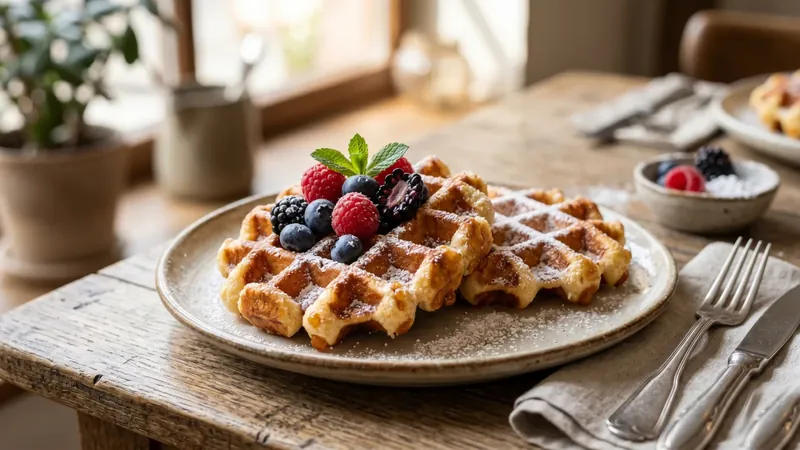
Because the sweetness and crunch are built into the waffle, it needs no syrup or elaborate toppings to be delicious; many Belgians eat them entirely plain, warm from the iron. A dusting of icing sugar, a few fresh berries or the smallest scoop of ice cream are all welcome, but the waffle itself is the point. If you do want to gild them, keep it simple: warm chocolate, a spoon of thick cream, or macerated summer fruit.
These are unequivocally best straight from the iron, when the caramelised sugar is still brittle. They soften as they cool, so if you are feeding a crowd, keep cooked waffles warm in a single layer on a rack in a low oven at 120C rather than stacking them, which traps steam and makes them go limp. Cold leftovers can be revived in a hot oven or a fresh pass through the iron; the microwave is a false friend that turns them chewy and damp.
The dough itself freezes well after the first prove: portion it, freeze on a tray, then bag it and thaw in the fridge before folding through the sugar and cooking. For a simpler cousin without the yeast dough and the prove, the thin, lemony batter of lemon sugar crepes delivers a different kind of pleasure entirely, while the dramatic oven-risen Dutch baby pancake with lemon and powdered sugar is the breakfast to make when you want the show of a waffle without owning an iron. Pearl sugar itself, once you have a bag, earns its keep folded into brioche buns and cinnamon rolls too, so it is rarely a wasted purchase.
Related Content