Beef Stroganoff with Smoked Paprika and Cornichons
Silky, tangy and quick
Contents
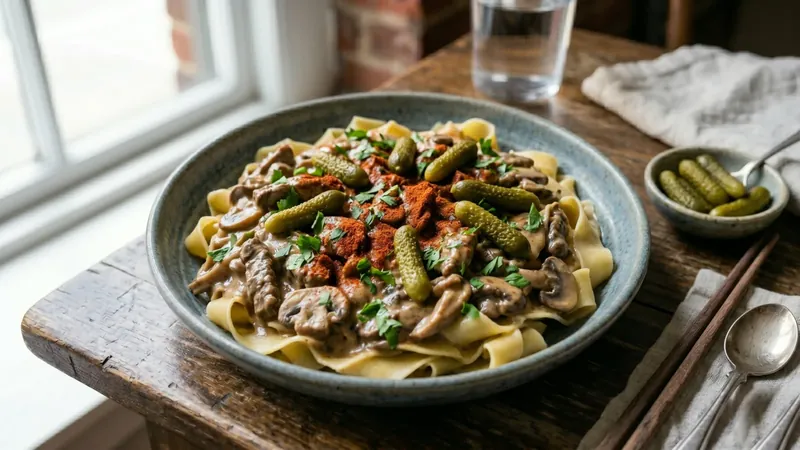
↓ Jump to recipeStroganoff can taste rather one-note, all cream and beef, so this version sharpens it. Smoked paprika lends a warm, gently smoky backbone, while a handful of finely chopped cornichons stirred in at the end brings a clean, briny snap that cuts straight through the soured cream. It is still quick, still silky, but brighter and more interesting, ready in under half an hour.
Beef Stroganoff with Smoked Paprika and Cornichons
Ingredients
- 600g beef fillet or sirloin, cut into thin strips
- 2 tbsp plain flour
- 1 tsp smoked paprika, plus extra to finish
- 3 tbsp butter
- 1 tbsp olive oil
- 1 onion, finely sliced
- 300g chestnut mushrooms, sliced
- 2 garlic cloves, crushed
- 1 tbsp Dijon mustard
- 250ml beef stock
- 150ml soured cream
- 4 cornichons, finely chopped
- Small handful of parsley, chopped
- Salt and black pepper, to taste
Method
- Toss the beef strips with the flour, smoked paprika and a good pinch of salt and pepper.
- Heat 1 tbsp butter and the oil in a large frying pan over a high heat and sear the beef in batches for about 1 minute until browned. Set aside.
- Lower the heat, add another knob of butter and cook the onion for 5 minutes until soft.
- Add the remaining butter and the mushrooms, and fry for 6-7 minutes until golden. Stir in the garlic for 1 minute.
- Stir in the Dijon mustard, then pour in the stock and let it bubble and reduce for 3 minutes.
- Lower the heat and stir in the soured cream until smooth. Do not let it boil hard.
- Return the beef and any resting juices to the pan and warm through for 1-2 minutes.
- Stir in the chopped cornichons, then taste and season.
- Scatter with parsley and a dusting of smoked paprika, and serve with rice or buttered noodles.
The story
Beef stroganoff is one of those dishes that has travelled so far from home it is almost unrecognisable from its origins. It emerged in nineteenth-century Russia and takes its name from the Stroganov family, an immensely wealthy dynasty of merchants and statesmen. The first widely cited printed recipe appears in the 1871 edition of Elena Molokhovets’s Russian cookery classic A Gift to Young Housewives, under the name govyadina po-strogonovski, describing lightly floured cubes of beef in a mustard and soured-cream sauce. It was refined, restaurant-adjacent cooking, a world away from peasant fare, and a competition dish attributed to a chef in the Stroganov household is often named as the immediate origin.
What is striking is how restrained those original versions were. There were no mushrooms and no onions in Molokhovets’s recipe, just beef, flour, a little mustard, bouillon and soured cream, finished simply. The mushrooms, onions and the now-familiar bed of noodles or rice were added later as the dish spread, picking up local habits wherever it landed. Émigrés and hotel chefs carried it out of Russia after the 1917 revolution, and by the mid-twentieth century it had become a staple across Europe and North America, and a fixture of dinner parties on both sides of the Atlantic, sometimes to its detriment as it slid into bland, over-creamed versions.
That history explains why two ingredients here feel entirely at home rather than forced. Mustard was part of the dish from the very beginning, so leaning on it is a return to roots rather than an invention. And soured cream, smetana in Russian, is the defining element, the thing that gives stroganoff its characteristic tang and silk.
Why the technique works
Two rules govern a good stroganoff, and both are about heat. The first concerns the soured cream. It behaves better than fresh cream over heat, splitting less readily thanks to its lower pH and the stabilising effect of its cultures, but it will still curdle if you boil it hard; add it off a rolling boil, stir it in over gentle heat, and never let it bubble aggressively once it is in. If you are nervous, stir a spoonful of the hot sauce into the soured cream first to temper it, then add it back. The second rule is speed with the beef. Use a tender cut such as fillet or sirloin, slice it thinly across the grain, sear it hot and fast in batches so it browns rather than stews, and return it to the pan only to warm through at the end. Cook it long and it will seize and toughen, undoing the whole point of a dish built for quick, last-minute cooking. This makes stroganoff the fast, weeknight cousin of a long-braised beef bourguignon, the same instinct for silky beef reached by the opposite route.
The twists draw on the same northern and eastern European pantry. Smoked paprika, more Spanish and Hungarian than Russian in its smoky form, adds warmth and a subtle savoury edge that flatters seared beef; the same ingredient does similar work in a chorizo and white bean stew, where smoke and richness balance each other. Cornichons, the tiny tart gherkins, are a natural partner to rich, creamy meat dishes, where a little acidity stops the whole thing feeling heavy. Chopped small and stirred in at the very end, they keep their crunch and scatter little bursts of brine through the sauce.
Substitutions, storage and serving
If you cannot get soured cream, crème fraîche works well and is even more stable over heat; full-fat Greek yoghurt will do at a pinch but must be kept well below a simmer. Swap the chestnut mushrooms for a mix of wild mushrooms in autumn, or add a soaked handful of dried porcini and their strained liquid for extra depth. No cornichons, a squeeze of lemon or a splash of the gherkin brine restores the acidity, though you lose the crunch. For a richer version, deglaze with a splash of brandy before the stock goes in.
Stroganoff is best eaten straight away, while the beef is just cooked and the sauce silky; it does not sit or reheat gracefully because the cream can split and the beef overcooks on a second heating. If you must make it ahead, cook everything up to the point before the soured cream, cool it, then reheat gently and stir the cream in fresh at serving time. Serve with buttered noodles, rice, or mash, a dusting of smoked paprika and plenty of chopped parsley.
Getting the mushrooms and the sauce right
The mushrooms deserve more care than they usually get. Sliced too thin and crowded into a lukewarm pan, they leach water, boil in their own liquid and turn to grey slippers; you want them golden and a little caramelised, so cook them in a hot pan with enough space, in two batches if your pan is small, and salt them only once they have taken colour. Salting early draws the water straight out and stalls the browning. Getting a proper sear on the mushrooms builds a savoury, almost meaty depth that the soured cream then softens rather than smothers.
The sauce itself wants to be loose enough to coat the beef and pool a little around the noodles, not claggy. If it looks thick before the cream goes in, loosen it with a splash more stock; if it is thin, let it reduce a minute longer before you lower the heat for the cream. The flour that coated the beef will have carried into the pan and does most of the thickening, which is deliberate, so there is rarely any need for extra. Taste right at the end and adjust: a stroganoff usually wants a touch more salt than you expect to lift the tang of the cream and the smoke of the paprika, and a final grind of black pepper.
A note on the beef
Fillet is the luxurious choice and cooks in barely a minute, but a well-trimmed sirloin or rump is more than good enough and stands up better to the pan. Whatever you use, slice it into short, finger-width strips across the grain and keep the pieces roughly even so they cook at the same rate. Pat the strips dry before they hit the flour, because a damp surface steams and refuses to brown, and get the pan genuinely hot before the first batch goes in. Crowding the pan is the usual undoing: pile in all 600g at once and the temperature crashes, the meat releases its juices and boils grey instead of searing, so work in two or three batches and let the pan recover its heat between them. Resist the urge to prod and turn the strips constantly; leave them to take colour on one side for the best part of a minute before flipping, which is where the flavour comes from. The whole dish comes together in under half an hour, which is exactly why it earned its place at so many mid-week and dinner-party tables alike: proper, satisfying cooking that asks for speed and attention rather than a free afternoon.
Related Content