Beef Stroganoff: The Russian Mustard and Soured Cream Sauté
Fifteen minutes of cooking, a hard sear, and soured cream that never sees a boil
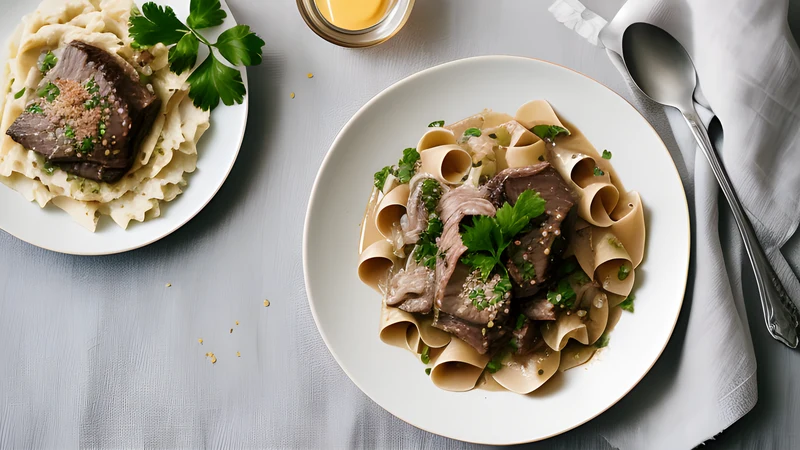
Contents
↓ Jump to recipeBeef Stroganoff spent the second half of the twentieth century being ruined. It became a school-dinner stew: cubes of chuck simmered for an hour, a tin of mushroom soup, a whisper of paprika, served over rice in a pale grey slick. That version has almost nothing to do with the dish, and it is why most British cooks under fifty think they dislike it. The soured cream here behaves exactly as it does in machanka — it wants gentle heat and it will punish a boil.
The real thing is a sauté. The beef is in the pan for 75 seconds. The whole cook is under fifteen minutes and the sauce is built in the same pan while the meat rests. Treat it as a stew and you have made something else.
Beef Stroganoff: The Russian Mustard and Soured Cream Sauté
Ingredients
- 700g beef fillet tail or sirloin, trimmed
- 1 tsp fine sea salt
- 1/2 tsp black pepper, freshly ground
- 2 tbsp sunflower oil
- 40g unsalted butter
- 2 medium onions, sliced 4mm thick
- 300g chestnut mushrooms, quartered
- 1 tbsp plain flour
- 2 tbsp Russian or Dijon mustard
- 100ml dry white wine or dry sherry
- 250ml beef stock, hot
- 250g soured cream, at least 20% fat, at room temperature
- 1 tsp lemon juice
- 20g flat-leaf parsley, chopped
- 600g floury potatoes, for straw potatoes
- 800ml sunflower oil, for frying the potatoes
Method
- Cut the beef across the grain into slices 1cm thick, then cut each slice into batons 1cm wide and 5cm long. Pat completely dry with kitchen paper and season with the salt and pepper.
- Cut the potatoes into 3mm matchsticks, rinse in cold water for 2 minutes, then dry very thoroughly. Heat the frying oil to 180C and fry the matchsticks in three batches for 3-4 minutes each until golden and crisp. Drain on a rack and salt at once.
- Heat a wide heavy frying pan over the highest heat for 2 minutes. Add 1 tbsp of the sunflower oil and, when it shimmers, add half the beef in a single layer with space between the pieces.
- Sear for 45 seconds without moving, turn, and sear 30 seconds more. Remove to a warm plate. Repeat with the remaining oil and beef. The beef should be brown outside and rare within.
- Lower the heat to medium. Add the butter and the sliced onions to the same pan and cook for 6 minutes until soft and golden, scraping the browned fond off the base as they release moisture.
- Raise the heat, add the mushrooms and fry for 5 minutes until browned and dry.
- Stir in the flour and cook for 1 minute. Add the mustard, then the wine, and let it bubble hard for 1 minute, stirring, until syrupy.
- Pour in the hot stock and simmer for 3 minutes until it coats the back of a spoon.
- Take the pan off the heat entirely. Wait 1 minute, then stir in the soured cream and the lemon juice until smooth.
- Return the beef and any resting juices to the pan and stir over the lowest heat for 60 seconds, without letting it bubble. Taste and correct the salt.
- Stir through half the parsley. Serve immediately over the straw potatoes, scattered with the rest.
The count, and the chef
The dish is named for the Stroganovs, one of the wealthiest families in imperial Russia — salt merchants who bankrolled the conquest of Siberia and ended up with more land than several European countries. The specific Stroganov is usually given as Count Alexander Grigorievich Stroganov, who kept an open table in Odessa in the 1860s where any respectably dressed person could turn up and eat.
The dish appears in print for the first time in the 1871 edition of Elena Molokhovets’s A Gift to Young Housewives, under Govyadina po-strogonovski s gorchitseyu — beef Stroganov style, with mustard. That recipe is instructive: cubed beef, mustard, bouillon, and soured cream, with no mushrooms and no onions at all. The chef was probably a Frenchman named Charles Brière working in the Stroganov kitchen, who entered a version in a Saint Petersburg cooking competition in 1891.
The most-repeated origin story — that the count had lost his teeth and needed his beef in small pieces — is charming and almost certainly invented after the fact. The likelier explanation is that small pieces cook in a minute, and a household serving an unpredictable number of drop-in guests needed a dish that could be made to order at speed. Stroganoff is designed for restaurant service, which is exactly why it collapses when you treat it as a braise.
Mushrooms and onions arrived later, via the Soviet canteen and the American dinner party. I keep them because they are good. The mustard is original and non-negotiable.
Cut and dryness
Use fillet tail, which is the tapering end of the fillet, cheaper than the middle and identical in tenderness. Sirloin works and has more flavour. Rump is acceptable if you slice it thin and across the grain. Chuck, braising steak or any other stewing cut will be tough after 75 seconds and needs 3 hours to be anything else, at which point you have made a stew.
Cut across the grain, always. The grain is the direction the muscle fibres run, and cutting across shortens them to the length of your slice, so the fork does less work than your teeth would. Cut with the grain and even fillet chews long.
Then dry the beef properly with kitchen paper. This is the step that decides whether you get a sear or a stew. Water on the surface of meat must evaporate before the surface can climb past 100C, and browning does not begin until around 140C. Wet beef in a hot pan spends its first minute boiling in its own moisture, goes grey, and toughens. A minute is all you have.
Searing in batches
Two batches, minimum, in a wide pan. Crowding is the other half of the same problem: too much cold meat drops the pan temperature below the browning threshold and floods it with released juice. Each piece wants space around it, so the steam has somewhere to go.
Get the pan properly hot first — two full minutes over the highest heat, until oil shimmers and moves like water. Then in, in a single layer, and leave it alone. Forty-five seconds untouched, turn once, thirty seconds more, out. The interior should be rare, because it is going back into a hot sauce at the end and will finish there.
Sear in oil rather than butter. Butter’s milk solids burn at the temperatures this needs. The butter comes in afterwards, with the onions, when the pan has come down.
The sauce, and the moment of danger
Everything that follows is built on the fond — the browned residue the beef left on the pan base. The onions release moisture as they soften, and that moisture lifts the fond; scrape it with a wooden spoon as they cook. That is your flavour.
The tablespoon of flour does two jobs. It thickens the sauce a little, and more importantly it stabilises the soured cream, because starch granules get physically between the casein micelles and stop them clumping when acid and heat would otherwise make them do exactly that. A floured sauce tolerates far more abuse than a plain one.
The moment of danger is the cream. Take the pan off the heat, wait a full minute for it to drop below a simmer, then stir the room-temperature cream in. Never let it bubble afterwards. Sixty seconds over the lowest flame to bring the beef back through is all it gets. If your sauce breaks into white grit and thin liquid, the pan was too hot, the cream was too cold, or the cream was too lean — 20% fat is the floor and 30% smetana is better.
The teaspoon of lemon juice at the end is not traditional and I add it every time. Two hundred and fifty grams of soured cream flattens on the palate, and the acid picks the whole pan back up.
The mustard question
Two tablespoons of mustard sounds like a lot and it is the ingredient the dish is named around — Molokhovets literally titles it “with mustard”. It is the backbone, and every version that leaves it out drifts towards a generic cream sauce.
Russian table mustard is the traditional choice and it is fierce: made from brown mustard seed, sharpened with vinegar, and considerably hotter than anything in a British supermarket. Dijon is the sensible substitute and gives a rounder, winier heat. English mustard is hotter than Russian but its heat is one-dimensional and it carries no acidity, so if it is all you have, use one tablespoon plus an extra teaspoon of lemon juice.
Add the mustard to the hot pan before the wine rather than at the end. Mustard’s pungency comes from allyl isothiocyanate, which is volatile and drives off with heat — a few minutes in the pan takes the raw nose off it and leaves the savoury, slightly bitter depth you want against the cream. Stirred in at the end, it tastes like mustard sitting on top of a sauce.
And paprika, which most British recipes insist on, appears in no nineteenth-century Russian version I can find. It arrived through Hungarian and then American intermediaries in the twentieth century. A teaspoon of sweet paprika does no harm and adds colour; smoked paprika takes the dish somewhere else entirely and I would leave it out.
The wine, and why it goes in early
A hundred millilitres of dry white wine or dry sherry, bubbled hard for a minute until it turns syrupy, does two things worth the trouble. It deglazes whatever fond the onions missed, and it adds acidity and depth that stock alone cannot.
Reduce it properly before the stock goes in. Wine added and then immediately diluted tastes raw and thin in the finished sauce — you need the alcohol gone and the volume down by about two-thirds, which takes roughly 60 seconds in a wide hot pan. The surface should look glossy and the bubbles should get lazy and large.
Dry sherry, specifically fino or a dry amontillado, is my preference and closer to what an imperial Russian kitchen would have had on the shelf. Madeira works and pushes it sweeter. Cognac, flamed, is the French restaurant flourish; it tastes good and it is showing off. Skip the wine entirely and add 50ml more stock plus an extra half teaspoon of lemon juice at the end, which gets you most of the way.
Failure modes
Grey, tough beef. Wet meat, crowded pan, or a stewing cut. In that order.
Split sauce. Heat after the cream went in. Rescue: take it off, whisk in a tablespoon of cold soured cream, and it will often come back. It will never look perfect.
Thin sauce. The stock did not reduce enough before the cream went in. It should coat a spoon at that stage, since the cream loosens it again.
Flat and beige. Underseasoned and no acid. Salt it after the cream goes in — dairy dulls salt perception — and use the lemon.
Watery mushrooms. Crowded, again. Fry them hard, in a hot pan, in one layer, until they squeak and brown.
What to serve it on
Straw potatoes are the correct answer and almost nobody does it. Molokhovets and the Russian restaurant tradition both put Stroganoff on crisp fried potato matchsticks, and it is decisively better than rice: the crunch survives about three minutes under the sauce, which is exactly the length of time it takes to eat, and the contrast is the whole pleasure. Rinse the matchsticks to wash off surface starch, dry them obsessively, and fry in three batches so the oil stays at 180C. The same technique that gives good crispy roast potatoes their shell applies here at a smaller scale.
The alternatives, in order: buttered egg noodles, which is the American convention and perfectly good; plain rice, which is the Soviet convention and absorbs everything without giving anything back; and mashed potato, which turns the plate into a single texture.
The case against, and the make-ahead problem
Stroganoff has one real flaw as a home dish: it cannot be made ahead. Reheating splits the cream and overcooks the beef, and there is no way around either. This is a cook-and-serve-immediately plate, which means fifteen minutes at the hob while your guests sit down, and I have made peace with that by doing every scrap of prep first — beef cut and dried, onions sliced, mushrooms quartered, stock hot, cream out of the fridge, potatoes fried and salted. With everything in bowls, the cooking is genuinely fifteen minutes.
The second honest point is cost. Seven hundred grams of fillet tail is not a Tuesday. Sirloin brings it down and rump brings it down further, and I would rather eat a rump Stroganoff cut properly thin than a chuck one simmered for an hour and called by the same name.
Leftovers keep two days in the fridge and reheat badly. Bring them to room temperature and warm over the lowest possible heat, stirring, accepting a slightly grainy sauce and a firmer piece of beef. It will still be worth eating for lunch, and it will not be the same dish.
Related Content