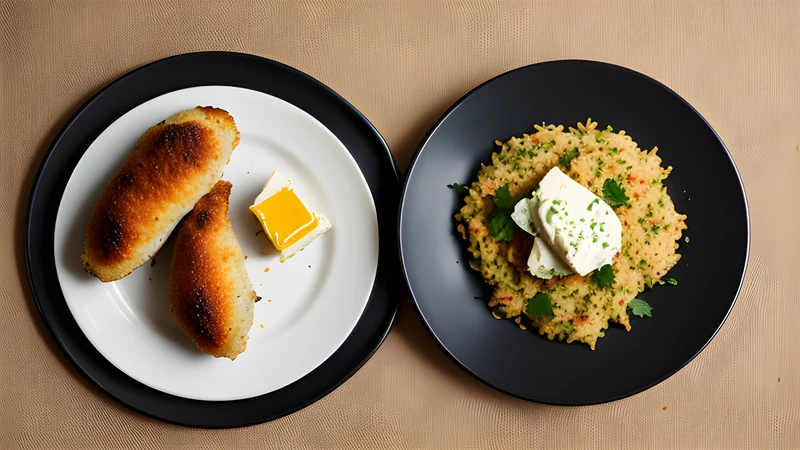
Banush: Ukrainian Cornmeal With Bryndza and Crackling
Hutsul cornmeal cooked in soured cream, with sheep's cheese and pork scratchings
Contents
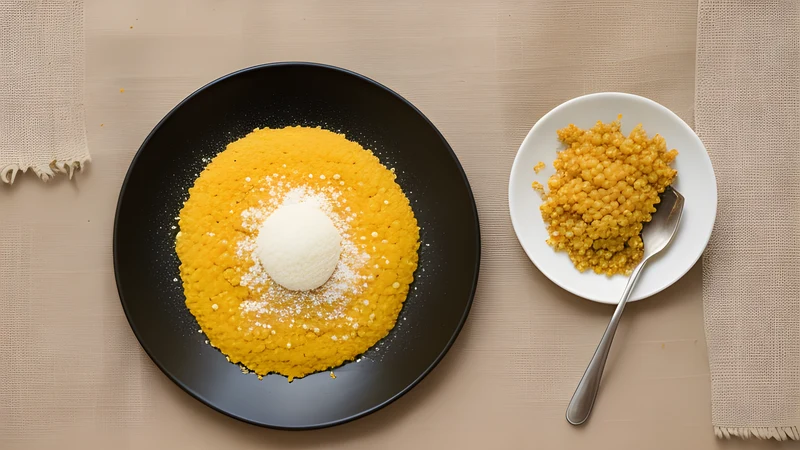
↓ Jump to recipeThere is a moment, about twenty minutes into cooking banush, when the pot changes its mind. Until then you have a pale, sulky porridge that clings to the spoon and seems determined to stay that way. Then small slicks of yellow fat start to bead on the surface, the mass begins to lift cleanly off the sides of the pan, and the whole thing turns glossy. The Hutsuls of the Ukrainian Carpathians say the banush has “given up its butter”, and that is exactly what has happened: the soured cream has broken, and the fat it was holding has come out to coat every grain of cornmeal. That released fat is the dish. Everything before it is just stirring.
Banush: Ukrainian Cornmeal With Bryndza and Crackling
Ingredients
- 600ml soured cream, 20% fat or higher, at room temperature
- 300ml whole milk
- 1 tsp fine sea salt
- 200g fine or medium yellow cornmeal (polenta), not instant
- 150g smoked streaky bacon or salt pork, cut into 1cm dice
- 1 medium onion, finely chopped
- 200g chestnut or field mushrooms, sliced 5mm thick
- 150g bryndza or young feta, crumbled
- 20g unsalted butter
- Black pepper, freshly ground
Method
- Fry the diced bacon in a cold dry frying pan over medium-low heat for 8-10 minutes until the fat runs and the pieces are crisp. Lift out with a slotted spoon onto kitchen paper and reserve the rendered fat in the pan.
- Add the chopped onion to the bacon fat and cook over medium heat for 5 minutes until soft and pale gold. Add the mushrooms, raise the heat and fry for 6-8 minutes until browned and dry. Season with a pinch of salt and set aside, keeping warm.
- Pour the soured cream and milk into a heavy-based saucepan or cast-iron pot. Add the salt. Warm over medium-low heat, stirring often, until it steams and just begins to bubble at the edges, about 6 minutes. Do not let it boil hard.
- Rain the cornmeal in with one hand while whisking constantly with the other. Keep whisking for 2 minutes until no lumps remain.
- Lower the heat to its lowest setting. Cook for 20-25 minutes, stirring with a wooden spoon every 2-3 minutes and scraping the base and corners. The mixture will thicken, pull away from the sides and eventually release visible beads of yellow fat on the surface.
- Stir in the butter and half the bryndza. Taste and add salt if needed.
- Spoon into warm shallow bowls. Top each with the mushroom and onion mixture, the remaining crumbled bryndza and the crisp bacon. Grind over black pepper and serve immediately.
What banush actually is
Banush belongs to the Hutsuls, the highland shepherds and foresters of the Carpathian ranges that run through Ivano-Frankivsk, Zakarpattia and Chernivtsi oblasts. It is cornmeal porridge, and it shares an ancestor with Romanian mămăligă and Italian polenta — maize arrived in the region from the Ottoman world during the seventeenth century and had displaced millet across the Carpathians by the eighteenth, largely because it yielded well on thin mountain soil that would not carry wheat.
The Hutsul innovation is the liquid. Mămăligă is cooked in water, sometimes salted water, and that gives you a firm, sliceable loaf of corn. Banush is cooked in soured cream, sometimes exclusively so, with no water at all. The result is richer by an order of magnitude and behaves differently in the pan: acid and fat, worked over low heat, produce a porridge that eventually splits and self-butters. A traditional Hutsul cook takes the emerging fat as the signal to stop.
Custom holds that banush should be cooked over an open fire, in a cast-iron pot, by a man, and stirred only clockwise, with a wooden spoon carved from a single piece. I am unconvinced by all four requirements but I keep the cast iron, because the thermal mass is what stops the base catching while you cook the starch long enough to break the cream. The dish appears at Christmas Eve tables, at weddings, and at the summer pastures where shepherds make it with the cream from that morning’s milk.
The toppings are equally fixed by convention: bryndza, crackling, and fried mushrooms. Bryndza is the soft, brined sheep’s-milk cheese of the Carpathian arc, sharp and grainy and aggressively salty. It is the same cheese that anchors Slovak halušky one valley to the west, which tells you how far a good cheese travels along a mountain range. The mushrooms are whatever came out of the forest — ceps in autumn, chanterelles in summer.
Getting the cream right
The single decision that governs your banush is the soured cream. It needs to be at least 20% fat; Ukrainian smetana runs to 30% and higher, and if you can find that, use it. British soured cream is typically 18-20% and works, though the split is less dramatic. Crème fraîche at 30% is an excellent substitute and splits beautifully. Low-fat soured cream will produce a thin, sad porridge that never gives up anything, because there is no fat to give.
Bring the cream to room temperature before it goes near the heat. Cold cream shocked over a hot ring will curdle instantly into grainy clots suspended in whey, which is a different failure from the controlled split you want later. What you want is a gradual warming, stirred, until it steams.
The milk is there to loosen the cream enough to take the cornmeal without seizing. Some Hutsul cooks use only cream; that version is superb and also enormous, and I find the 2:1 cream-to-milk ratio gives the same finish with a texture you can eat a full bowl of.
Cornmeal, and why grade matters
Use fine or medium yellow cornmeal — what an Italian shop sells as polenta. Coarse grind takes 45 minutes and stays gritty in a cream base, because the acid slows starch gelatinisation. Instant polenta hydrates in three minutes and gives you a smooth paste that will never split, since the whole point of the long cook is to keep working the pot while the cream slowly separates. If your polenta is done before the cream breaks, you have made a rich corn porridge and missed the dish.
The pouring technique matters more than people expect. Rain the meal in slowly, in a thin stream, whisking hard the whole time. Dumping it in creates a raft of dry meal on the surface that hydrates on the outside and seals dry powder inside, and no amount of later whisking gets those lumps out. Two minutes of vigorous whisking after the meal is in buys you a smooth pot for the next half hour.
The long low cook
Once the meal is in, drop the heat as low as your hob goes. Cornmeal is a starch slurry and it does what starch slurries do: it thickens, traps steam, and fires scalding bubbles at your forearm. A low heat and a heavy pan slow this to a manageable blurp. Stir every couple of minutes, dragging the spoon across the base and into the corners.
Watch for three stages. First the porridge thickens and turns matte. Then it starts to hold the shape of the spoon’s track for a second before closing. Finally, somewhere between 20 and 25 minutes, the surface turns shiny and yellow beads appear at the edges — most visible where the porridge meets the pan wall. That is your finish line. Two minutes more and stop.
If it never breaks, the cream was too lean or your heat was too low to drive the reaction. Push the heat up a notch for the last five minutes and stir continuously. If it breaks too early and turns greasy and loose, the heat was too high; add a splash of hot milk and beat it back together.
Failure modes worth knowing
Catching on the base. Thin pans burn banush. You will smell it before you see it, and once scorched corn is in there, the whole pot tastes of it. Heavy cast iron and a low ring prevent it; a diffuser under a thin pan is the workaround.
Setting like concrete. Banush stiffens rapidly as it cools, because gelatinised corn starch retrogrades fast. Serve it in warmed bowls straight from the pan. Leftovers set into a firm slab overnight — cut that into fingers and fry them in bacon fat until crisp, which is better than reheating.
Cheese that seizes. Adding all the bryndza to the hot pot makes it stringy and squeaks against the teeth. Half in, half on top, is the compromise: the cooked half seasons the porridge, the raw half stays in salty crumbles.
The case against
Banush is very rich. Six hundred millilitres of soured cream between four people, plus bacon fat, butter and cheese, is a plate built for a day of moving sheep between pastures. Eaten at a desk it can defeat you by the third mouthful. Serve small portions, in shallow bowls, and put something sharp alongside — pickled cucumbers, or a plain tomato salad with vinegar. The Hutsuls do this too; there is nearly always a jar of something pickled on the table.
The other honest criticism is that the toppings do the flavour work. The porridge itself is mild — corn, cream, salt — and if you skip the crackling and the mushrooms, you have a bowl of pleasant beige. Make the toppings properly or make something else.
Variations
Swap the bacon for shkvarky, the proper Ukrainian crackling rendered from cured pork fat, if you can get salo from a Ukrainian or Polish shop. Diced small and rendered slowly, it gives crisper scratchings and a cleaner fat than smoked bacon.
Dried ceps, soaked for 20 minutes in warm water and fried with the fresh mushrooms, push the whole dish towards the forest; add a tablespoon of the strained soaking liquid to the pan.
For a lighter mid-week version, cook the cornmeal in half cream and half milk and finish with a spoonful of cream stirred in at the end. It stays emulsified and creamy, and it is still very good.
A note on bryndza
Bryndza is protected in Slovakia and made across the Ukrainian Carpathians without paperwork, which means what you buy varies enormously. Real Hutsul bryndza is sheep’s milk, curdled with rennet, drained, salted hard and packed into wooden tubs, where it ferments for weeks and turns creamy, crumbly and sour. Salt content can reach 4%, which is roughly twice what a British cheddar carries. It should smell faintly of a barn on a warm day.
Ukrainian and Polish delicatessens stock it in tubs; supermarkets do not. Young feta is the closest easy substitute — same brine, same crumble, less funk — and I would rather use feta well than chase a bad imitation. Rinse feta briefly under cold water and pat it dry if it is very salty, because you are adding it to a dish that already carries bacon. Ricotta salata works if you grate it. Avoid anything that melts smoothly; the point of the cheese is that it stays in distinct salty pockets against the mild corn.
Rendering the crackling properly
Start the bacon in a cold, dry pan. This is the part people rush. Fat renders by slowly melting out of connective tissue, and it needs time at a temperature well below the point where the outside browns. Cold pan, medium-low heat, and eight to ten minutes gives you clear fat in the pan and pieces that are crisp all the way through. Hot pan and the dice seize, brown on the outside and hold soft fat inside, which eats greasy.
The rendered fat is not a by-product to pour away. It fries the onions and mushrooms, and it is what you will fry tomorrow’s cold banush fingers in. Keep any surplus in a jar in the fridge; it will hold for a month and improve most things you put a potato in — the same logic that makes duck fat roast potatoes worth the effort.
The mushrooms want a hot, dry pan and space. Crowd them and they steam in their own liquid, going grey and slippery. Fry in two batches if your pan is small. You are after browned edges, because that is where the flavour is that stands up to the cream.
Storage and make-ahead
Banush is a cook-and-eat dish. It will keep three days covered in the fridge, where it sets solid. Slice the cold block into 2cm fingers and fry in bacon fat or butter over medium heat for 4 minutes a side until a crust forms — crisp outside, molten within, and arguably a better breakfast than the original was a dinner. The mushroom topping and crackling both keep separately for three days; refresh the crackling in a dry pan for a minute before serving.
Related Content