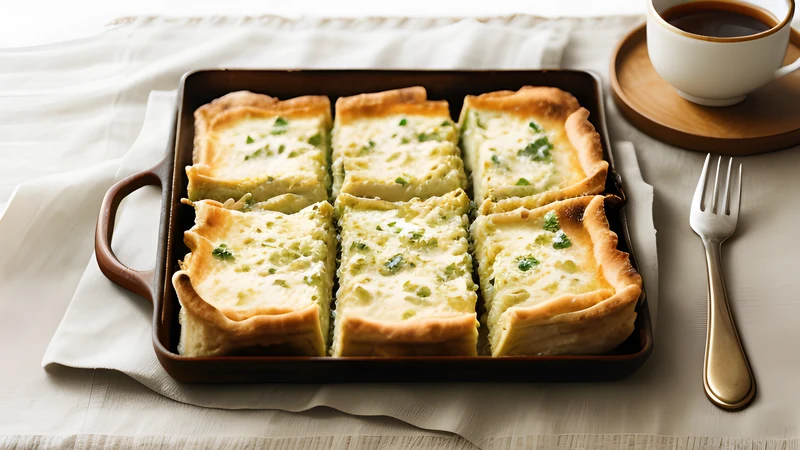
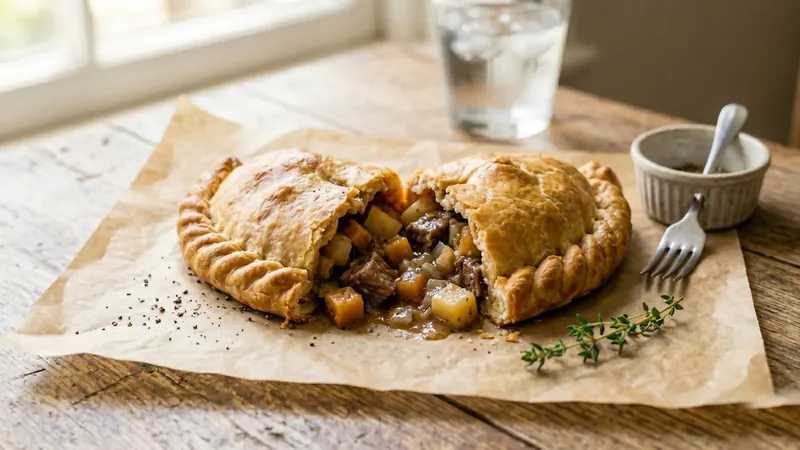
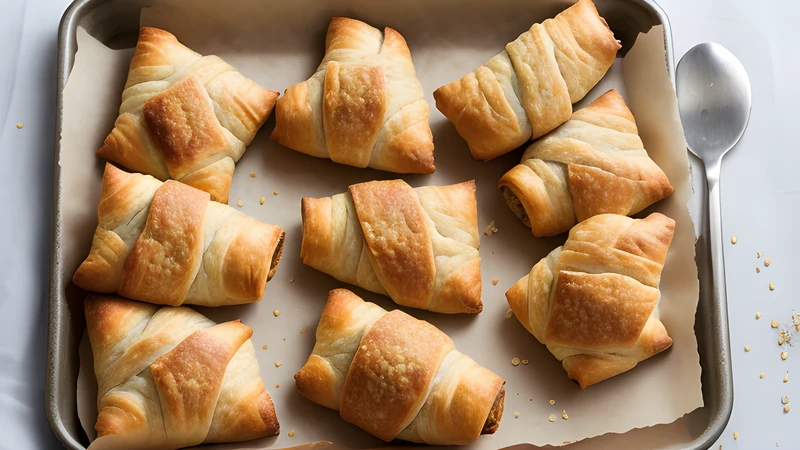
Banitsa: The Bulgarian Filo Coil With Sirene
A spiral of pastry, brined cheese and egg, baked until the ridges go dark
Contents
↓ Jump to recipeThere is a moment, roughly thirty minutes into baking a banitsa, when the kitchen smells like a bakery in a Sofia side street: hot butter, brined cheese, and the faint sulphur of egg setting inside pastry. It is one of the great smells. And it comes from four ingredients that cost almost nothing — filo, cheese, egg, yoghurt — arranged in a spiral and pushed hard in a hot oven.
Banitsa is Bulgaria’s national pastry and its most argued-about dish. Every family has a shape, a cheese ratio, and a firm opinion about whether you may add sparkling water. I am going to give you mine, and I am also going to tell you why the fizzy water actually does something, because it does, and it is not folklore.
Banitsa: The Bulgarian Filo Coil With Sirene
Ingredients
- 500 g filo pastry (about 12–14 sheets), thawed but cold
- 400 g sirene, or Bulgarian white brine cheese, crumbled
- 4 large eggs
- 200 g full-fat natural yoghurt
- 100 ml sparkling mineral water, cold
- 1 tsp baking powder
- 120 g unsalted butter, melted
- 3 tbsp sunflower oil
- 1/4 tsp fine salt (only if your cheese is mild)
- 1 tsp nigella seeds, for the top (optional)
Method
- Heat the oven to 190C fan / 210C conventional. Brush a 28 cm round tin with melted butter.
- Crumble the sirene into a bowl, leaving some pieces as large as a hazelnut. Do not mash it to paste.
- Whisk the eggs until loose, then whisk in the yoghurt and baking powder until smooth. Stir this into the cheese. Add salt only if the cheese tastes mild.
- Combine the melted butter and sunflower oil in a small jug.
- Lay one sheet of filo on the worktop with a long edge towards you. Brush it lightly with the butter-oil mix, then flick over a tablespoon of the sparkling water.
- Spoon a thin line of filling along the long edge nearest you, leaving 2 cm clear at each end. Roll the sheet away from you into a loose rope about 3 cm thick.
- Coil the rope into the centre of the tin. Repeat with the remaining sheets, joining each new rope to the end of the last, spiralling outwards until the tin is full.
- Brush the whole coil generously with the remaining butter-oil and scatter over the nigella seeds.
- Bake for 40–45 minutes, until the raised ridges are deep brown and the valleys are golden.
- Rest in the tin for 20 minutes before cutting. Banitsa eaten straight from the oven tastes of hot egg; banitsa rested tastes of cheese.
Where the coil comes from
Banitsa belongs to the enormous family of Balkan and Anatolian layered pastries that spread with the Ottoman Empire — the same lineage that gives you Serbian gibanica, Bosnian burek and Turkish su böreği. What separates them is less the filling than the geometry and the handling of the dough.
The Bulgarian version is defined by kori — thin sheets stretched from a soft, well-rested dough, traditionally pulled out over a floured table until you could read a newspaper through them. Before commercial filo arrived in Bulgarian shops in the 1960s and 70s, this stretching was the whole skill of the dish. Grandmothers in Veliko Tarnovo and Plovdiv rolled with a sukalo, a slim wooden dowel about a metre long, wrapping the dough around it and rolling it thinner with each turn. Good bakers could get a sheet to a metre across.
The coil shape has a practical origin. A round tava — a shallow tinned copper pan — was what most households had, and it sat directly on the hearth or went to the village bakery’s communal oven. A spiral fills a round pan with no waste, and crucially it produces enormous surface area: every turn of the coil gives you two more browned edges. Bulgarians eat banitsa for the edges. The soft interior is the price you pay for them.
The dish also carries a specific calendar weight. On New Year’s Eve, families bake a banitsa s kasmeti — fortune banitsa — with small paper messages wrapped in foil and hidden between the layers. Everyone gets a wedge, everyone digs out their fortune, and someone always gets “health” while someone else gets “money” and pretends not to be pleased. There is a related tradition of hiding a coin; the finder gets a lucky year, and if they are unlucky, a dental appointment.
Then there is the cheese. Sirene is a white brine cheese made from cow’s, sheep’s or buffalo milk, cured in salt water in wooden barrels or tins. It is often described as Bulgarian feta, which is close enough for shopping purposes and annoying to Bulgarians. The real difference is texture: sirene is drier and more crumbly than most Greek feta, with a sharper lactic tang that comes from a specific bacterial culture, Lactobacillus bulgaricus, the same organism that makes Bulgarian yoghurt behave the way it does. If you cannot find sirene, use a firm sheep’s-milk feta and drain it on kitchen paper for twenty minutes first.
What the sparkling water is doing
Here is the mechanism, because it explains most of the recipe.
Filo is a dry, low-fat sheet. Left alone in a hot oven it does one thing: it dehydrates and turns to a brittle crisp. That is fine for the top ridges and disastrous for the interior, where you want the pastry to stay tender enough to yield against your teeth.
The butter-oil brush handles fat, which keeps sheets separate and carries browning. The sparkling water handles moisture and lift. When you flick cold fizzy water onto the sheet, two things happen: the water flashes to steam inside the roll and physically pushes the layers apart, and the dissolved carbon dioxide comes out of solution as the sheet warms, contributing a small extra push. The steam is doing most of the work — still water would get you eighty per cent of the way there — but the carbonation makes the effect more even, because it releases gas throughout the sheet rather than only where a droplet landed.
The baking powder in the egg mixture is the third leg. It gives the custard a slight puff as it sets, which stops the filling from going dense and rubbery, and it pushes gently outwards against the pastry so the coil holds an open structure rather than compacting.
Butter alone gives you flavour and pale, soft layers. Oil alone gives you crispness and no taste. Mixing them, roughly two parts butter to one part oil by volume, gets you both: butter’s milk solids for browning and flavour, oil’s higher smoke point and lack of water for shatter. It is the same instinct behind frying a croque monsieur in butter cut with a little oil, so the outside browns without the butter catching.
The method, and the bit everyone rushes
Work cold and work fast. Filo dries out in about ninety seconds of open air, and dry filo tears when you roll it. Keep the stack under a clean, barely damp tea towel and pull sheets one at a time.
Do not overfill. The temptation is enormous — you have a bowl of cheese custard and thirteen sheets and it looks like too much filling for too little pastry. It is not. A rope stuffed to bursting will split as it bakes, and the filling will run out into the tin and fry, giving you a scorched brown crust welded to the base. A thin line, roughly a tablespoon per sheet spread over the length, is correct.
Roll loosely. This is the counterintuitive part. A tightly rolled rope has no room for steam, so the layers stay glued and the interior turns to a solid pale slab. A loose roll — barely enough to hold shape, with visible slack — inflates in the oven.
Coil with slack too. Leave a couple of millimetres between turns. As the pastry expands it will close those gaps itself and press the coil together. If you pack it tight from the start, the ridges have nowhere to rise and you get a flat, uniform disc instead of the ridged landscape you want.
The method in full
Heat the oven to 190C fan (210C conventional) and butter a 28 cm round metal tin. Crumble 400 g of sirene into a bowl by hand, stopping while some pieces are still the size of a hazelnut. Whisk 4 large eggs until they are completely loose and no ropes of white remain, then whisk in 200 g of full-fat yoghurt and 1 teaspoon of baking powder. Pour this over the cheese and fold — do not beat. Taste. If the cheese is mild, add a quarter-teaspoon of fine salt; if it is a fierce barrel-cured sirene, add nothing.
Melt 120 g of unsalted butter and stir in 3 tablespoons of sunflower oil. Pour 100 ml of sparkling water into a small bowl and keep it cold.
Take one sheet of filo, long edge towards you, and brush it lightly with the butter-oil — lightly means you can still see the pastry through it. Dip your fingers in the sparkling water and flick roughly a tablespoon across the sheet. Spoon a thin line of filling along the near long edge, leaving 2 cm clear at each end, then roll away from you into a slack rope about 3 cm across. Coil it into the centre of the tin.
Repeat, butting each new rope against the tail of the last, spiralling outwards. Thirteen sheets fills a 28 cm tin with a couple of millimetres of slack between turns. Brush the finished spiral generously — this coat should be visibly wet — and scatter over nigella seeds if you have them.
Bake 40–45 minutes. Look for deep brown on the raised ridges and proper gold in the valleys; a uniformly pale-gold banitsa is underdone. Rest 20 minutes in the tin before cutting, then cut in wedges with a serrated knife using a sawing motion. Pressing down with a chef’s knife crushes every layer you just spent an hour building.
When it goes wrong
Soggy bottom. Almost always underbaking or the wrong tin. Use metal, never glass or ceramic — glass conducts poorly and the base sets before it browns. Put the tin on a preheated baking sheet on the oven’s lower-middle shelf for the first twenty minutes.
The filling leaked. Overfilled ropes, or you left the filling too close to the ends. Two clear centimetres at each end of the sheet is the margin; the roll seals itself there.
Pale, floppy top. Not enough fat on the outside, or an oven that is not hot enough. The final brush should look almost excessive — the top of a banitsa should glisten before it goes in.
Rubbery, bouncy filling. Too much egg relative to cheese, or cheese that was mashed into paste. Leaving hazelnut-sized lumps means you get pockets of cheese flavour rather than a uniform savoury custard. It matters more than it sounds.
Cracked, shattering top that showers crumbs. This is not a fault. This is the dish. Bulgarians call it good.
Variations worth making
Swap a third of the sirene for grated kashkaval — the yellow, semi-hard cheese found across the Balkans — for a stretchier, milder result. Add 200 g of wilted, hard-squeezed spinach to the filling for banitsa sas spanak, which is the closest Bulgarian relative to spanakopita and wants a scrape of nutmeg. In autumn, tikvenik replaces the cheese entirely with grated pumpkin, sugar and walnuts, rolled the same way and dusted with icing sugar.
The one twist I keep coming back to is browning half the butter before mixing it with the oil. Take the 120 g to a nut-brown foam, let the solids settle, and use the whole lot including the sediment. It costs five minutes and adds a toasted, almost hazelnut background that makes the brined cheese taste rounder. Purists in Sofia would raise an eyebrow. They would also finish the wedge.
Eating it
Banitsa is breakfast. It is sold from bakery windows in a paper napkin, eaten walking, and washed down with boza — a thick, faintly fermented millet drink that tastes like sweet, malty gravy and which I have never got on with. A glass of cold ayran, salted drinkable yoghurt, is the better call, and it is the same instinct behind serving tarator alongside anything rich and salty.
Leftovers keep three days covered at room temperature, and reheat properly at 180C for eight minutes on a wire rack. The microwave turns banitsa into a damp sponge in forty seconds. Do not do it.
Related Content