Banh Cuon: Steamed Rice Rolls With Wood Ear
Silky rice-flour sheets steamed over cloth, filled with pork and mushroom
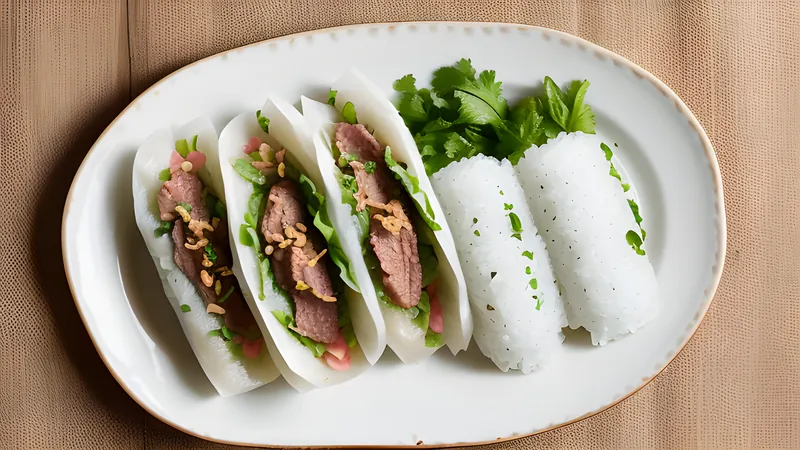
Contents
↓ Jump to recipeBanh Cuon: Steamed Rice Rolls With Wood Ear
Ingredients
- 200g rice flour
- 40g tapioca starch
- 1/2 tsp salt
- 600ml water, plus extra for steaming
- 2 tbsp vegetable oil
- 250g minced pork shoulder
- 15g dried wood ear mushroom, soaked 20 minutes
- 3 shallots, 2 finely chopped and 1 thinly sliced for frying
- 2 garlic cloves, minced
- 1 tbsp fish sauce
- 1/2 tsp white pepper
- 150g beansprouts, blanched 10 seconds
- Handful of Vietnamese mint and Thai basil
- 4 tbsp nuoc cham (fish sauce, lime, sugar, water, chilli)
Method
- Whisk rice flour, tapioca starch and salt with 600ml water and 1 tbsp oil until smooth. Rest 30 minutes; the starch needs that time to hydrate fully or the sheets tear.
- Drain the wood ear and chop finely. Fry 1 tbsp oil with chopped shallots and garlic until fragrant, add pork and cook until it loses its pink colour, breaking it into small pieces.
- Stir in wood ear, fish sauce and white pepper. Cook 3 minutes until the mixture is dry enough to hold together when pressed with a spoon. Set aside.
- Fry the sliced shallot in the remaining oil over medium-low heat until deep gold and crisp, about 6 minutes. Lift out onto kitchen paper; keep the shallot oil.
- Stretch a clean, tightly woven cotton cloth over a wide pot of simmering water and secure with an elastic band, drum-tight.
- Stir the rested batter (it will have settled), ladle a thin layer onto the hot cloth and spread with the back of the ladle into a 20cm circle. Cover and steam 60-90 seconds until translucent and no longer wet-looking.
- Slide a thin spatula or chopstick under one edge and lift the sheet free onto an oiled plate. Spoon a line of pork filling across the lower third and roll once, then twice, into a loose cylinder.
- Repeat with the remaining batter, stacking finished rolls with a brush of shallot oil between layers so they don't stick.
- Serve warm, scattered with fried shallots, beansprouts and herbs, with nuoc cham for dipping or spooning over.
The rice sheet that has to be right
Banh cuon lives or dies on the sheet. Too thick and it’s a pancake; too thin and it shreds the moment you try to lift it. The ratio above — rice flour cut with tapioca starch — gives you a sheet that’s translucent enough to see the pork filling through, with just enough tapioca elasticity to survive the transfer from cloth to plate without splitting. Skip the tapioca starch and you get something closer to a crepe: perfectly edible, but it won’t have the particular slither that makes banh cuon what it is.
The traditional method stretches cotton cloth over a pot of boiling water, secures it drum-tight, and steams individual sheets one at a time directly on the fabric. It’s slower than using a shallow pan, but the cloth lets steam through evenly and the sheet peels off cleanly once it’s set. If you’ve only ever made rice-paper spring rolls, this is a different animal — you’re cooking the wrapper fresh each time, not rehydrating a dried one.
Where the dish comes from
Banh cuon traces to the Red River Delta in northern Vietnam, and Hanoi in particular claims the tightest version of the technique: paper-thin sheets, a filling that’s more about texture than volume, and a serving style that treats the roll almost like a delicate parcel rather than a heavy breakfast. Street vendors in Hanoi’s Old Quarter set up steam rigs before dawn, cranking out rolls to order for commuters who eat standing at low plastic stools. The filling is minimal by design — a thin layer of pork and wood ear, not a stuffed dumpling — because the point is the sheet itself, and a heavy filling would tear it.
Southern versions, more common in Ho Chi Minh City, tend to be a little thicker and more generously filled, sometimes with shrimp folded into the pork mixture. Either way, the accompaniments do a lot of the work: fried shallots for crunch and a toasted, nutty sweetness; fresh herbs for lift; and nuoc cham, the sweet-sour-salty dipping sauce that shows up across Vietnamese cooking, to tie the plate together. Some stalls serve banh cuon with a few slices of Vietnamese pork sausage (cha lua) on the side, and a scatter of crispy shallot on top is close to non-negotiable — it’s what separates a good plate from a great one.
Historically, this is peasant food elevated by technique rather than expensive ingredients — rice, a little pork, mushrooms that grow on dead wood and need almost nothing to cultivate. The skill is entirely in the hands of whoever’s stretching the cloth and timing the steam, which is why good banh cuon vendors build loyal followings: the ingredients are cheap, but the execution is not.
Banh cuon shares an ancestor with Cantonese cheung fun, the rice-noodle rolls served in dim sum halls — both come from a wider Southeast Asian and Chinese tradition of steaming rice batter into thin sheets, a technique that likely spread south along trade routes centuries ago and then developed independently in each region’s kitchens. The Vietnamese version stays lighter and thinner, served at room temperature or just-warm with fresh herbs rather than the soy-and-sesame glaze that finishes cheung fun, but lift a sheet of either dish to the light and the family resemblance in the translucent, faintly wobbly texture is obvious.
Getting the cloth-steaming technique right
The stretched-cloth method intimidates people who’ve never seen it done, but it comes down to three things: tension, heat, and timing.
Tension. The cloth needs to be taut enough that batter poured onto it doesn’t pool unevenly or sag into the steam below. A wide elastic band or several loops of kitchen string around the rim of the pot will do it — just make sure the cloth doesn’t touch the water.
Heat. You want a steady, rolling simmer, not a violent boil that spits water up through the fabric and turns your sheet soggy at the edges. Medium heat, lid on between sheets to keep steam building.
Timing. Ninety seconds is usually enough once the pot is properly hot, but the first sheet or two will often need longer while everything comes up to temperature. Watch for the batter to turn from milky-opaque to glassy translucent — that’s your cue, not a fixed clock.
If you don’t have a pot wide enough for a proper cloth rig, a well-oiled non-stick frying pan with a lid works as a shortcut: pour a thin layer, cover, and steam over a small amount of water in the base, or simply cook it like a very thin crepe over direct low heat with the lid on to trap steam. You lose a little of the traditional texture, but you keep the dish recognisable, and for a first attempt it removes the single trickiest variable. A wide wok with a bamboo steamer basket and a plate lined with muslin cloth is another workable substitute for the classic drum-tight rig, and it’s closer to the traditional texture than the frying-pan method since steam still passes directly through the fabric rather than conducting through a metal base.
Making the nuoc cham properly
The dipping sauce is doing as much work on the plate as the filling, so it’s worth getting the ratio right rather than eyeballing it. A reliable starting point is 3 tablespoons fish sauce, 3 tablespoons sugar, the juice of 2 limes, 4 tablespoons water and one finely chopped bird’s-eye chilli with a little garlic, stirred until the sugar dissolves completely. Taste before you commit — the balance shifts with how sour your limes are and how salty your fish sauce is, and a good nuoc cham should hit sweet, sour, salty and hot in roughly equal measure without any one note dominating. Make it at least twenty minutes before serving so the chilli and garlic have time to steep into the liquid rather than just floating on top.
What can go wrong
Sheets that tear on lifting almost always mean one of two things: the batter went on too thin, or it wasn’t left on the cloth quite long enough to fully set before you tried to peel it away. Translucent is the target, but there’s a difference between translucent-and-set and translucent-and-still-wet — press the centre gently with a fingertip, and if any batter sticks to your finger, give it another twenty seconds before lifting.
A cloth that isn’t taut enough is the other common failure point. Slack fabric lets batter pool unevenly in the middle, which cooks a thick, chewy centre surrounded by a papery, fragile edge — exactly the opposite of the even sheet you want. Re-tension the cloth between sheets if you notice it loosening, which happens naturally as the fabric absorbs steam and heat over a cooking session.
If your rolls stick together in a stack despite the shallot oil brushed between layers, the sheets probably went onto the plate too hot and too close together. Give each roll a few seconds to firm up on its own patch of plate before adding the next one, and don’t crowd them — banh cuon wants a little space to breathe as it cools.
Assembly and serving
Work fast once a sheet comes off the cloth — it firms up within a minute or two and gets harder to roll cleanly. Have your filling, oiled plate and spatula all within reach before you steam the first sheet.
Lay the sheet flat, spoon a modest line of pork and wood ear across the lower third — resist the urge to overfill, since a fat roll won’t hold together as neatly — and fold the near edge over the filling before rolling forward into a loose cylinder. The finished roll should be soft and a little floppy, not tight and dense like a spring roll.
Serve immediately while warm, ideally within twenty minutes of steaming, with fried shallots scattered on top, a small tangle of blanched beansprouts and herbs alongside, and a bowl of nuoc cham for dipping or drizzling directly over the top. Some households add a few drops of the reserved shallot oil to the nuoc cham itself for extra richness — worth trying once you’ve made the dish a couple of times and have a feel for the balance.
Variations and substitutions
Prawns work well folded into the pork filling, chopped small and cooked through with the mince — this is the more common southern-style filling. For a vegetarian version, swap the pork for finely chopped shiitake and firm tofu, seasoned the same way with fish sauce substituted for a mushroom-based alternative or extra soy.
Wood ear mushroom is worth sourcing specifically rather than substituting with something else — its bounce and near-flavourless crunch is part of the textural signature of the dish, contrasting with the softness of the pork and the rice sheet. Dried wood ear keeps for months in a cupboard and rehydrates in twenty minutes of warm water, so it’s worth having a bag on hand if you cook Vietnamese or Chinese food regularly. Fresh shiitake, finely diced, is the closest substitute if you genuinely can’t find wood ear, though it brings its own flavour to the mix rather than staying neutral, so cut the quantity back slightly and expect a mushroomier filling than the traditional version.
Storage and make-ahead
The rice batter can be mixed the night before and kept covered in the fridge; give it a good stir before using, as the starches will settle. The pork and wood ear filling also keeps well for two days refrigerated and reheats gently in a pan.
The rolled banh cuon itself doesn’t store well once made — the sheets turn gummy and stick to each other in the fridge — so this is a dish to cook and eat within the hour, in batches, rather than to prep entirely ahead. If you’re feeding a crowd, steam sheets continuously and serve them as they come off the cloth, the way stalls in Hanoi do it, rather than trying to plate a finished stack all at once.
For more from the Vietnamese repertoire, the deep beef broth of bo kho and the crab-laced tomato noodle soup bun rieu both draw on the same pantry of fish sauce, lemongrass and fresh herbs that makes banh cuon sing.
Related Content