Bagna Càuda: The Anchovy and Garlic Dip of Piedmont
A whole head of garlic, a tin of anchovies, and an afternoon of low heat
Contents
↓ Jump to recipeBagna càuda smells like a mistake for the first ten minutes. Twelve cloves of garlic and a hundred grams of anchovy going into a pot is not a subtle proposition, and if you have never made it, the smell coming off the pan at that stage suggests you have misread the quantities badly.
You have not. Give it an hour on the lowest heat you can produce and something quite unexpected happens: the garlic loses its aggression, the anchovies stop being fish, and what is left is a warm, savoury, faintly sweet bath the colour of milky coffee that people will eat until they are ill. The Piedmontese have been doing this since at least the sixteenth century and they know exactly what they are doing.
Bagna Càuda: The Anchovy and Garlic Dip of Piedmont
Ingredients
- 12 large garlic cloves (about 2 heads), peeled
- 300 ml whole milk
- 100 g salted anchovies, or 80 g good anchovy fillets in oil
- 250 ml extra virgin olive oil, a mild Ligurian or Garda oil
- 40 g unsalted butter, cubed and cold
- 1 tbsp double cream (optional, for stability)
- 1 head celery, trimmed into batons
- 3 raw peppers, red and yellow, cut into strips
- 6 Jerusalem artichokes, peeled and sliced 3 mm thick
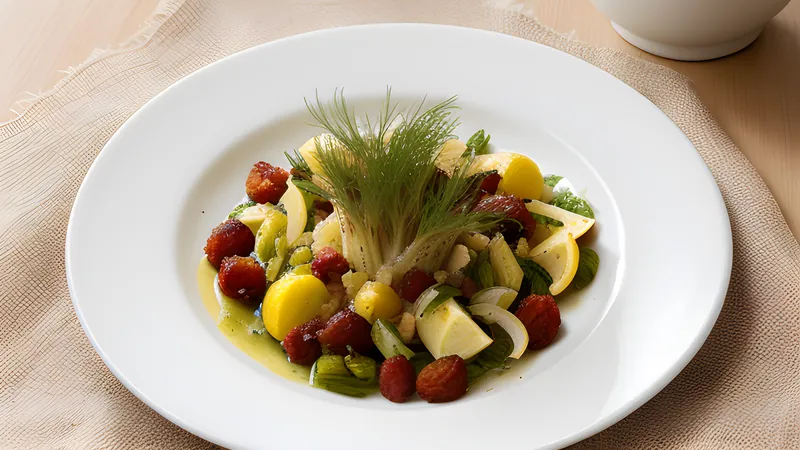
- 1 head raw fennel, cut into wedges
- 6 spring onions, trimmed
- 500 g cardoons, or 2 heads chicory, if you can get them
- 1 loaf coarse country bread
Method
- Slice each garlic clove in half lengthways and flick out the green germ from the centre with a knife tip. Discard the germs.
- Put the garlic in a small pan with the milk. Bring to a bare simmer over low heat and cook for 30 minutes, never letting it boil, until the cloves crush to paste against the side of the pan with no resistance.
- Drain the garlic, discarding the milk, and mash to a smooth paste with a fork.
- If using salted anchovies, rinse them thoroughly under cold running water, split them open with your thumb, lift out the spine and tail, and pat dry. Oil-packed fillets need only draining.
- Warm the olive oil in a heavy earthenware or cast-iron pot over the lowest possible heat. It should never exceed a hand-warm 60-70C - no bubbles, no shimmer.
- Add the anchovies and the garlic paste. Cook for 25-30 minutes, stirring with a wooden spoon every few minutes, pressing the anchovies against the base until they dissolve completely and the sauce turns the colour of milky coffee.
- Take the pot off the heat. Whisk in the cold butter a cube at a time, then the cream if using, until glossy and slightly thickened.
- Transfer to a heatproof pot set over a tealight or a small burner at the table. Serve with the raw and cooked vegetables and torn bread.
What bagna càuda is for
The name is Piedmontese dialect for “hot bath”, and the dish is a communal one in a way most Italian food only pretends to be. A pot goes in the middle of the table over a small flame — traditionally a fojòt, a squat terracotta vessel with a candle in its belly — and everyone dips. It occupies the entire evening; nothing follows it.
The origins sit with the wine harvest. Bagna càuda was eaten in the Langhe and the Monferrato at the end of the vendemmia, when the grapes were in and the whole village had been working, and it is still a late-autumn and winter dish tied to the first frosts. That timing is agricultural: the cardoons that are the canonical vegetable for dipping need a frost to sweeten them, and the gobbo cardoons of Nizza Monferrato are grown bent over and buried so they blanch pale and tender.
The anchovies are the interesting historical bit. Piedmont is landlocked and mountainous, about as far from a Mediterranean fishing port as Italy gets. The anchovies arrived along the via del sale, the salt roads over the Ligurian Alps, carried by the acciugai — travelling anchovy merchants from the Val Maira who worked a route between the coast and the Po valley for centuries. There is a persistent story that anchovy barrels were used to smuggle salt underneath, since salt was taxed and fish was not, and that the anchovy habit is a side effect of tax evasion. It is probably too neat to be true, but the trade route certainly existed and the anchovy dependence of a landlocked region needs some explanation.
Piedmont’s producers formalised things in 2005 with a “delegation of bagna càuda” and an agreed official recipe. It specifies garlic, anchovies and olive oil, and it permits milk-poaching the garlic. It also causes arguments, which is the point of any official recipe in Italy.
The garlic problem, and the milk
Twelve cloves is a lot of garlic. Raw, that quantity would take the roof of your mouth off. The reason it does not is a combination of two things.
First, the germ. That pale green shoot in the centre of each clove is where most of the bitter, acrid compounds concentrate, and it gets more pronounced as garlic ages through the winter. Halve each clove lengthways and flick it out with a knife tip. It takes three minutes for a whole head and it removes the harshest edge.
Second, the milk poach. This is the step that turns bagna càuda from a challenge into a pleasure, and it is worth knowing why it works. Garlic’s pungency comes from allicin, produced when you damage the cells and an enzyme called alliinase meets a compound called alliin. Allicin is unstable — heat destroys it. Thirty minutes at a bare simmer breaks it down almost entirely, leaving the sweeter sulphur compounds behind. The milk does two extra jobs: its casein proteins bind some of the remaining sulphur compounds and carry them off when you drain it, and the milk buffers the temperature so the garlic cannot catch and scorch.
Never let the milk boil. Boiling milk splits and coats the garlic in curds, and it heats hard enough that the outside of each clove goes to mush while the middle stays firm. A bare simmer means the occasional lazy bubble at the edge and nothing more.
Some Piedmontese cooks skip the milk entirely and poach the garlic in the oil from the start, arguing that milk is a modern softening for weak stomachs. They are welcome to their version. Mine tastes better and I sleep afterwards.
The anchovies, which are the whole dish
Buy well. This is a two-ingredient dish and one of the ingredients is anchovy, so the tin you choose is the recipe.
Salted anchovies — whole fish packed in salt, sold in tins from Italian delis — are what Piedmont uses and they are noticeably better than oil-packed: firmer, less oxidised, cleaner-tasting. They need work. Rinse them under cold running water for a minute, rubbing the salt off, then split each one open with your thumb along the belly, lift the spine out from the head end in a single motion, and pull off the tail. Pat dry. Ten fish takes five minutes.
Oil-packed fillets are fine if the oil is olive rather than sunflower, and if they are Cantabrian or Sicilian rather than the cheap grey ones. Drain them; do not add their packing oil to the pot, as it carries the flavour of however long they have sat on a shelf.
The anchovies must dissolve completely. Over 25 minutes of gentle heat the fillets break down entirely, their proteins and fats dispersing into the oil, and the finished bagna càuda comes out perfectly smooth and reads as savoury depth rather than fish. If you can still see fillet, keep going and press them with the spoon.
The mechanism is straightforward salt-cure chemistry. Months in salt let the fish’s own enzymes cut its muscle proteins into short peptides and free amino acids, glutamate chief among them. Warm oil finishes the job by melting the connective tissue that was holding the fillet in one piece, and the peptides go into solution. What lands on your tongue is glutamate — the same savoury hit as parmesan or soy sauce — with the fishiness left behind in the oxidised oils you drained away.
The oil
Use a mild olive oil and use a lot of it. This is the medium the whole dish lives in, and 250 ml for six people is correct.
Piedmont has no olive oil of its own, so the traditional choice came up the same trade roads as the anchovies: Ligurian oil, pressed from Taggiasca olives, soft and almost sweet with none of the pepper. A grassy, bitter Tuscan or Pugliese oil fights the garlic and the anchovy instead of carrying them, and the finished sauce tastes harsh. Garda oil is the other good option. If your only oil is aggressive, cut it half and half with a neutral one.
Keep it cool. Olive oil starts to degrade well below its smoke point, and the whole method here holds it at 60-70C precisely so its flavour survives an hour in the pan. Dip a finger in — you should be able to hold it there.
The twist: cold butter, off the heat
The traditional recipe finishes with butter stirred in, and it is often a small amount added to the hot pot, where it melts and separates and sits on top in a slick.
Do it the other way. Take the pot off the heat entirely, let it drop for a minute, then whisk in cold butter one cube at a time — the monter au beurre technique from French sauce work. Cold butter added to a sauce below about 80C emulsifies rather than melting: the butterfat disperses into droplets held by the milk solids, and the result is glossy, slightly thickened and stable enough to cling to a celery baton instead of sliding off it. A tablespoon of cream makes the emulsion more forgiving still, though purists will scowl.
That clinging is the practical point. A split bagna càuda is a pot of oil with sludge at the bottom, and everyone ends up dredging.
Heat, vessels and what to dip
The temperature at the table matters as much as the temperature in the pan. A tealight under a terracotta fojòt holds the sauce around 50-60C, which is warm enough to smell and cool enough to stay emulsified. A gas burner turned up will boil the oil, break the emulsion and fry the garlic solids into bitterness within ten minutes. If you have no fojòt, a small enamelled cast-iron pot over a tealight works; the mass of the pot does the regulating.
For dipping, the canon runs: cardoons first (raw, in lemon water, if you have found gobbi), then Jerusalem artichokes raw and sliced thin, raw peppers, celery, fennel, spring onions. Cooked options are equally traditional — roast onions, boiled potatoes, roast beetroot, savoy cabbage leaves. Chicory or witloof stands in perfectly well for cardoon and is available everywhere.
The ending is fixed by tradition and I would not skip it: when the vegetables are gone, crack an egg or two into what remains in the pot and scramble it slowly with a wooden spoon. That is the best part and the Piedmontese know it.
Storage. It keeps five days in the fridge in a sealed jar and sets solid. Rewarm very gently over the lowest heat, stirring; if it splits, whisk in a teaspoon of cold cream. Leftovers are extraordinary tossed through hot pasta or spooned over roast potatoes.
Quantity. Half a recipe is not worth making. The pot is meant to be alarming.
The garlic aftermath. Everyone at the table will smell of it for two days; this is understood, discussed openly and considered part of the deal. The Piedmontese solution is that everyone eats it together, which neatly removes the problem. Milk-poaching cuts the effect substantially but nothing eliminates it — the persistent compound is allyl methyl sulfide, which your body cannot break down and simply exhales for about 48 hours. Parsley helps a little. Planning helps more.
What can go wrong. Bitterness means the garlic caught, the germs stayed in, or the oil got too hot. Graininess means the emulsion split, usually from adding warm butter to a hot pot. A thin, oily sauce that will not coat anything means the anchovies did not fully dissolve, so there is nothing in there to emulsify with.
If you want more of this, the Castilian garlic soup does the same slow-sweetening trick with bread and paprika, hasselback potatoes with anchovy butter put the two ingredients under a roast, and charred hispi cabbage with anchovy butter is what to do with the leftover tin. The green goddess dressing is the cold, herbal answer to the same question.
Related Content