Baeckeoffe: The Alsatian Baker's Oven Casserole
Three meats, marinated overnight in Riesling, sealed under potatoes with a rope of dough
Contents
↓ Jump to recipeThe instruction that makes this dish is the one that tells you to do nothing. Four hours, sealed shut, no stirring, no basting, no peeking. A baeckeoffe cannot be checked, and once you have pressed the dough rope around the rim you have surrendered every lever a cook normally has. It is an unusual feeling. It is also the entire point.
Baeckeoffe: The Alsatian Baker's Oven Casserole
Ingredients
- 500 g beef shin or chuck, in 4 cm cubes
- 500 g pork shoulder, in 4 cm cubes
- 500 g boneless lamb shoulder, in 4 cm cubes
- 1 pig's trotter, split (optional but recommended)
- 750 ml dry Alsace Riesling or Sylvaner
- 2 medium onions (about 250 g), thinly sliced, plus 2 more for layering
- 3 garlic cloves, sliced
- 2 bay leaves
- 4 sprigs thyme
- 6 juniper berries, lightly crushed
- 1 tsp black peppercorns
- 2 cloves
- 1 leek (about 150 g), sliced into rounds
- 1.5 kg waxy potatoes, peeled and sliced 4 mm thick
- 20 g butter, for the pot
- 2 tsp fine salt
- 1 tsp freshly ground black pepper
- 2 tbsp chopped flat-leaf parsley, to finish
- 200 g plain flour, for the seal
- 110 ml water, for the seal
Method
- The day before, put all three meats and the split trotter into a large bowl with the 2 sliced onions, the garlic, bay, thyme, juniper, peppercorns and cloves. Pour over the Riesling, cover, and refrigerate for at least 12 hours and up to 24.
- The next day, drain the meat through a colander set over a bowl. Keep the wine. Pick out the bay and thyme and reserve them; discard the marinade onions.
- Butter the inside of a 4-litre earthenware baeckeoffe pot or a lidded casserole. Slice the 2 remaining onions thinly.
- Lay a third of the potato slices across the base, overlapping like roof tiles. Season with a third of the salt and pepper.
- Add half the drained meat, half the fresh onion and half the leek. Tuck in the trotter halves. Season.
- Repeat with another third of the potatoes, the remaining meat, onion and leek, and season again. Finish with the last third of the potatoes, arranged neatly, and the last of the salt and pepper. Lay the reserved bay and thyme on top.
- Pour the reserved wine down the side of the pot until it reaches just below the top layer of potatoes, about 600 ml. Top up with water if you are short.
- Mix the flour and water to a stiff, non-sticky dough. Roll it into a rope about 2 cm thick and long enough to circle the rim. Press it around the rim, set the lid on, and pinch the dough up against the lid to seal all the way round.
- Bake at 160C fan for 4 hours. Do not open it.
- Bring the sealed pot to the table. Crack the dough with the back of a knife, lift the lid, and scatter the parsley over. Serve with a green salad dressed sharply.
The Monday laundry, and a name that means what it says
Baeckeoffe is Alsatian dialect for baker’s oven. The story attached to it is one of the rare food origin stories that survives scrutiny reasonably well.
Monday was washing day across much of nineteenth-century Alsace, and washing day was brutal — hauling water, heating it, scrubbing at the communal washhouse from dawn. Nobody was going to stand over a stove afterwards. So on Sunday evening the household put meat to marinate in wine. On Monday morning, on the way to the washhouse, the woman of the house dropped the assembled pot at the village bakery. The baker’s bread came out early; the wood-fired oven then sat at a falling heat all morning with nothing to do. The pots went in. They came out at midday, and each family collected its own.
The dough seal was practical rather than decorative. It kept the moisture in an oven with no thermostat and, crucially, it stopped the neighbours getting your lamb. Some households scratched initials into the dough. The seal was a signature and a security device before it was ever a technique.
The clay pot is a real object with a real trade behind it. Baeckeoffe pots come from Soufflenheim and Betschdorf in northern Alsace, where potters have been throwing them since the eighteenth century, and they are still made — oval, glazed inside, decorated outside with flowers and cockerels, sized to feed a family and to fit through a bakery door.
Why three meats
Beef, pork and lamb, in equal weight. The convention is fixed and the reason is functional.
Beef shin brings collagen and the deepest flavour; it needs the full four hours and will still be improving at the end. Pork shoulder brings fat, which renders down through the layers and is what stops the potatoes going chalky. Lamb shoulder brings a distinct, slightly gamey sweetness that reads across the whole pot — leave it out and the dish loses its signature immediately.
The pig’s trotter is optional in the sense that a bridge’s handrail is optional. It contributes nothing to eat, and it turns the wine and rendered fat into a broth with enough gelatine to coat a spoon. Without it you get meat in liquid. With it you get meat in something that sets slightly as it cools on the plate.
Cut everything to 4 cm. Smaller cubes shred into fibres over four hours; larger ones stay tough in the middle.
What the marinade actually does
Twelve hours minimum, and I would push to eighteen. The wine does three jobs at once.
Its acidity — Alsace Riesling sits around pH 3.2 — begins breaking down connective tissue before any heat is involved, which is why a marinated baeckeoffe is tender at four hours where an unmarinated one wants five. It carries the juniper and thyme into the meat rather than leaving them on the surface. And it becomes the braising liquid, so the aromatics you put in on Sunday night are the ones you taste on Monday.
Use a wine you would drink. This is a cliché and it is also arithmetic: 750 ml of wine reduced against three kilos of solids is a high concentration, and anything harsh or oxidised concentrates along with everything else. Dry Sylvaner is the thrifty Alsatian answer and works perfectly.
Discard the marinade onions. They have given everything they had and gone stringy; fresh onions go in for the layering.
Layering, and the potato that holds it up
Slice the potatoes 4 mm. Thinner and the bottom layer disintegrates into the broth; thicker and the top layer never softens through. A mandoline makes this trivial, and a steady hand with a knife makes it fine.
Waxy varieties only — Charlotte, Nicola, Belle de Fontenay. A floury Maris Piper collapses into paste by hour three and you will be serving stew with a mash lid, which is a legitimate dish and is not this one.
The three-layer structure does real work. The bottom potatoes sit in the wine and go almost translucent, absorbing the marinade. The middle ones cook in rendered fat and meat juice and end up the richest thing in the pot. The top layer sits above the liquid line, steams rather than boils, and holds its shape — it is the lid that makes the whole thing look composed when you crack the seal.
Do not fill the wine above the bottom of the top potato layer. Drown that layer and you lose the structural distinction entirely.
The dough seal, honestly assessed
The seal is flour and water, roughly 2:1 by weight, kneaded for two minutes to a stiff putty. It is not for eating. In the bakery it comes off in one piece and goes to the chickens; at home the bin is fine, though a friend of mine dries it and uses it as a pot label, which is very Alsace.
Does it matter? Yes, more than I expected before I tested it. A baeckeoffe cooked under a plain lid loses roughly a fifth of its liquid over four hours and the top potatoes brown and dry. Sealed, essentially nothing escapes, and the wine’s alcohol — which would otherwise boil off — stays in the pot and keeps stripping fat and carrying aroma the whole way through. The broth from a sealed pot is noticeably more perfumed.
If you have no earthenware, a cast-iron casserole with a well-fitting lid and a dough rope gets you about ninety per cent of the way. Foil crimped under the lid gets you seventy.
Seasoning a new pot
If you buy a Soufflenheim pot, it arrives unglazed on the outside and porous. The Alsatian ritual is to soak it in cold water for two hours before its first use, then rub the inside with a cut garlic clove and a smear of lard, fill it with water and heavy trimmings, and bake it low for an hour. The clay takes up water, and that water turns to steam in the oven and helps drive the cooking; a pot that has gone into a hot oven bone dry can crack along a wall.
Two rules afterwards. Never put an earthenware pot on a hob or under a grill — the heat is too concentrated and too local, and the wall will split. And never move it from the fridge into a hot oven; put a cold pot into a cold oven and let them come up together. Wash it with hot water and a brush, and skip the detergent, which the porous body will absorb and hand back to your next dinner.
Variations that Alsatians actually cook
The trotter is sometimes joined or replaced by an oxtail, which gives even more gelatine and a darker broth. Some houses tuck two or three whole peeled carrots between the layers, fished out before serving in the same way as the carrot in a choucroute — a slow sugar drip against the wine’s acid.
Baeckeoffe au poisson, a Strasbourg restaurant invention of the last forty years, replaces the meats with pike, salmon and monkfish and cuts the oven time to fifty minutes, since fish needs a fraction of the heat. It is a different dish wearing the same pot, and it is good.
A vegetarian version circulates in the Vosges with celeriac, swede and mushrooms standing in for the meat. It is honest and it misses the trotter badly; a spoon of white miso in the wine gets some of that savoury weight back.
The one modification I would resist is browning the meat first. Every instinct trained on French braising says to sear, and every historical account of this dish says no — the bakery had no hob and the cook had no time. The flavour here is clean and winey and comes from the marinade. Sear it and you have made a very good beef stew that is wearing a costume.
Failure modes
Grey, dry meat. Your oven ran hot. 160C fan is a ceiling; a browning smell before hour three means it is too high. The dish has no browning stage at all, and any Maillard flavour would be an accident.
Watery broth. No trotter, and probably too much liquid at the start.
Sludge instead of layers. Floury potatoes, or slices under 3 mm.
The seal blew. The dough was too wet and softened, or the oven was too hot and the pot built up pressure. A stiff putty at 2:1 flour to water holds all the way through; a sticky dough will slump off the rim by hour two.
Bland. The commonest fault, and it is salt. Three kilos of meat and potato with 2 tsp of salt is barely enough; season each layer as you build, because there is no way to correct at the end without wrecking the structure.
Neighbours, ahead, after
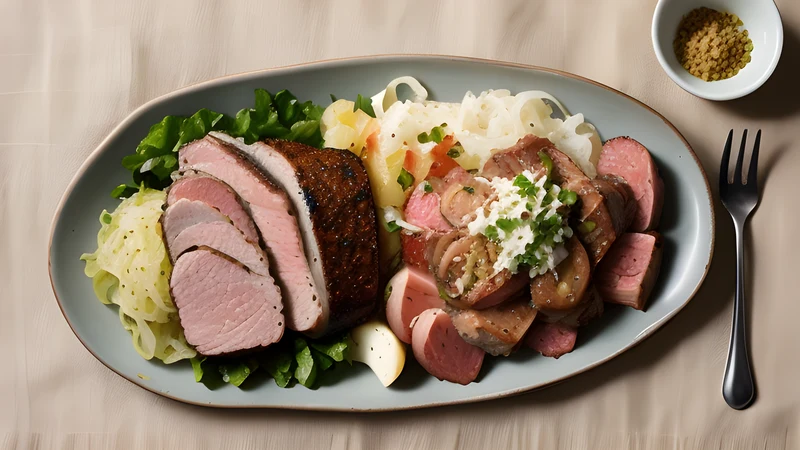
The dish sits in the same Alsatian repertoire as choucroute garnie — same Riesling, same juniper, same instinct for pork and slow heat — and the same weekend often produces both, with flammekueche as the Friday-night opposite: ten minutes rather than four hours. For the same logic applied to beef and a whole bottle of red, coq au vin is the answer from Burgundy, and gratin dauphinois shows what the same waxy potatoes do with cream instead of wine.
Assemble the pot the night before if you like — marinate, layer, seal, refrigerate — and put it in the oven cold, adding twenty minutes to the time. That is the closest a modern kitchen gets to handing it to the baker.
Serve it in the pot, at the table, and crack the seal in front of people. This is theatre and it is also the only way anyone gets to smell the thing at full strength — four hours of Riesling, juniper and rendered pork come out of that pot in one wave and then disperse for good. Spoon straight down through all three layers so every plate gets the winey bottom potatoes, the fatty middle and a piece of the intact lid.
Leftovers are excellent for three days and reheat best in the oven at 150C, covered, for thirty minutes. It does not freeze well; the potatoes go grainy and the broth’s set breaks. Eat it instead. A green salad with a mustardy dressing, sharp enough to cut across all that fat, is the only accompaniment the dish has ever needed.
Related Content