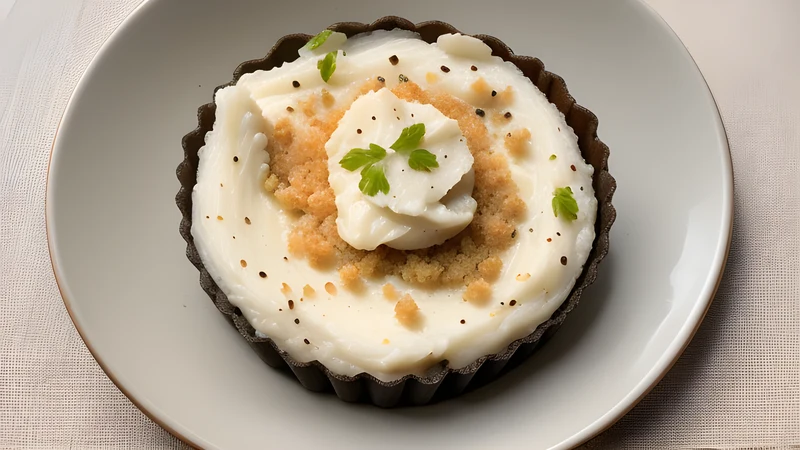
Baccalà Mantecato: The Whipped Salt Cod of Venice
Poached stockfish beaten into a pale, airy cream with olive oil and garlic confit
Contents
↓ Jump to recipeVenice built an empire on the movement of things that keep. Salt, pepper, dried fruit, and — from the fifteenth century onwards — a plank of dried cod from an island 3,000 kilometres north, which the city turned into something resembling clouds.
Baccalà mantecato is the best argument I know that a preserved ingredient can be more interesting than a fresh one.
Baccalà Mantecato: The Whipped Salt Cod of Venice
Ingredients
- 500g stoccafisso (dried unsalted stockfish) or 500g baccalà (salt cod), thick loin pieces
- 1 bay leaf
- 1/2 white onion
- 1 celery stick
- 250ml mild extra-virgin olive oil, at room temperature
- 6 garlic cloves, peeled
- 150ml olive oil, for the confit
- 3 tbsp flat-leaf parsley, very finely chopped
- Freshly ground white pepper
- Fine sea salt, to taste
- Squeeze of lemon juice (optional)
- Grilled polenta or good bread, to serve
Method
- Soak the fish in a large bowl of cold water in the fridge for 48 hours if using stockfish, or 24 hours if using salt cod. Change the water every 8 hours. The fish should swell, soften and lose its rigidity; a corner pinched off and tasted raw should be pleasantly saline rather than aggressive.
- Make the garlic confit: put the peeled cloves and the 150ml of olive oil in a small pan over the lowest possible heat. Cook for 25 minutes until the cloves are soft enough to crush with a spoon and pale gold. Do not let them brown. Cool, then mash 3 cloves into the oil and reserve; save the rest for another use.
- Drain the fish and put it in a pan with the bay leaf, onion half and celery. Cover with cold water. Bring slowly to a bare simmer, then take off the heat immediately, cover, and leave for 20 minutes.
- Lift the fish out and let it cool until you can handle it. Reserve 150ml of the poaching liquid. Flake the fish, pulling out every bone and every scrap of skin with your fingers. Do not rush this; a single bone ruins the mouthfeel.
- Put the warm flakes in a large bowl or a stand mixer with the paddle. Beat on medium for 3 minutes until the fibres break down into a rough paste.
- Now add the room-temperature olive oil in a thin, steady stream, beating constantly, exactly as if making mayonnaise. It will take 8 to 10 minutes for all 250ml to go in. The mixture will pale, lighten and roughly double in volume.
- Beat in 3 tablespoons of the garlic confit oil with its mashed cloves, then loosen with the reserved poaching liquid a tablespoon at a time until the texture is soft and spoonable. Fold in the parsley and white pepper, taste for salt, and add lemon if you want it. Serve at room temperature on grilled polenta.
The shipwreck, and the trade it started
The story Venetians tell involves Pietro Querini, a merchant captain whose ship broke up off Norway in the winter of 1431. He and the survivors washed onto Røst, in the Lofoten archipelago, and spent three months with the islanders before making their way home. Querini wrote an account of it — one of the earliest European descriptions of Arctic Norway — and in it he described the fish the islanders lived on: cod, gutted, hung on wooden racks in the cold dry air, and left until it was hard as a board.
The account is real; the causal story is probably tidier than the truth. Dried cod was already circulating in Mediterranean ports before 1431, and Venice was hardly ignorant of northern trade. What Querini’s report did was give the trade a founding myth and, quite possibly, a commercial nudge. Within a century stockfish was moving south in serious volume, and it stayed a Venetian staple for the next five hundred years.
The linguistic confusion is worth clearing up because it causes real problems at the fishmonger. Stoccafisso is cod dried in cold air with no salt at all, hard as timber, and it keeps for years. Baccalà is cod split and cured in salt, softer, and it also keeps for years. Everywhere in Italy except Venice, baccalà means the salted one. In Venice, baccalà means the dried one, so baccalà mantecato is made from stoccafisso. This is entirely typical of Venice and there is no point arguing about it.
Mantecato means whipped or creamed, from manteca, an old word for butter or lard. There is no butter in this dish, which is the joke: the creaminess is manufactured out of fish and oil by force.
Buying the fish, which decides everything
You cannot fix bad stockfish with technique, and stockfish varies enormously.
The best comes from Lofoten, hung on racks between February and May when the air is cold enough to prevent spoilage and dry enough to pull water out steadily. That slow cold drying is a fermentation as much as a dehydration: enzymes inside the flesh keep working for weeks, breaking proteins into amino acids and giving the finished fish a savoury depth that fresh cod never develops. Italian importers grade it, and the grades genuinely mean something. Ragno is the top tier, thick and pale and even. Westre is a step down and perfectly good for this. Anything unlabelled and grey is a gamble.
Look for pieces that are thick through the loin, uniformly pale straw in colour, with no yellow patches and no rusty orange spots. Yellowing indicates fat oxidation, and cod has little fat to begin with, so the fat that has gone off is concentrated in exactly the places you will taste it. Rusty marks mean the fish got damp during drying and the mould got in. A good piece smells faintly of the sea and clean hay, and a bad one smells of an old wardrobe.
Salt cod is easier to buy and easier to read. It should be white and slightly translucent at the edges, flexible enough to bend a little, with clean white salt crystals rather than damp grey ones. Vacuum-packed salt cod loins from Portugal or Spain are consistent and widely available, and they are the sensible starting point if this is your first attempt.
Weight is the other trap. Five hundred grams of dried fish is roughly 1.4kg once soaked, and 500g of salt cod comes back closer to 800g. This recipe is written for 500g of dry weight either way, so do the sums at the counter rather than at the sink.
The soak, which is most of the work
Dried cod arrives at something like fifteen per cent of its original water content and carrying, in the salted version, more sodium than anyone could eat. The soak reverses both, and it cannot be hurried.
Stockfish wants forty-eight hours in cold water, changed every eight. Salt cod wants twenty-four to thirty-six, changed as often. Both must happen in the fridge or in a genuinely cold larder, because a warm bowl of rehydrating fish is a bacterial holiday camp and it will smell like one by hour twelve.
Change the water on schedule. Salt and the compounds that make dried fish taste of the docks move out of the flesh and into the water by diffusion, and once the water is saturated, diffusion slows to nothing. Four changes over two days do far more than one enormous bowl left alone.
Judge it by touch and by taste. Properly soaked fish is pliable, springs back when you press it, and has swollen to nearly three times its dry weight. Pinch off a corner and taste it raw: it should be pleasantly saline, at roughly the level of a well-seasoned soup. Aggressive salt means more soaking. No salt at all means you have gone too far and stripped the flavour out with it, which is a real risk after seventy-two hours.
Buy thick loin pieces. Tail ends are thin, dry out unevenly in curing, and turn stringy no matter what you do to them.
Poaching, and why it barely counts as cooking
Bring the pan slowly to a bare simmer and then take it off the heat. That is the entire cooking process.
Cod is nearly pure lean protein with very little connective tissue and almost no fat. Its muscle fibres are held together in flakes by a thin sheet of collagen that dissolves around 55C, which is why cod falls apart so obligingly. Push the fish past about 65C and the fibres themselves contract, squeeze out their water and turn from tender to cottony, and no amount of oil will bring them back. Salt cod is more forgiving than fresh because curing has already partly denatured the proteins, and it is not forgiving enough to survive a rolling boil.
So: cold water, slow rise, off the heat at the first tremor, twenty minutes covered. The residual heat does the rest and the fish comes out at around 60C, opaque and flaking cleanly.
Save the poaching liquid. It is mild, gelatinous and tastes of the fish, and it is what you use to loosen the finished cream. Water would do the same job and taste of nothing.
Then flake it warm, with your fingers, and hunt for bones. There are pin bones along the loin and there are usually a few strips of skin, and both are invisible in a pale mousse until someone finds one. Ten minutes with your hands beats any shortcut.
The beating, which is an emulsion
This is mayonnaise made of fish. Understanding that fixes every problem you will have.
The fish proteins, warm and broken up by the initial beating, act as the emulsifier. Oil goes in slowly and gets sheared into droplets small enough to stay suspended; the proteins coat those droplets and stop them coalescing. Two hundred and fifty millilitres of oil into 500g of fish is a lot, and the mixture pales and swells as it goes in because you are whipping air in alongside.
Three rules and it will not split. Beat the fish warm — around 40C, where the proteins are relaxed and receptive. Cold fish out of the fridge refuses the oil. Use room-temperature oil, since cold oil is viscous and shears badly. Add it slowly, in a thread, especially for the first 50ml; once the emulsion is established you can be braver.
If it splits — it looks grainy and weeps oil — stop, put two tablespoons of the warm poaching liquid in a clean bowl, and beat the split mixture into it a spoonful at a time. It comes back every time.
Use a mild olive oil. A big peppery Tuscan oil at 250ml will bulldoze the fish and turn bitter under high-speed beating, because the polyphenols that give good oil its pepper get concentrated as air whips in. Venetians historically used sunflower oil for exactly this reason and it makes a cleaner, blander mousse.
Traditionalists do this in a wooden bowl with a spoon and it takes twenty minutes and a strong forearm. A stand mixer with the paddle takes ten and produces an identical result. A food processor produces glue: the blade shears the fibres to nothing and you lose the slight strandiness that tells you this was once a fish.
The garlic, done the only way that works
Raw garlic in baccalà mantecato is common and it is wrong. Crushed raw garlic releases allicin, which is sharp, sulphurous and gets more aggressive as it sits, and by the time your bowl reaches the table two hours later it tastes of garlic and very little else.
Garlic confit solves this. Six cloves in 150ml of olive oil, twenty-five minutes on the lowest heat, no colour. Gentle prolonged heat destroys the enzyme that makes allicin and drives the sulphur compounds towards sweeter, rounder molecules. What comes out is soft, mellow and nutty, and the oil is now a garlic oil that emulsifies straight into the fish.
Three mashed cloves and three tablespoons of their oil, beaten in at the end. It sits underneath the fish instead of shouting over it, and it does not get louder overnight. The leftover cloves and oil keep a fortnight in the fridge and improve roast potatoes considerably.
Tips, swaps and serving
Serving. This is cicchetti, Venetian bar food, and it belongs on grilled polenta squares or thin toast with a small glass of something white and sharp. Room temperature always; fridge-cold mutes it and the emulsion firms into paste.
Make ahead. Three days in the fridge, covered with a film of oil. Bring it out ninety minutes before serving and beat it briefly with a spoon to bring the texture back. It does not freeze — the emulsion breaks on thawing.
Fresh cod. Not the same dish, and worth doing anyway. Salt 500g of thick cod loin heavily for 24 hours in the fridge, rinse, and proceed from the poaching step. You get something lighter with less of the aged, faintly cheesy depth that curing produces.
Other fish. Smoked haddock makes an excellent unauthorised version. Halve the poaching time and skip the salt entirely.
Texture. For a coarser, more rustic mousse, hold back 50ml of oil. For the silkiest version, add another 30ml of poaching liquid at the end.
For the other great Iberian-Venetian salt cod dish, bacalhau à brás shreds it with potato and egg instead of whipping it, and ackee and saltfish shows where the same barrels ended up across the Atlantic. Serve this alongside sarde in saor and you have half a cicchetti bar on the table.
Related Content