Axoa de Veau: The Espelette Veal of Saint-Jean-Pied-de-Port
Hand-chopped veal, green peppers and Espelette, from a Pyrenean market day
Contents
↓ Jump to recipeThe first rule of axoa is that you chop the meat by hand, and the second rule is that you will be tempted not to and you should ignore the temptation. A mincer takes ninety seconds. A knife takes twenty-five minutes. The mincer produces a dish that is recognisably the same recipe and eats like bolognese, and there is no way to explain why until you have made both.
Axoa de Veau: The Espelette Veal of Saint-Jean-Pied-de-Port
Ingredients
- 900 g veal shoulder, boneless
- 3 tbsp olive oil
- 2 medium onions (about 250 g), finely chopped
- 4 garlic cloves, finely chopped
- 500 g green peppers (about 3), deseeded and cut into 1 cm dice
- 2 green chillies, mild, deseeded and finely chopped (optional)
- 2 tsp piment d'Espelette
- 1 tsp sweet paprika
- 2 bay leaves
- 3 sprigs thyme
- 300 ml chicken or veal stock, plus more if needed
- 150 ml dry white wine, such as Irouléguy or a dry Jurançon
- 1.5 tsp fine salt
- 0.5 tsp freshly ground black pepper
- 800 g waxy potatoes, peeled and halved, to serve
- 2 tbsp chopped flat-leaf parsley, to finish
Method
- Trim the veal of gristle and any thick sinew, leaving the fat. Cut it into 1 cm slices, then into 1 cm strips, then chop across into rough 1 cm dice with a heavy knife. Work in batches and keep the pieces distinct. Do not use a mincer or a food processor.
- Heat 2 tbsp of the oil in a wide casserole over a medium heat. Add the onions and a pinch of the salt and cook for 12 minutes until soft and pale gold.
- Add the garlic and cook for 2 minutes, then add the green peppers and the chillies. Cook for 12 minutes more, stirring, until the peppers have slumped.
- Push the vegetables aside, add the last 1 tbsp oil and the chopped veal, and stir over the heat for 4 minutes until the meat has turned from pink to grey. Avoid browning it; this is a white stew.
- Stir in the Espelette and paprika and cook for 60 seconds so the spices bloom in the fat.
- Pour in the wine and let it bubble for 3 minutes. Add the stock, bay, thyme, the rest of the salt and the black pepper. The liquid should barely cover; add a splash more stock if not.
- Cover and cook at the barest simmer, on the hob or in a 150C fan oven, for 1 hour 30 minutes, until the veal pulls apart into threads under a spoon.
- Uncover, remove the bay and thyme, and simmer hard for 8-10 minutes to reduce the sauce until it clings to the meat and pools rather than runs.
- Meanwhile, boil the potatoes in well-salted water for 18-20 minutes until tender, and drain.
- Taste the axoa and correct the salt and Espelette. Scatter with parsley and serve with the potatoes alongside.
A market-day dish with a market-day reason
Axoa — pronounced roughly a-shoa — is Basque for something like a hash or a chopped thing. It belongs to Saint-Jean-Pied-de-Port, the walled town at the foot of the Roncevaux pass in Basse-Navarre where pilgrims on the Camino cross into Spain and where, every Monday for centuries, there has been a livestock market.
The dish’s logic follows directly from that market. Veal was the animal traded and the animal available, and on market day the cafés around the Place Charles de Gaulle needed to feed a large number of farmers quickly, from cuts nobody would pay for. Shoulder and neck and trim. Chopping those cuts small does two things: it turns tough working muscle into something that cooks in ninety minutes rather than four hours, and it stretches a small amount of meat across a lot of pepper.
It is still a Monday dish there. It is also on the menu of essentially every restaurant in the French Basque Country, which is unusual for something this local, and it has never really left.
Hand-chopped, and what the difference actually is
Mincing shears meat cells and pushes them through a plate, which destroys the fibre structure and releases myosin. That released protein is what makes a burger bind and what makes minced meat, when stewed, turn into a homogeneous granular mass with a slightly pasty mouthfeel.
Chopping cuts across the fibres and leaves the bundles intact. Each 1 cm cube then does what a large braising cube does — its collagen melts, its fibres relax and separate — except at a scale that takes ninety minutes. The result on the spoon is threads and shreds with distinct edges, sitting in sauce, and it is unmistakably a stew of meat rather than a mince.
Technique for the chopping: get the veal properly cold, almost frozen at the edges, which firms it and stops the knife dragging. Use the heaviest knife you own and keep it sharp — a dull blade tears and squashes and you will have made mince the slow way. Slice, strip, dice, and work through the piece in four batches so the meat you have not reached yet stays cold. Aim for 1 cm and accept anything from 6 mm to 15 mm; the ragged variety is part of the texture.
If your butcher will do it, ask for veal shoulder haché au couteau — knife-chopped. Some will. Most will offer to mince it, and you should say no politely.
Veal, and the honest alternatives
Shoulder is the cut: enough collagen to give the sauce body, enough intramuscular fat to keep the shreds moist. Neck works and is cheaper. Leg is too lean and comes out dry and stringy no matter how long you cook it.
Veal in Britain and Ireland carries baggage that it mostly no longer deserves. Rose veal — from calves raised in groups with access to roughage, slaughtered at six to eight months — is a by-product of the dairy herd that would otherwise be shot at birth, and buying it is a defensible act rather than an indulgent one. It is darker and more flavourful than the pale Dutch stuff, and it is what you want here anyway.
Lamb shoulder makes a genuinely good axoa and Basque shepherds have been doing it for as long as anyone. Pork shoulder works and pushes the dish sweeter. Both need the same hand-chop and about the same time.
Green peppers, again, and the Espelette
Green peppers are compulsory and their bitterness is the point, exactly as it is in piperade. Half a kilo of them against 900 g of meat sounds like a lot; on the plate it reads as an equal partner, which is the historical intent of a dish designed to eke out expensive protein.
Dice rather than the strips a piperade uses. The pieces need to match the meat’s scale so the two lose their separate identities somewhere around the hour mark.
Piment d’Espelette is the dish’s signature and the reason it tastes Basque instead of merely stewed. Two teaspoons against 900 g of meat is assertive without being hot — Espelette runs about 4,000 Scoville, so this lands somewhere below a mild curry — and what it delivers is a fruity, faintly smoky warmth and the rust-orange colour that identifies an axoa across a dining room.
Bloom it in fat for a full minute before the liquid goes in. Capsaicin and the carotenoid pigments are fat-soluble, so a spice that meets oil gives up its colour and aroma; a spice that meets stock stays a grainy suspension and tastes dusty. That sixty seconds is worth more to the finished dish than any other minute in the method.
The fresh green chillies are traditional in some houses and optional in most. Saint-Jean cooks use a mild local one. Two deseeded green chillies add a vegetal top note and very little heat.
The white stew rule
There is no browning. Every French braising instinct says to sear the meat hard for the Maillard flavour, and the axoa says no.
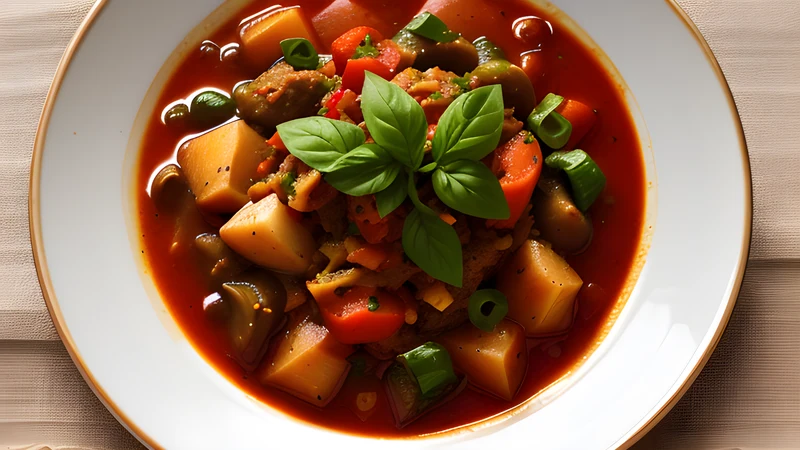
The reason is chromatic and it is real. A browned axoa goes muddy brown and the Espelette’s orange disappears into it. An unbrowned one stays the colour of terracotta, which is how the dish is meant to look and how every restaurant in Bayonne serves it. The flavour is meant to be clean — veal, green pepper, Espelette, in that order — and a hard sear puts a layer of roasted meat over the top of all three.
Stir the meat only until it turns grey. If a brown fond starts building on the base, the heat is too high.
The liquid, and how much
Barely covering. This is a stew that concentrates rather than a soup that gets thickened, and it carries no flour, no roux, no cornflour slurry. The body comes from the veal shoulder’s collagen dissolving into gelatine over ninety minutes and from the peppers and onions breaking down into a pulp fine enough to disappear.
Which means the starting volume decides the finish. Cover the meat by two centimetres and ninety minutes will leave you with veal floating in broth, and reducing that far will overcook the meat. Add too little and the top layer dries before the collagen has gone.
Stock beats water by a wide margin. A veal or chicken stock with any gelatine in it gives the sauce a gloss that water cannot, and the difference is visible on the spoon. If all you have is a cube, use two thirds of the strength the packet suggests and correct the salt at the end, since the reduction will concentrate whatever salt is in there by about a third.
The wine is regional and it is doing acid work. Irouléguy makes a white from Petit Manseng and Courbu that is dry and faintly citrus, and any dry, unoaked, high-acid white does the same job — the acid brightens a dish that is otherwise all fat, meat and sweet pepper. Skip it and the axoa is noticeably flatter and heavier at the hour mark.
Failure modes
It went pasty. Minced meat, or a blunt knife.
Dry and stringy. Leg instead of shoulder, or the simmer was actually a boil. A boiling braise squeezes water out of muscle fibres faster than collagen can melt.
Watery sauce. Skip nothing at the end: those last eight uncovered minutes are the whole finish.
No colour. The Espelette went in with the liquid instead of the fat.
Bitter and sharp. Green pepper pith and seeds. Strip them out.
Variations, and one modern habit
Some Saint-Jean cooks add a chopped tomato or two with the stock. It is a minority position and it softens the dish’s edges pleasantly; it also nudges the axoa towards piperade, and the whole reason both dishes exist separately is that one is about pepper and one is about meat.
A spoonful of Bayonne ham trimmings, chopped in with the onions, is the upgrade I use most. It adds cured salt and a little smoke under everything and it costs whatever the butcher charges for the end of the leg, which is usually nothing.
The Espelette can be pushed to three teaspoons without the dish becoming hot in any meaningful sense. Basque restaurants tend to be bolder with it than home recipes suggest, and a serious axoa should announce itself before the fork reaches your mouth.
The modern habit worth resisting is the pressure cooker. Thirty-five minutes under pressure will make the veal tender and it will also drive the green pepper past slumped and into dissolved, and the whole point of the dish is that you can still find the pepper. Ninety minutes at a bare simmer is the recipe. It came from a café that had to feed a market in a hurry and it still could not be hurried.
Ahead, after, and the table
Axoa is better on day two, without qualification. The Espelette diffuses, the pepper’s edge softens, and the sauce sets to a spoonable gel and then loosens again on reheating. It keeps five days and freezes for three months with no damage at all.
Reheat gently with a splash of stock. It reduces further every time it is warmed and will eventually go claggy.
Potatoes are the accompaniment and they are boiled — plain, waxy, halved, salted hard. Rice appears in some houses; mash is wrong, because it dilutes a sauce that has been carefully concentrated. Drink Irouléguy, the Basque red from the vineyards on the slopes above Saint-Jean itself, which is tannic and a bit wild and was built for exactly this. If the market-day instinct interests you, garbure is the same economy applied over the mountain in the Béarn, and cassoulet is what the same instinct becomes when the region has beans instead of peppers.
Related Content