Aseeda: Sudan's Sorghum Dome with Mullah
A smooth, stretched dough eaten by hand from a shared bowl
Contents
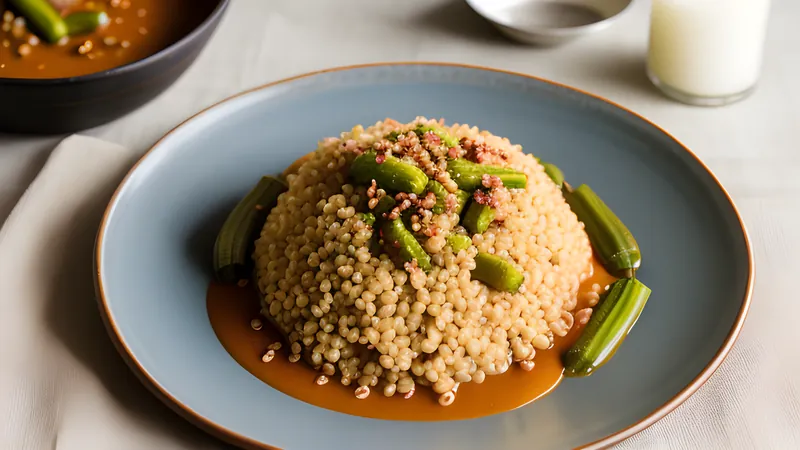
↓ Jump to recipeAseeda is eaten by hand, torn straight from a shared platter rather than served on individual plates. It is a smooth, stiff dough of beaten sorghum, worked over heat until it turns glossy and elastic, then shaped into a wide dome or bowl with a well pressed into the centre for sauce. In Sudan the whole dish sits on a shared platter, and everyone tears off a piece of the dough by hand, using it to scoop mullah, a rich, glossy stewed sauce, straight from the well at the middle. It is a meal built around one motion repeated by everyone at the table, and it is one of the oldest ways of eating grain still practised anywhere on the continent. My twist is a squeeze of lemon stirred into the mullah at the very end, which lifts the whole stew without needing any extra chilli.
Aseeda: Sudan's Sorghum Dome with Mullah
Ingredients
- 250g sorghum flour (or fine white cornmeal as a substitute)
- 700ml water, plus 250ml more for mixing
- 0.5 tsp fine salt
- 300g okra, topped and sliced into rounds
- 2 tbsp vegetable oil
- 1 onion, finely chopped
- 3 garlic cloves, crushed
- 500g beef or lamb, cut into 2cm cubes
- 2 tbsp tomato puree
- 1 tsp ground coriander
- 0.5 tsp ground cumin
- 600ml beef or lamb stock, hot
- 1 tsp fine salt, plus more to taste
- 1 lemon, juiced, to finish (the twist)
Method
- Whisk 250g sorghum flour with 250ml cold water to make a smooth, lump-free slurry.
- Bring the remaining 700ml water to the boil in a heavy saucepan with 0.5 tsp salt.
- Pour the slurry into the boiling water, whisking constantly, and cook for 3 minutes until it thickens.
- Reduce the heat to low and beat the mixture vigorously with a wooden spoon or aseeda whisk for 10 minutes, until smooth, elastic and pulling away from the pan sides.
- Tip the dough into a lightly oiled bowl, smooth the top with a wet spoon, and press a well into the centre. Set aside, covered, to firm slightly.
- For the mullah, heat the oil in a pot and brown the meat in batches, then set aside.
- Fry the onion for 8 minutes until soft, add the garlic, coriander and cumin, and fry for 1 minute.
- Stir in the tomato puree, return the meat to the pot, add the hot stock and salt, and simmer covered for 20 minutes.
- Add the sliced okra and simmer, uncovered, for 8-10 minutes until the sauce is glossy and slightly thickened.
- Stir in the lemon juice, spoon the mullah into the well of the aseeda dome, and serve for everyone to share.
Why the technique works
Beating the sorghum slurry after it thickens is the single technique that separates real aseeda from a bowl of thick porridge, and it is genuinely hard physical work, which is exactly why it is often done by two people taking turns or a strong dedicated whisk. As the starch gelatinises in the boiling water, continuous beating develops a stretchy, elastic structure very similar to what kneading does to wheat gluten, except here it comes entirely from mechanical action on the starch itself rather than any protein network, since sorghum contains no gluten. Stop beating too soon and the dough stays grainy and stiff rather than smooth and pliable; the ten-minute mark given here is a minimum, not a target, and longer beating only improves the texture.
The well pressed into the centre of the dome is not decorative. Sauce poured over a flat surface of aseeda runs off the sides and pools uselessly on the plate; a proper well holds the mullah in place so that every torn piece of dough gets dipped rather than merely dressed, and it is the reason the dish is shaped into a dome with raised edges rather than simply spooned into a bowl.
Method
- Whisk 250g sorghum flour with 250ml cold water in a bowl or jug until you have a smooth, completely lump-free slurry.
- Bring the remaining 700ml water to the boil in a heavy saucepan with 0.5 teaspoon of salt.
- Pour the slurry into the boiling water in a steady stream, whisking constantly, and cook for 3 minutes, until it thickens into a rough porridge.
- Reduce the heat to low. Switch to a sturdy wooden spoon and beat the mixture vigorously and continuously for 10 minutes, until it turns smooth, elastic and pulls cleanly away from the sides of the pan as you stir.
- Tip the dough out onto a lightly oiled shallow bowl or plate. Smooth the top with the back of a wet spoon and press a well into the centre with your thumb or the spoon. Cover and set aside to firm slightly while you make the mullah.
- For the mullah, heat the oil in a separate pot over high heat and brown the meat in batches, 3-4 minutes per batch, then set aside.
- Fry the onion in the same pot for 8 minutes until soft, then add the garlic, ground coriander and cumin, and fry for 1 minute until fragrant.
- Stir in the tomato puree, return the browned meat to the pot, add the hot stock and 1 teaspoon of salt, and simmer, covered, for 20 minutes.
- Add the sliced okra and simmer uncovered for 8-10 minutes, until the sauce turns glossy and slightly thickened, stirring occasionally.
- Stir in the lemon juice off the heat. Spoon the mullah into the well of the aseeda dome and serve immediately, for everyone to share from the same bowl.
Tips and Substitutions
Genuine sorghum flour is sold in African and Middle Eastern grocers and increasingly in larger supermarkets; if you cannot find it, fine white cornmeal makes a reasonable substitute, though the flavour leans more toward polenta than the nuttier, slightly sour note of real sorghum. Do not use coarse cornmeal or polenta grains, which will not gelatinise into the smooth texture the beating stage relies on.
Okra can turn slimy if overcooked or cut too small; slicing it into generous rounds and adding it only in the final 8-10 minutes, rather than at the start of the simmer, keeps its texture pleasant while still thickening the sauce properly. If okra is genuinely not available, a tablespoon of okra powder whisked into the stock achieves a similar thickening effect. Lamb and beef both work well; goat is traditional in many households and can be substituted directly with the same timings.
If your aseeda seizes into hard lumps rather than smoothing out, the slurry likely went in too fast or the water was not at a full rolling boil; next time, pour it in a slow, steady stream while whisking hard, and make sure the water is properly boiling first.
Variations
A version made with millet flour instead of sorghum is common in western Sudan, giving a slightly darker, denser dough with an earthier flavour. Some households skip the meat entirely and make a purely vegetable mullah with okra, tomato and onion alone, particularly during periods of fasting, which keeps the dish just as satisfying without losing the essential sauce-and-dough structure. A dry-spiced version of the meat, rubbed with berbere-style spice before browning, is a popular border variation that shows the dish’s proximity to Ethiopian and Eritrean cooking further south.
Storage and Serving
Aseeda is very much a fresh, eat-immediately dish; the dough firms and turns rubbery as it cools, and it does not reheat well once it has properly set. If you must hold it, cover it tightly with a damp cloth at room temperature for up to an hour, and reheat gently over a low heat with a splash of water, beating it again briefly to restore some smoothness. The mullah, by contrast, keeps well in the fridge for up to 3 days and freezes for up to 2 months, so it is worth making a double batch of sauce even if the dough itself must be freshly made each time.
Serve aseeda for a communal meal alongside other Nile Valley dishes; a bowl of egusi soup shares the same hand-scooped, sauce-and-starch structure if you want to build out a wider shared-platter spread, and bariis iskukaris makes a good rice-based counterpoint on the same table.
Related Content