Ärtsoppa: Swedish Yellow Pea Soup With Mustard
The Thursday soup, with a pork hock and a bloom of mustard on top
Contents
↓ Jump to recipeSweden eats yellow pea soup on Thursdays. This is an operating fact rather than a folk memory: military canteens, school dining halls, hospital kitchens and a large number of ordinary lunch restaurants put ärtsoppa on the board every Thursday, followed by pancakes with jam, and have done for longer than anyone can properly document. The Swedish Armed Forces still do it. Ask a Swede why and you will get one of three answers, delivered with total confidence and no evidence.
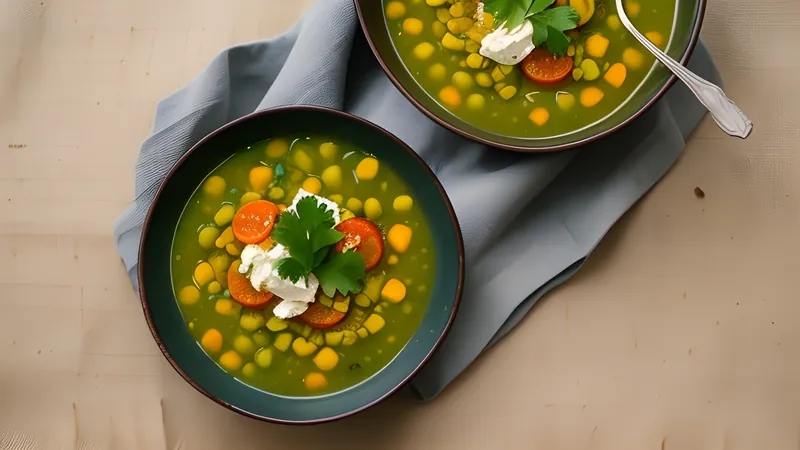
The soup itself is a thick, sweetish, faintly smoky purée the colour of old varnish, with shreds of pork through it and a blob of mustard stirred in at the table. It is one of the best cheap things in northern European cooking and one of the most reliably ruined, almost always for the same reason, which is water.
Ärtsoppa: Swedish Yellow Pea Soup With Mustard
Ingredients
- 500 g dried whole yellow peas
- 2 litres water, plus more as needed
- 1 smoked or salted pork hock, about 800 g
- 1 large onion, finely diced
- 1 tsp dried marjoram
- 0.5 tsp dried thyme
- 2 tsp fine sea salt, plus more to finish
- 0.5 tsp freshly ground white pepper
- 1 tsp caster sugar
- Swedish sweet mustard or Dijon, to serve
- Fresh marjoram or thyme leaves, to serve
Method
- Rinse the peas and cover them with 1.5 litres of cold soft water. Soak for 10–12 hours at room temperature. Do not add salt to the soaking water.
- Drain the peas, discarding the soaking water. Tip them into a large heavy pot with 2 litres of fresh cold water.
- Bring to the boil over high heat. Skim off the grey foam and the loose skins that rise for the first 5 minutes.
- Add the pork hock, onion, marjoram and thyme. Reduce to a bare simmer, cover with the lid slightly ajar, and cook for 1 hour 30 minutes.
- Lift out the hock and set it aside. Continue simmering the soup for a further 30–60 minutes, stirring occasionally, until the peas have collapsed and the soup coats a spoon thickly. Add water if it gets too thick to stir.
- Pull the meat from the hock, discarding skin, bone and gristle. Shred into bite-sized pieces.
- Return the meat to the pot. Stir in the salt, white pepper and sugar. Taste and adjust — smoked hocks vary enormously in saltiness.
- Simmer for a final 5 minutes. The soup should be thick but pourable; loosen with water if needed.
- Ladle into deep bowls. Serve with a pot of mustard on the table for each person to stir in, and a scatter of fresh herbs.
The Thursday question
The most-repeated explanation is Catholic: Friday was a fast day, so Thursday’s meal was loaded with fat and protein to carry you through. This is tidy, plausible, and unproven. Sweden broke with Rome in the 1520s under Gustav Vasa, and the Thursday habit is documented well after that, which means it would have to be a fossil practice surviving four centuries of Lutheranism on pure inertia. Food habits are stubborn enough that it could have happened, though the chain of evidence has a large hole in it.
The second explanation is that peas cook slowly and Thursday was a convenient day to have a pot going while the household did something else. The third is that it was simply the day cheap protein got eaten before the weekend, and that the armed forces standardised it in the nineteenth century and everybody else copied the army. The last is boring and probably closest to the truth: institutional catering has enormous power to set a nation’s habits, and a soup that costs pennies, feeds a barracks and improves overnight is exactly what a quartermaster wants.
The pancakes-after are the same logic that gives you raggmunk: batter, a pan, and a cook who already has one thing on the stove. The soup is also drunk with punsch — a sweet arrack liqueur — in the older tradition, warm, in small glasses, which does more for a February Thursday than it sounds like it should.
Yellow peas themselves predate all of this by a long way. Pisum sativum was one of the founding crops of Neolithic agriculture, and dried field peas were a staple protein across northern Europe centuries before beans or potatoes arrived. Sweden’s version is distinct from the Dutch erwtensoep mainly in the pea: the Dutch use split green peas, which disintegrate to a smooth sludge, while Sweden uses whole yellow peas, which hold some structure and leave the soup with body rather than mere thickness.
Whole peas, and why the skins matter
This is the first thing people get wrong. Ärtsoppa is made with whole yellow peas, skins on, sold in Sweden as gula ärter. Split yellow peas are a different product — mechanically decorticated and halved, with the skins removed — and they will give you a soup that is smooth, uniform and slightly characterless.
The skins do two things. They are almost entirely insoluble fibre, so they survive the cooking and give the finished soup a texture with grain in it, a slight resistance that a purée lacks. And a proportion of them detach during cooking and float, which is why you skim in the first five minutes; the ones that stay in are the ones you want.
A good ärtsoppa is around two-thirds collapsed. Some peas dissolve entirely and thicken the liquid; some hold their shape and give you something to find with the spoon. If yours is a homogeneous paste, you either used split peas or cooked it an hour too long.
The water problem
Here is the thing that actually decides whether your soup works, and almost nobody mentions it.
Dried pulses will refuse to soften in hard water. The mechanism is well established: calcium and magnesium ions cross-link with the pectin in the pea’s cell walls, forming calcium pectate, which is essentially a mineral scaffold that no amount of simmering will break down. You can boil a pot of yellow peas in hard water for four hours and end up with peas that are still gritty in the middle and a broth that never thickens. Your peas are fine. The chemistry is the problem.
Britain has a lot of hard water. If you live anywhere across the chalk and limestone belt — London, the south-east, much of the Midlands — your tap water is likely somewhere between 200 and 350 mg/l of calcium carbonate, which is more than enough to cause this.
Three fixes, in order of preference. Use filtered or bottled soft water for both the soak and the cook; a Brita jug takes out enough hardness to make a visible difference. Add a quarter-teaspoon of bicarbonate of soda to the soaking water, which raises the pH and helps dissolve the pectin — effective, though it costs you some thiamine and can make the peas taste faintly soapy if you overdo it. Or buy the peas from a Nordic or Polish shop with a recent packing date, because old pulses are drier, more cross-linked and worse in every respect.
Salt in the soaking water, incidentally, is fine and possibly helpful — the old advice that it toughens skins has been fairly thoroughly debunked, and sodium ions actually displace some calcium. But salt in the cooking water early on will season unevenly once the hock’s salt starts leaching in, which is why the seasoning here goes in at the end.
The hock
A smoked pork hock — knuckle, shank, whatever your butcher calls the joint above the trotter — is doing three jobs. It seasons the soup with salt and smoke, it contributes gelatine from the huge amount of connective tissue around the joint, and it eventually provides the meat.
The gelatine matters more than people expect. It gives the soup a body that starch alone will not, a slight lip-stickiness that makes a bowl of pulses feel like a proper meal. This is why a vegetarian ärtsoppa, however well seasoned, always tastes a little thin. If you are making one, a spoonful of miso and a good glug of rapeseed oil at the end goes some way to compensating.
Salted rather than smoked is the older Swedish practice and gives a cleaner, sweeter soup. Smoked is what you will find and it is very good. Either way, taste before you salt: I have had hocks that needed two teaspoons and hocks that needed none.
The mustard
Mustard goes in at the table, per bowl, stirred through by the person eating. Treat it as an ingredient rather than a garnish — a bowl of ärtsoppa without it is noticeably duller.
The reason is volatility. Mustard’s heat comes from isothiocyanates, produced when the enzyme myrosinase meets glucosinolates in the presence of water. Both the enzyme and the resulting compounds are destroyed by sustained heat, which is why mustard cooked into a soup goes flat and slightly bitter. Added to a hot bowl at the last second, it blooms — you get the aromatic hit in the nose and the sharpness on the palate before the heat has time to kill it.
Swedish sweet mustard is traditional and its sugar plays well against the smoked pork. Dijon works and is sharper. Either way, a proper teaspoon per bowl, stirred in, and then more if you want it. The same principle drives hovmästarsås, where the mustard is never heated at all.
Consistency, and how to steer it
The finished soup should fall off a ladle in a thick ribbon and hold a shallow trench when you drag a spoon across the surface, closing over in two or three seconds. Thicker than that and it is a purée; thinner and it is broth with peas in it.
Steering it is mostly about the last half-hour. Once the hock comes out, you are simply boiling water off and letting starch leach from the peas, and you have total control. Lid off, and it thickens quickly. Lid on and heat low, and it holds. The mistake is judging thickness while it is boiling — a hot pea soup is always looser than the same soup ninety seconds later, because the amylose has not yet set. Pull a spoonful into a cold saucer and wait; that is what the bowl will be like.
If you have overshot and it is cementing, water is the answer, added a ladleful at a time off the heat and stirred in properly. Stock makes it saltier and muddier. If it is stubbornly thin after an hour, mash a cupful of the peas against the side of the pot with the back of a wooden spoon and stir them back through; ruptured cells release starch immediately and you will see the change within a minute.
The case against
Ärtsoppa is a beige soup with a beige flavour profile and it does very little to sell itself. It has no bright note anywhere in it except the mustard, which is why the mustard is compulsory. Served without it to someone who has never had it, the reaction is usually polite bewilderment.
It is also a five-hour proposition once you count the soak, and there is no honest shortcut. Tinned peas produce a different dish. A pressure cooker will get you there in about forty minutes at high pressure, and it works well, though you lose the gradual layering of the hock’s smoke into the broth and the result tastes assembled rather than cooked. If you have a pressure cooker and a Thursday that got away from you, use it and do not apologise.
And the pork hock is not a delicate thing. There is a lot of fat on a knuckle, and a fair amount of it ends up in the soup. Chilling the soup overnight and lifting the set fat cap off before reheating removes most of it, at the cost of some flavour and most of the point.
Storage, and the second day
Ärtsoppa is better on day two, unambiguously. Overnight in the fridge the starch retrogrades, the smoke distributes, and the whole thing settles into itself. It will also set almost solid — thin it with water, not stock, and bring it back gently, stirring, because a thick pea soup catches and scorches on the bottom of a pan with very little provocation.
It keeps five days refrigerated and freezes well for three months. Freeze it slightly thinner than you want it; you can always cook it down.
Serve it with rye crispbread and butter, and pancakes afterwards if you are doing it properly. It is a Thursday. You may as well.
Related Content