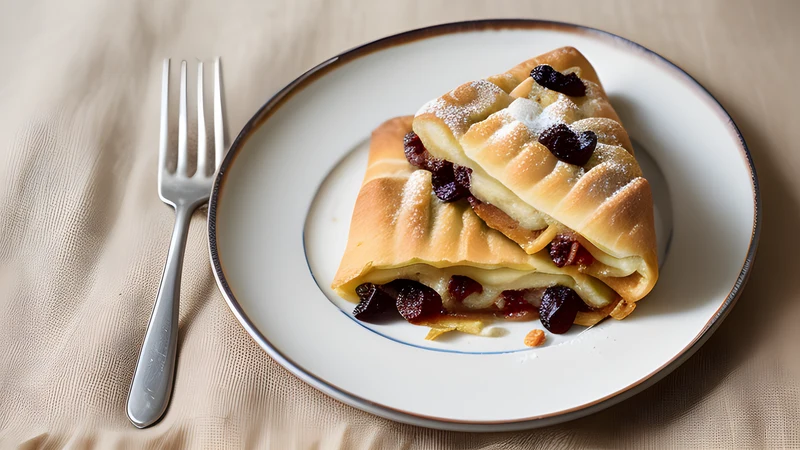
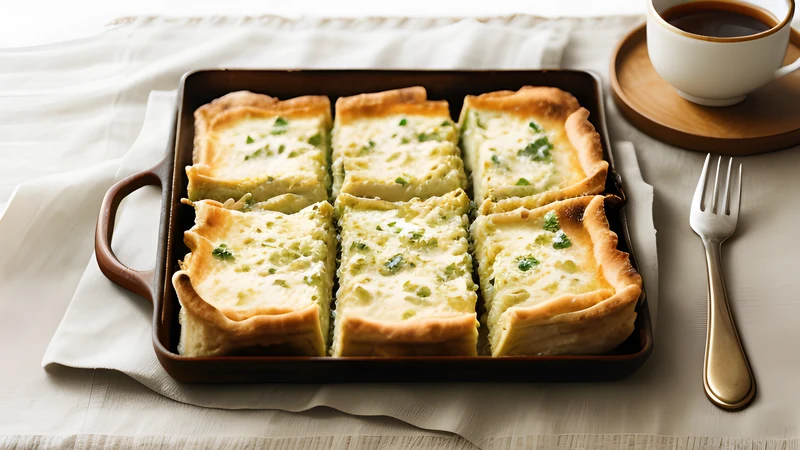
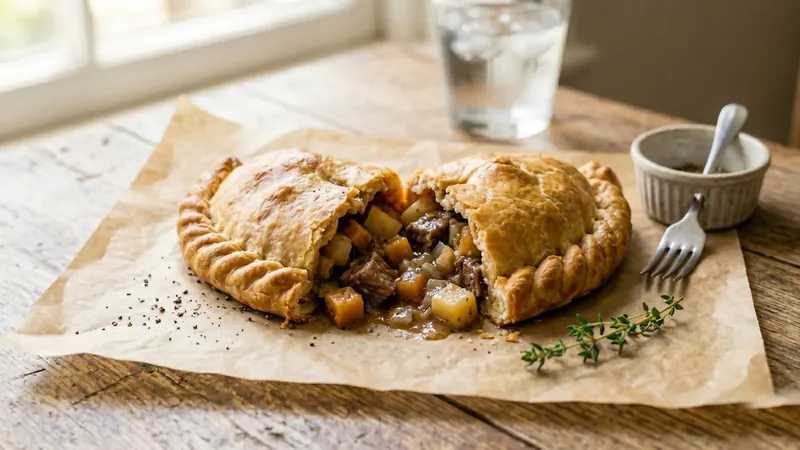
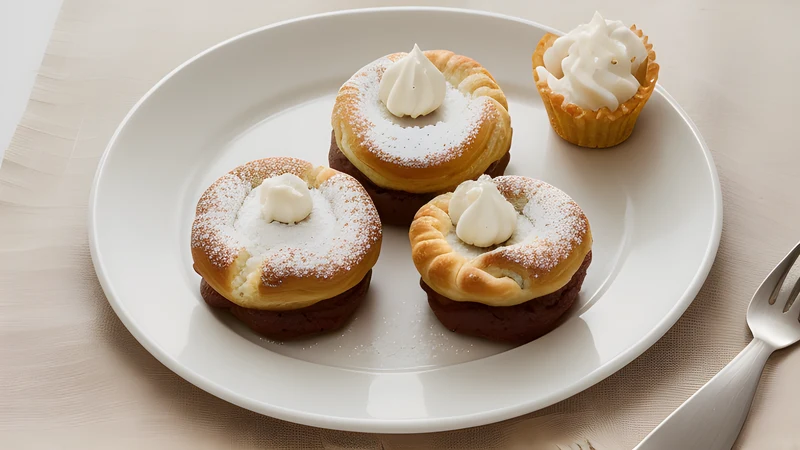
Apfelstrudel: Pulled Pastry Thin Enough to Read Through
A tablecloth, two hands, and 300 years of Viennese showing off
Contents
↓ Jump to recipeThe oldest strudel recipe anyone can point to sits in the Wiener Stadtbibliothek, handwritten in 1696, and it is for a Milchrahmstrudel — a cream strudel. It is worth knowing that the document exists, because it dates the dish to a moment when Vienna had just spent a century being besieged by the Ottoman Empire and was busy absorbing its cooking.
That is the honest genealogy. Strudel dough is a descendant of the paper-thin yufka and filo of Anatolia, carried north through Hungary into the Habsburg lands, where cooks stopped layering the sheets with butter and started rolling a single enormous one around a filling. The Turks made the pastry. The Hungarians moved it. The Viennese made it a national symbol and put it on a plate with whipped cream, and by the nineteenth century you could not be a serious Austrian cook without being able to do it.
The measure of that dough has been the same for 300 years. You should be able to lay it over a newspaper and read the newspaper.
Apfelstrudel: Pulled Pastry Thin Enough to Read Through
Ingredients
- 250 g strong white bread flour
- 125 ml warm water, at 40°C
- 2 tbsp sunflower oil, plus more for coating
- 1 tsp white wine vinegar
- 1/2 tsp fine salt
- 1 large egg yolk
- 80 g raisins
- 3 tbsp dark rum
- 100 g unsalted butter, for the crumbs
- 120 g dry white breadcrumbs
- 40 g dark muscovado sugar
- 1 kg tart apples (Bramley, Boskoop or Braeburn), peeled, cored and sliced 3 mm thick
- 80 g caster sugar
- 2 tsp ground cinnamon
- Finely grated zest of 1 lemon
- 2 tbsp lemon juice
- 60 g walnuts, roughly chopped
- 100 g unsalted butter, melted, for brushing
- Icing sugar, to finish
Method
- Put the flour, warm water, 2 tbsp oil, vinegar, salt and egg yolk in a stand mixer and knead with a dough hook for 10 minutes, until the dough is very smooth, soft and slightly shiny.
- Shape it into a tight ball, coat it all over in oil, put it in a bowl, cover, and rest somewhere warm for 45 minutes. It must be soft and slack when you come back to it.
- Soak the raisins in the rum for 30 minutes.
- Melt the 100 g butter in a wide frying pan over medium heat. Add the breadcrumbs and fry for 8 minutes, stirring constantly, until deep golden. Add the muscovado and fry 2 minutes more, until the crumbs darken and smell of toffee. Tip onto a plate and cool completely.
- Toss the sliced apples with the caster sugar, cinnamon, lemon zest and lemon juice. Do this no more than 15 minutes before assembly.
- Heat the oven to 190°C. Cover a table with a large clean cotton cloth or tablecloth and dust it well with flour.
- Roll the dough on the cloth into a rough 30 cm rectangle. Now put your floured hands underneath, backs upward, and stretch the dough outward from the centre, working around the edges, until it covers about 70 x 50 cm and you can read newsprint through it. Trim off the thick edges.
- Brush the whole sheet with melted butter. Scatter the cooled crumbs over the lower two thirds, leaving a 5 cm border all round. Pile the apples in a log along the near edge, on top of the crumbs, then scatter over the drained raisins and walnuts.
- Fold the two side borders inward over the filling. Lift the near edge of the cloth and let the cloth roll the strudel away from you into a tight log. Roll it seam-side down onto a lined baking tray, curving it if needed to fit.
- Brush generously with the remaining melted butter. Bake for 45 minutes, brushing twice more during the bake, until deep brown and blistered.
- Cool for 20 minutes, dust heavily with icing sugar, and cut with a serrated knife.
The dough, and why it can do that
There are six ingredients here and each one is doing a specific job.
Strong flour. You want the highest protein you can buy — 12–14%. Everything about this dough depends on gluten, and specifically on extensibility: the ability of the network to stretch a long way without snapping back or tearing. Plain flour at 9% will not go past about half the size you need.
Ten minutes of kneading. Longer than bread. You are building the most developed gluten network you will ever make deliberately, aligning the glutenin chains into long elastic strands.
Vinegar. A teaspoon, and it earns its place. Lowering the pH of the dough weakens some of the disulphide bonds cross-linking the gluten proteins, which makes the network more extensible and less springy. It is the difference between dough that stretches and dough that fights you.
Oil, inside and out. It lubricates the gluten sheets so they can slide past one another, and the coating on the outside stops a skin forming during the rest.
Warm water and a warm rest. This is the one people skip and it matters more than any of the others. Gluten relaxes as a function of temperature and time, and 45 minutes at room temperature does what three hours in a fridge will not. The dough must be genuinely soft and slack when you come back — if it springs back when poked, it needs longer. There is no shortcut and pulling an under-rested dough is a guaranteed tear.
Egg yolk. Optional in some Austrian households, and it makes the sheet a little more forgiving and slightly richer.
Pulling it
Flour the cloth well. Roll the dough out to a rectangle first, then stop using the pin.
The stretch happens with the backs of your hands, floured, underneath the dough. Take off every ring. Fingertips puncture; knuckles do not. Work from the centre outward and move around the table constantly, so that you are always pulling the thickest part. The dough will thin unevenly if you stay in one place, and once a section goes translucent, it will keep going and then hole.
Let gravity help. Lift a section and let the weight of the sheet do some of the work as you walk it outward. It will feel alarming. The dough is far stronger than it looks and 250 g of it will comfortably cover most of a kitchen table.
The edges stay thick because they have nothing to pull against, and that is normal. Trim them off with a knife once you have finished; leaving them gives you a raw, doughy seam in the finished roll.
When it tears — and it will, the first three times — carry on. A hole in the middle of the sheet gets rolled up inside 5 or 6 turns of pastry and nobody will ever find it. A tear at the near edge, where the filling sits, is the only one worth patching, and you patch it with a trimmed scrap of the thick edge pressed on with buttered fingers.
If you genuinely cannot face it, filo is an honest substitute. Six sheets, each brushed with butter, layered. It gives you about 80% of the result and no drama. The Viennese would rather you did that than gave up.
The crumbs are the recipe
A kilogram of apples releases a startling amount of juice in a 190°C oven. If nothing absorbs it, that juice sits against the pastry for 45 minutes and you slice into a strudel with a grey, sodden underside. Buttered breadcrumbs are what stops it, and they are the ingredient most home recipes treat as an afterthought.
My change is to take them further than tradition does. The standard is breadcrumbs fried in butter until golden. I fry them for eight minutes until deep golden, then add 40 g of dark muscovado and give them two minutes more, until the sugar melts, coats every crumb and starts to catch. What comes out is a candied, dark, almost praline-like crumb that tastes of toffee and toast.
This does two things. It still absorbs the juice — the starch is doing that regardless. And it stops the crumb layer being a purely functional barrier and makes it the best-tasting thing in the strudel. Muscovado brings its own molasses, so you get a bitter-caramel note underneath the apple that plain crumbs cannot reach.
Cool them completely. Warm crumbs on a buttered sheet make it greasy and the sheet will tear as you roll.
The apples
Tart, firm, and sliced rather than chopped. Bramley collapses to purée, which some Austrians actually want; Boskoop is the classic and holds shape while going properly soft. Braeburn is the best widely available compromise in Britain. Sweet eating apples produce a filling with nothing to say.
Three millimetres. Thicker and they stay crunchy in the centre of a rolled log; thinner and they disintegrate. Slice, do not dice — the slices lie against each other and knit into a layer, while cubes leave gaps that fill with juice.
Toss them with sugar and lemon no more than fifteen minutes before rolling. Sugar draws water out of apple by osmosis, and apples left sitting for an hour will be swimming, and you will have poured that water into the pastry.
Failure modes
Soggy base. Not enough crumbs, or crumbs spread too thin. 120 g for a kilo of apples is right, and the layer should be a visible bed under the fruit.
It bursts in the oven. Rolled too loosely, or seam-side up. Steam needs a tight roll to push against. Seam down, and pinch the ends closed.
Pale and soft. Underbaked, or underbuttered. Strudel wants 45 minutes and it wants brushing three times — the butter is what blisters and crisps the outer sheets. It should be genuinely dark brown before it comes out.
It shatters when sliced. Serrated knife, gentle sawing, and give it 20 minutes to settle first. A strudel straight from the oven has steam pressure inside it and will explode under a blade.
Variations across the old empire
Strudel spread with the Habsburgs, and every province that got it changed something.
Vienna keeps it as written: apple, cinnamon, raisin, walnut, crumbs, served warm with a jug of vanilla sauce or a scoop of unsweetened whipped cream. The cream is unsweetened deliberately, because the strudel already carries 120 g of sugar.
Hungary calls it rétes, pulls the dough even thinner, and makes it in numbers — cherry, poppy seed, cabbage, curd. The savoury cabbage rétes, with caramelised cabbage and a great deal of black pepper, is the version most Austrians have never tried and should.
South Tyrol grinds the walnuts finer and adds pine nuts, and often uses a short pastry base instead of pulled dough entirely, which produces a sturdier thing closer to a tart.
Bohemia soaks the raisins in slivovitz rather than rum and adds a little ground clove.
The one variation to avoid is the version with custard poured inside before baking. It sounds appealing and it destroys the crumb layer’s ability to manage moisture, and you will slice into paste.
Two things worth adding
Brown a knob of butter for the final brush. The last coat of butter, taken to nut-brown, gives the outer sheets a deeper colour and a nuttiness that plain melted butter does not. Use it only for the final brushing — brown butter on the raw sheet burns over 45 minutes.
A pinch of salt in the apples. Half a teaspoon across a kilo. Undetectable as salt, and it sharpens the cinnamon and stops the sugar reading as flat. Every professional Austrian kitchen does this and no home recipe writes it down.
Storage
Best two hours out of the oven, warm, and it declines from there. Overnight the crumbs give the moisture back and the pastry softens; a reheat at 170°C for 12 minutes recovers perhaps three quarters of the crispness. It keeps two days at room temperature under a cloth, never in a fridge, where it will go limp within hours.
The raw dough freezes well for a month, wrapped tightly and oiled. Thaw it overnight and then rest it warm for a full hour before pulling — cold gluten will not stretch.
The case against, honestly
This needs a table you can walk all the way around, cleared, covered with a cloth, in a warm kitchen. A worktop will not do it. That requirement alone rules it out of a lot of homes, and there is no version of the pulling that works in a confined space.
It is also a two-person job the first time. Somebody needs to hold the far edge while you walk the near one, and somebody needs to lift the cloth when the roll starts. Austrians learn it standing next to a grandmother, which is the correct method and difficult to arrange at short notice.
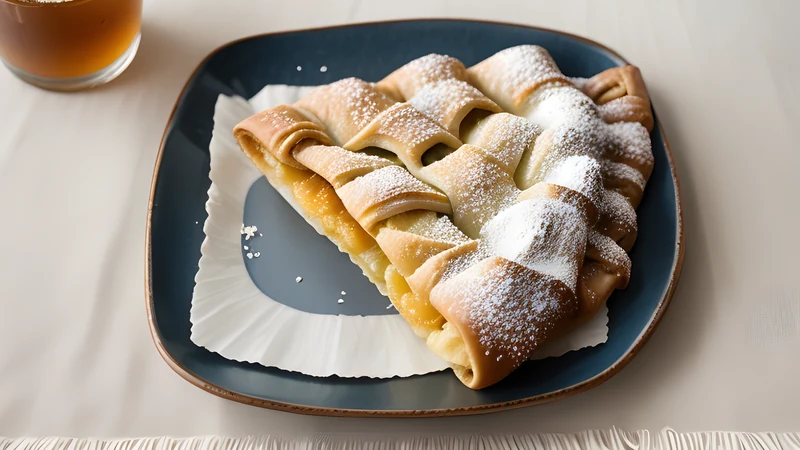
And it is fundamentally a modest dessert dressed as a spectacle. Once you cut it, it is apples and cinnamon in pastry. The pleasure is in the thinness — six or seven distinct layers in a slice, each one crisp — and if the pulling goes badly, what you have is a large apple turnover with a story attached.
Where it sits
Topfenstrudel uses the identical dough with quark instead of fruit, and it is closer to that original 1696 cream strudel than the apple version is. Kaiserschmarrn is what the same Viennese kitchen does when it has fifteen minutes rather than three hours, and Marillenknödel uses buttered crumbs for exactly the same reason this does.
For apples handled entirely differently, appelflappen drop the fruit into hot fat and are done in four minutes.
Icing sugar heavily, at the table. It dissolves into the hot pastry within ten minutes and then you have to do it again.
Related Content