Anzac Biscuits with Coconut and Golden Syrup
Chewy, oaty and unapologetically old-fashioned
Contents
↓ Jump to recipeSome biscuits are clever and some are just right, and the Anzac biscuit firmly belongs in the second camp. There is no egg to separate, no leavening drama, no chilling of the dough, no chocolate to temper, no piping bag in sight. There is oats, coconut, butter and golden syrup, bound by a clever little chemistry trick, and baked into a biscuit that manages to be chewy in the middle and crisp at the edge, sweet but not sickly, and deeply, satisfyingly nostalgic. It is the sort of thing you make in one bowl on a wet afternoon, with ingredients that live permanently in the cupboard, and then find you cannot stop eating straight off the cooling rack.
A biscuit with a history
The Anzac biscuit carries real weight behind its homely appearance. ANZAC stands for the Australian and New Zealand Army Corps, and the biscuits are associated with the First World War, when versions of this hard-keeping oat biscuit were made and sold to raise funds for the war effort and, in popular memory, sent in care packages to soldiers serving overseas. Their lack of eggs was practical as much as anything: eggs were scarce, and an egg-free biscuit travelled far better, keeping for weeks without spoiling on the long sea voyage.
That heritage means the name carries genuine significance in Australia and New Zealand, where the term Anzac is legally protected and the biscuit is closely tied to commemoration around Anzac Day on the twenty-fifth of April. The protection is not a figure of speech: Australian law restricts commercial use of the word “Anzac” and, by convention, the product must be called a biscuit rather than a cookie and must not stray far from the traditional recipe. Tradition holds firmly that they should be called biscuits, never cookies. They remain a fixture of home baking across both countries, the kind of recipe handed down on a splattered index card, and arguments about the correct degree of chewiness versus crispness are a genuine and ongoing national sport.
It is worth clearing up one persistent piece of folklore. The idea that these exact biscuits were baked at home and posted to the trenches at Gallipoli is largely a later, romantic embellishment; food historians point out that the recipe as we know it, with rolled oats and coconut, appears mostly in cookbooks from the 1920s, after the war. What is true is that egg-free, long-keeping oat biscuits were sold at fêtes and galas to raise money for the war effort, and that the association between the biscuit and remembrance grew from there. The heritage is real; the specific care-package story is a myth that hardened into fact, as good stories tend to.
Anzac Biscuits with Coconut and Golden Syrup
Ingredients
- 100g rolled oats
- 85g desiccated coconut
- 150g plain flour
- 150g caster sugar
- 125g unsalted butter
- 2 tbsp golden syrup
- 0.5 tsp bicarbonate of soda
- 2 tbsp boiling water
- 0.25 tsp fine salt
Method
- Heat the oven to 160C fan and line two trays with baking paper.
- Mix the oats, coconut, flour, sugar and salt in a large bowl.
- Melt the butter with the golden syrup in a small pan over a low heat until smooth.
- Stir the bicarbonate of soda into the boiling water, then stir this into the warm butter mixture, where it will foam up.
- Pour the wet mixture into the dry ingredients and stir until evenly combined.
- Roll heaped tablespoons into balls, place well apart on the trays and flatten each gently.
- Bake for 13 to 15 minutes until deep golden all over.
- Leave on the trays for ten minutes to firm up, then transfer to a rack to cool completely.
The golden syrup and bicarb trick
What makes an Anzac biscuit work is the interplay between golden syrup and bicarbonate of soda. Golden syrup is a thick, amber British and Australasian sweetener, an inverted sugar syrup with a gentle butterscotch flavour, and it is the soul of the biscuit. It brings moisture, chew and a caramel depth that ordinary sugar cannot. There is no real substitute, although a light treacle or a mild honey will get you somewhere close in a pinch.
The bicarbonate of soda is the magic. Dissolved in boiling water and stirred into the melted butter and syrup, it foams up dramatically, and that aeration is what gives the baked biscuit its slightly open, sandy texture rather than a dense, hard one. The foaming is a small acid-base reaction: the mildly acidic golden syrup reacts with the alkaline bicarb to release carbon dioxide, and the boiling water speeds it along, which is why the mixture froths the instant you stir it in. That gas gets trapped in the warm, thick batter and expands in the oven, opening up the crumb. The bicarb, being alkaline, also raises the pH of the dough, and a higher pH encourages faster browning through the Maillard reaction and helps the biscuits spread, which is exactly what you want. Stir it in quickly and get the mixture into the dry ingredients while it is still lively, because if you let it sit, the gas escapes and you lose some of the lift.
There is a reason there is no egg here beyond wartime thrift, and it is worth understanding. Eggs add structure and set a biscuit firmer and cakier; leaving them out is what allows the Anzac to stay tender and chewy in the middle. The binding job the egg would normally do is handled instead by the golden syrup and melted butter, which glue the dry ingredients together, and by the starch in the oats and flour. It is a beautifully economical piece of baking, every element earning its place.
Chewy or crisp, the eternal question
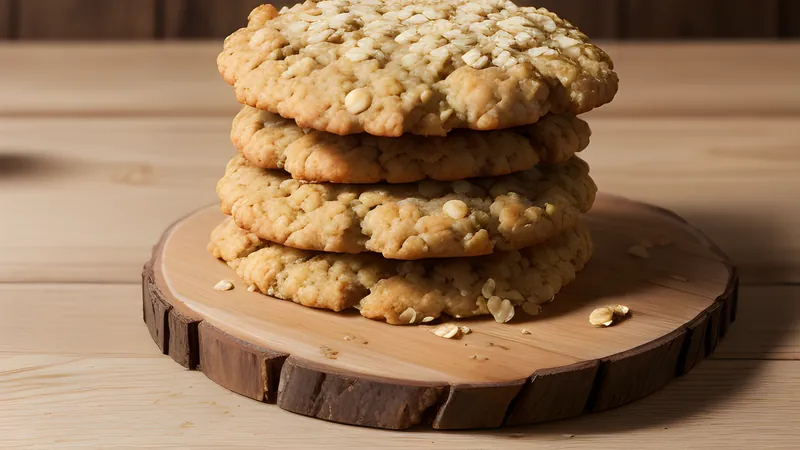
Here is the one decision you actually have to make. Anzac biscuits can be baked chewy or crisp, and the difference comes down mostly to size, thickness and time. For chewy biscuits, roll the dough into balls, flatten them only a little, and pull them out while they still look slightly soft, around the thirteen-minute mark; they firm up as they cool. For crisp, snappable biscuits, press them flatter, space them generously so they spread thin, and bake a couple of minutes longer until uniformly deep gold. Both are correct, whatever your relatives insist.
Whichever you choose, the crucial step is to leave them on the hot tray for a good ten minutes after baking. Straight from the oven they are floppy and fragile, and trying to move them too soon will tear them apart. As they sit, the sugar and syrup set and the biscuits become sturdy enough to lift onto a rack. This patience is the difference between intact biscuits and a tray of delicious rubble. The reason is simple physics: while hot, the melted sugar in the biscuit is fluid and offers no support, and only as it cools below its setting point does it turn back into a rigid structure that can hold the biscuit’s shape. Rush it and you are asking a liquid to behave like a solid. Space the biscuits well apart on the tray, too, because they spread considerably as the butter melts and the bicarb does its work, and a crowded tray gives you one large biscuit sheet rather than twenty individual ones.
Tips for the best batch
Use rolled porridge oats rather than instant or jumbo for the ideal texture; very large oats stay tough, and instant ones turn powdery. Desiccated coconut is traditional and gives a finer crumb, though a little shredded coconut adds pleasant texture if you prefer. Watch the colour closely at the end, because there is no egg or flour cue to tell you they are done; deep golden all over is your signal. A pinch of salt, not always traditional, sharpens the caramel and is, in my opinion, a small improvement worth making.
For variations, a handful of chopped dark chocolate or some flaked almonds folded into the dough is a modern liberty that purists will frown at and everyone else will enjoy. A little grated lemon or orange zest lifts them nicely. A pinch of ground ginger or mixed spice pushes them towards the warmer, spiced end of things without betraying the recipe. But the plain original, all oats and coconut and golden syrup, is hard to beat, and it keeps in a tin for a fortnight, which is exactly what it was designed to do.
If you like the way desiccated coconut behaves in baking, it does similar work binding and enriching the semolina and coconut cake namoura with orange blossom syrup, and it turns up in a savoury register in a warming red lentil coconut dal. The same bag of coconut is equally at home stirred into mango coconut overnight oats for the morning after a baking session.
Related Content