Älplermagronen: Alpine Macaroni With Potato, Cream and Apple Sauce
Pasta and potato in one pan, and apple sauce on the side
Contents
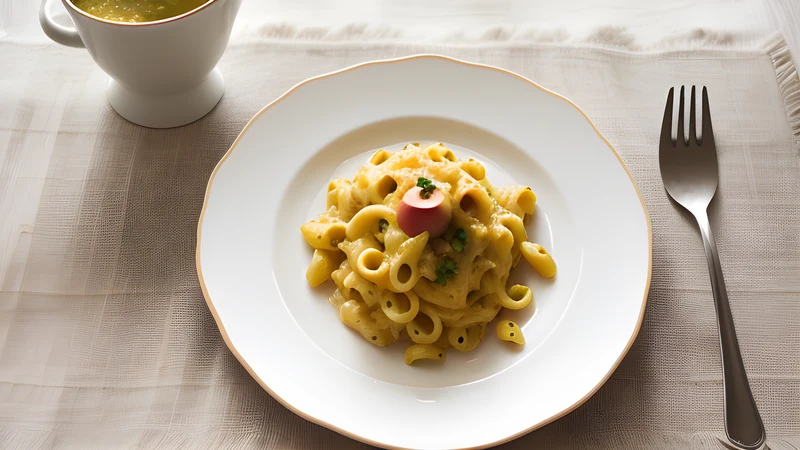
↓ Jump to recipeThe first time someone puts a bowl of apple sauce next to your macaroni cheese, you assume a mistake has been made. It has not. Älplermagronen is a Swiss dish built on three ideas that each sound wrong and are each correct: pasta and potato in the same bowl, both cooked in the same pan of milk, and apple sauce on the side.
The name translates as “alpine herdsman’s macaroni” — Älpler being the men who spent the summer on the high pastures with the cattle, in huts a long walk from anywhere. Everything about the dish follows from that setting.
Älplermagronen: Alpine Macaroni With Potato, Cream and Apple Sauce
Ingredients
- 500 g Bramley or Boskoop apples, peeled, cored and chopped
- 2 tbsp caster sugar
- 1 strip lemon peel
- 3 tbsp water
- 3 large onions, about 400 g, halved and sliced 3 mm thick
- 40 g unsalted butter
- 2 tbsp neutral oil
- 0.5 tsp fine salt, for the onions
- 500 g waxy potatoes, peeled and cut into 1.5 cm dice
- 400 ml whole milk
- 400 ml chicken or vegetable stock
- 1.5 tsp fine sea salt
- 250 g macaroni or short elbow pasta
- 250 ml double cream
- 150 g Gruyère, coarsely grated
- 100 g Appenzeller or a mature Bergkäse, coarsely grated
- 0.25 tsp freshly grated nutmeg
- 0.5 tsp freshly ground black pepper
Method
- Make the apple sauce first. Put the apples, sugar, lemon peel and water in a small pan, cover, and cook over a low heat for 12–15 minutes, stirring twice, until completely collapsed. Beat with a spoon to a rough purée, discard the peel, and leave to cool to room temperature.
- Fry the onions. Melt the butter with the oil in a wide frying pan over a medium heat, add the onions and the 0.5 tsp salt, and cook for 20–25 minutes, stirring every few minutes, until deep brown and crisp at the edges. Lower the heat if they colour unevenly. Drain on kitchen paper and set aside.
- Put the diced potato in a large, wide pan with the milk, stock and 1.5 tsp salt. Bring to a gentle simmer — watch it, milk catches — and cook for 8 minutes.
- Add the macaroni to the same pan and stir. Cook at a gentle simmer for a further 9–11 minutes, stirring every 2 minutes to stop the base catching, until the pasta is al dente and the potato is tender. The liquid will have reduced and thickened considerably.
- Pour in the cream and bring back to a simmer for 2 minutes.
- Take the pan off the heat. Wait 60 seconds, then add the Gruyère and Appenzeller a handful at a time, stirring after each until melted. Adding cheese to a boiling pan will make it stringy and greasy.
- Stir in the nutmeg and black pepper. Taste for salt — the cheese is salty, so it may need none.
- Tip into a warm serving dish, pile the fried onions over the top, and bring the apple sauce to the table in its own bowl.
Why the herdsmen made this
Think about what an Älpler had in a summer hut at 1,800 metres in about 1900. He had milk and cream, because he was standing next to fifty cows. He had cheese, because making it was his job. He had potatoes, which grow at altitude and keep for months. He had onions, which keep even longer. And from the late nineteenth century onwards, once the Swiss railways reached the valleys and dried pasta became cheap and shippable, he had macaroni — a dry good that weighed almost nothing, kept indefinitely, and cooked in ten minutes over a small fire.
That last part is the key to why the dish exists at all. Dried pasta arrived in the Swiss Alps as an industrial convenience, and the herdsmen adopted it enthusiastically for exactly the reasons that make it convenient today. Älplermagronen is a modern dish wearing a rustic costume; it cannot be older than the pasta trade that supplied it.
The one-pan method has the same logic. Fuel at altitude means wood you carried up yourself, so you do not boil pasta in one pot and drain it and cook potatoes in another. You put everything in the one pan, in the milk you have too much of, and you eat it out of the pan.
The apple sauce is the part that looks decorative and is actually structural. Everything on this plate is fat, starch and salt — cream, cheese, potato, pasta, butter. There is no acid anywhere. A cold, sharp apple purée alongside cuts through it, resets your palate between mouthfuls, and makes the fourth forkful as good as the first. It is doing the same job that cranberry does next to turkey, or that German Rotkohl with apple and clove does next to pork. Use a sharp cooking apple and do not sweeten it much; Bramley is ideal precisely because it is unpleasant to eat raw.
The one-pan starch trick
Cooking pasta in milk-and-stock instead of boiling it in water and draining it is the technique that makes this different from macaroni cheese.
When pasta cooks, it sheds amylose and amylopectin into the surrounding liquid. Drain that liquid down the sink and the starch goes with it; you then have to rebuild body with a roux or with an enormous quantity of cheese. Cook the pasta in a measured amount of liquid that stays in the pan, and all that starch stays too, thickening the liquid into a sauce as it goes. Add the potato — which sheds its own starch — and you have a self-thickening system that needs no flour at all.
Two things make this go wrong. The first is scorching: milk proteins and lactose catch and burn on a hot base, and the burnt flavour is unrecoverable. Use the heaviest wide pan you own, keep it at a gentle simmer with bubbles just breaking, and stir every two minutes, scraping the base with the flat of a wooden spoon. The second is the ratio. Eight hundred millilitres of liquid for 250 g pasta and 500 g potato is calculated to leave you with a thick, saucy result at the moment both are cooked. Use more and it is soup; use less and the pasta will be chalky because there was not enough water for the starch to hydrate.
The potato goes in eight minutes ahead because 1.5 cm dice of waxy potato takes about seventeen minutes at a simmer and the macaroni takes about nine. Cut the dice smaller and they turn to mush; cut them larger and they are hard when the pasta is done. Waxy varieties, again — Charlotte or Nicola — because floury potatoes disintegrate entirely and turn the whole thing into wallpaper paste. The same distinction matters for rösti, and for the same reason.
The cheese, and the temperature that ruins it
Take the pan off the heat before the cheese goes in, and wait a minute. This is the single most important instruction here.
Cheese is a protein matrix holding fat globules. Warmed gently, the matrix relaxes and the fat disperses into the liquid, giving you a smooth sauce. Heated past about 80°C, the casein proteins contract and squeeze the fat out — the emulsion breaks, the protein pulls into stringy ropes, and a slick of orange oil rises to the surface. Once it splits, it stays split.
So: off the heat, a minute’s pause, then cheese in handfuls with a stir between each. Grating coarsely rather than finely helps too, oddly — fine gratings clump together and melt as a mass, while coarse shreds disperse before they melt.
Gruyère is the backbone: it is a good melter with real nuttiness. Appenzeller brings the funk, which the dish needs; it is washed in a herbal brine and tastes of it. A mature alpine Bergkäse does the same job. Cheddar is a poor substitute here — it is more acidic, it breaks more readily, and it tastes of the wrong country. If you want a study in cheese sauce done the other way, with a roux, mac and cheese is that argument, and cauliflower cheese with a mustard crumb is the same technique applied to a vegetable.
The onions do real work
Röstzwiebeln — properly browned, crisp fried onions — go on top, and they are load-bearing. They contribute the only crunch on the plate and the only bitterness, and both are needed against all that dairy.
Twenty-five minutes is the honest time. Onions contain a lot of water and a lot of sugar; they must sweat, then dry, then brown, in that order, and rushing the heat gives you onions that are black at the edges and raw in the middle. Salting them at the start draws the water out faster and speeds the whole thing up. Drain them on paper so they crisp as they cool.
Make double. They keep in a jar for a week and improve almost anything.
The pasta shape, and why it has to be short
Macaroni, and specifically short elbow macaroni around 2 cm long. The Swiss are firm about this and they are right for a reason that is easy to demonstrate: the dish is eaten with a spoon, and every mouthful should contain pasta, potato and sauce in roughly equal parts. A short tube is close in size to a 1.5 cm potato dice, so the two distribute evenly through the pan and end up together on the spoon. Anything long — spaghetti, tagliatelle — separates from the potato immediately and you get two dishes sharing a bowl.
The tube also earns its keep. Sauce gets inside it, which shells and twists manage less well, and the hollow means the pasta cooks from both surfaces and finishes in step with the potato. If you cannot find macaroni, use small penne or ditalini. Avoid anything with ridges designed to grip a thin sauce — this sauce is thick enough already and the ridges just make it cling in clumps.
Buy bronze-die pasta if the choice is there. The rougher surface sheds more starch into the pan, which in a dish that relies entirely on shed starch for its body is a genuine advantage rather than a marketing line.
Variations, troubleshooting and storage
The Swiss argue about additions. Diced Speck fried with the onions is common and good. Some versions bake the finished dish under a cheese crust, which is a betrayal of the one-pan idea and produces something closer to a gratin. Others add a splash of the pasta’s cooking milk at the table if it has tightened.
It is gluey. Overcooked pasta, or floury potatoes. Both release too much starch.
It is soupy. Under-reduced. Simmer another two minutes before the cream goes in; it thickens further as it stands.
It split. The cheese went into a boiling pan. A splash of cold milk and vigorous stirring off the heat sometimes rescues it.
It caught on the base. Heat too high, pan too thin, or you did not stir. Do not scrape up the burnt layer — you will distribute it.
It tastes flat. You skipped the apple sauce, or you skipped the nutmeg. Both are structural.
It keeps for three days in the fridge and it thickens dramatically as the starch retrogrades overnight. Reheat in a pan over a low heat with 50–100 ml of milk stirred in, which brings it back almost completely. It does not freeze well; the sauce breaks on thawing. Fry fresh onions for the reheated version — the old ones will have gone soft in the fridge, and the crunch is half the point.
Related Content