Agnolotti del Plin: The Pinched Parcels of the Langhe
Roast-meat filling, a strip of dough, and one pinch per parcel
Contents
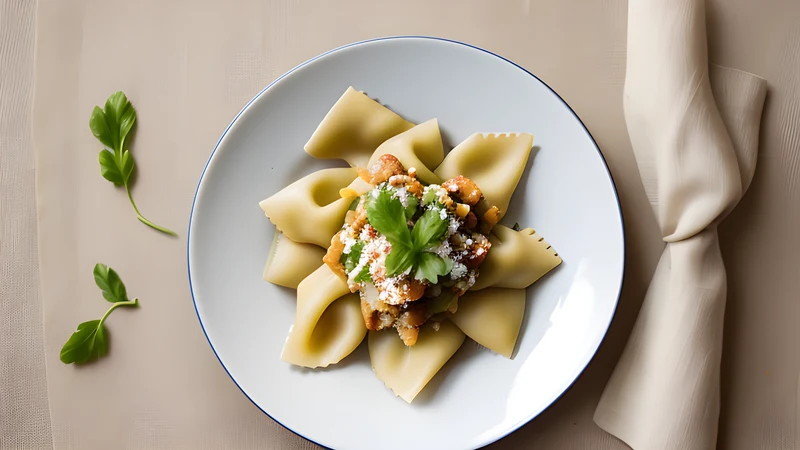
↓ Jump to recipePlin is Piedmontese for “pinch”, and it is the entire instruction. You lay a line of filling along a strip of dough, fold the dough over, and pinch between each blob with the side of your little finger. The pinch seals the parcel, portions it, and leaves the little pleated waist that gives the pasta its name. Everything else is detail.
The detail takes an afternoon. Agnolotti del plin are the smallest serious filled pasta in Italy — a good one is about the size of a thumbnail — and the filling is roast meat that has spent two hours in a covered pot. This is a Sunday project and it is worth every minute, because the payoff is the best pasta in Piedmont and one of the best in the country.
Agnolotti del Plin: The Pinched Parcels of the Langhe
Ingredients
- 300 g Italian 00 flour
- 3 large eggs
- 6 large egg yolks
- 5 g fine sea salt
- 1 tbsp olive oil
- 250 g pork shoulder, in one piece
- 250 g veal or beef shin, in one piece
- 200 g rabbit leg meat, off the bone
- 30 g unsalted butter
- 2 tbsp olive oil, for roasting
- 1 small onion, finely chopped
- 1 carrot, finely chopped
- 1 celery stick, finely chopped
- 2 garlic cloves, crushed
- 1 sprig rosemary
- 2 sage leaves
- 150 ml dry red wine
- 200 g savoy cabbage or escarole leaves
- 60 g Parmigiano Reggiano, finely grated
- 1 large egg, for the filling
- 1 pinch freshly grated nutmeg
- 50 g unsalted butter, to finish
- 6 sage leaves, to finish
Method
- Mound the flour on a board, make a deep well and add the eggs, yolks, salt and olive oil. Draw the flour in with a fork, then knead hard for 10 minutes until the dough is smooth, very firm and springs back slowly. Wrap and rest at room temperature for 1 hour.
- Heat the oven to 160C fan. Season the pork, veal and rabbit generously with salt. Brown them hard in a casserole in the butter and olive oil, in batches, about 4 minutes a side, until deeply coloured.
- Lift the meat out. Add the onion, carrot, celery and garlic to the pot and cook for 8 minutes until soft. Pour in the wine and let it bubble down by half, scraping the base.
- Return the meat with the rosemary and sage, cover and roast for 2 hours, until the meat pulls apart with a fork. Add 100 ml water if it looks dry.
- Lift out the meat. Strain the pan juices into a small pan and reserve every drop - this is the sauce.
- Blanch the cabbage in boiling salted water for 3 minutes, drain, cool under cold water and squeeze it as dry as you physically can.
- Chop the meat and cabbage together very finely by hand, or pulse 8-10 times in a food processor. Do not make a paste.
- Mix the meat with the Parmigiano, the egg, the nutmeg and 2 tbsp of the reserved juices. Season with salt and taste it. Chill for 1 hour.
- Roll the dough through a pasta machine to the thinnest setting, in strips about 12 cm wide. Work with one strip at a time and keep the rest covered.
- Pipe or spoon hazelnut-sized blobs of filling in a line along the lower half of the strip, 2 cm apart, 1.5 cm from the edge.
- Fold the top half of the dough over the filling. Press down firmly between each blob with the side of your little finger - this is the plin, the pinch.
- Cut along the folded edge with a fluted wheel to trim it, then cut between each parcel. Toss on a lightly floured tray.
- Bring the reserved pan juices to a simmer. Melt the 50 g butter in a wide pan with the sage until it foams and smells nutty.
- Cook the agnolotti in plenty of boiling salted water for 2-3 minutes, until they float and the dough at the pinch is tender.
- Lift them straight into the butter pan with a spider, add 4 tbsp of the hot pan juices and 2 tbsp pasta water, and toss for 30 seconds until glossy. Serve at once.
Where they come from and why they are so small
The Langhe is the hill country south of Alba: Barolo, Barbaresco, hazelnuts, truffles, fog. It is now one of the wealthiest agricultural landscapes in Europe. It was, within living memory, poor. The two facts explain the pasta between them.
Agnolotti del plin began as leftovers. A farming household roasted meat on a Sunday — whatever there was, which in the Langhe meant pork, some veal if you were doing well, rabbit because everyone kept rabbits — and on Monday the scraps got chopped with whatever greens were about, bound with an egg and some cheese, and wrapped in pasta to make them go further. The smallness is the point of the exercise: the less filling each parcel needs, the further the meat stretches. A dish that reads as luxury now was an economy measure, and the discipline of that economy is what made it good.
The name agnolotti probably comes from anolino or from the dialect agnulot, and there is a persistent local legend about a cook named Angiolino at a Monferrato inn who invented them during a siege. Take that with a large pinch of salt, which is roughly what it deserves.
What distinguishes the plin from every other agnolotto is the construction. Standard agnolotti — the square Piedmontese ones — are made by laying a sheet over blobs and cutting them out individually, the same logic as ravioli. The plin method folds a single strip over a single row and pinches. It is faster, it uses less dough, and it produces a parcel with dough on three sides and a fold on the fourth, which cooks unevenly in a way that turns out to be delicious: the fold is thick and chewy, the cut edges are thin and delicate.
Piedmont takes this seriously enough to have written it down. The plin has a Slow Food presidium behind it and an agreed set of practices among the Langhe restaurants, which specify the three roast meats, the hand-pinch and a maximum size. The rules exist because the pasta is easy to industrialise badly: a machine-made plin is bigger, thicker and filled with a paste, and it sells in every supermarket in Turin. The difference between that and the real thing is roughly the difference between a photograph of a meal and the meal.
They are traditionally served al tovagliolo — tipped onto a folded napkin, no sauce at all, eaten with the fingers — or dressed in sugo d’arrosto, the roasting juices. The napkin version is a party trick. The juices are the real answer.
The dough: yolks, and lots of them
Three whole eggs and six yolks to 300 g of flour is a rich, yellow, very firm dough, and both qualities are deliberate.
The yolks bring fat and emulsifiers, which do two things. They tenderise, since fat interrupts gluten. And they colour: a plin dough should be egg-yolk orange, and Piedmont’s pasta traditions run richer than the north Italian average for exactly that reason.
The firmness is what makes the pinch work. This dough should feel almost too dry when you start kneading — stiff, resistant, hard work for the first five minutes. A soft dough cannot be rolled to the thinness a plin needs without tearing, and, more importantly, a soft dough will not hold a pinch. You press it, it seals, and then it slowly relaxes and the seal opens in the pot. Firm dough takes the crease and keeps it.
Knead for a full ten minutes. Rest for an hour at room temperature, wrapped — the gluten needs to relax or you will fight the machine at every pass.
Roll thin. The thinnest setting on a domestic machine, and if yours has nine settings, use nine. You should be able to see the shadow of your hand through the sheet. Thick dough on a parcel this small means you are eating mostly pasta.
The filling, and the twist: use the pot
The traditional filling is a tris of roast meats, and I have kept that: pork for fat, veal for gelatine and sweetness, rabbit for its faint gaminess. Roast them together, low and covered, until they collapse.
The clever part is what you do with the pot afterwards, and it is the thing most recipes throw away. Strain the juices. Put two tablespoons of them into the filling, and keep the rest for the sauce. That closes a loop: the parcels are filled with the meat and dressed in the meat’s own liquid, so the dish tastes of one thing at two intensities. It is the backbone of a better sauce than anything you could build separately, and it costs nothing because you have already made it.
The cabbage is structural. Blanched, squeezed and chopped in, it lightens a filling that would otherwise be dense to the point of being tiring, and it holds moisture that the meat has lost. Squeeze it properly — wring it in a tea towel until you are embarrassed — because water in the filling means a burst parcel.
Chop by hand if you have the patience. A food processor turns roast meat into pâté in about four seconds, and a pâté filling has no texture at all. Eight to ten pulses, checking between each.
The filling must be cold and it must be firm enough to hold a shape on a spoon. If it slumps, chill it longer or add another tablespoon of Parmigiano.
Making the plin
Work with one strip at a time and keep everything else under a cloth. Egg pasta dries fast and dry dough will not seal.
Pipe the filling if you can — a disposable bag and no nozzle, hazelnut-sized blobs, 2 cm apart. Spooning works but it is slower and less even, and evenness is what makes them cook at the same rate.
Fold the top over. Then, with the strip in front of you, press down between each blob with the side of your little finger, firmly, right to the board. Push the filling snug against the fold with your other hand as you go, so there is no air trapped. Trapped air expands in the water and pops the parcel.
Cut the long open edge off with a fluted wheel first — this trims the seam to a neat 5 mm border — then cut between each pinch. Toss the finished parcels on a floured tray so they do not stick to each other, and do not stack them.
If a seal fails in the water, it will fail because of air or because of moisture. There is no rescue mid-cook; there is only checking as you pinch.
The sauce, in ninety seconds
The finishing is quick and it is where a lot of home pasta goes wrong, so it is worth spelling out.
Two pans. In one, the reserved roasting juices, brought to a simmer and reduced a little if they seem thin — you want about 150 ml of concentrated, slightly sticky liquid for four people. In the other, the butter, melted with sage over medium heat until it foams and the solids toast to hazelnut brown.
Everything then happens fast. The agnolotti come out of the water with a spider and go straight into the butter pan, wet. Four tablespoons of the hot juices go in, and two of the starchy pasta water. Then toss — properly, with a flick of the wrist, for about thirty seconds.
What you are doing is building an emulsion. The starch in the pasta water is a stabiliser: its long amylose chains hold the butterfat and the water-based juices together in a suspension that clings to the pasta as a glossy coat. Skip the pasta water and the sauce breaks into a puddle of fat with the meat juices sitting under it. Add too much and it turns to gluey soup. Two tablespoons is right; a third if it looks tight.
Do not let it sit. An emulsion this thin holds for about a minute off the heat. Warm the bowls beforehand and get it to the table.
Cooking, freezing, variations
Two to three minutes in a big pot of well-salted water, no more. They float within a minute; give them another ninety seconds after that so the doubled dough at the fold cooks through.
Lift them out with a spider straight into the sauce pan. Draining agnolotti in a colander crushes them under their own weight.
Freezing. They freeze beautifully. Space them on a floured tray, freeze solid for two hours, then bag them. Cook from frozen for 4 minutes. Freezing is arguably the best use of the afternoon — make a triple batch.
Variations. Vegetarian plin with ricotta, spinach and nutmeg are common in Alba restaurants and are perfectly good. In white truffle season, the traditional dressing is butter and a shaving of truffle, and nothing else should be within a metre of the plate.
Make-ahead. The filling keeps three days in the fridge and improves on day two. The dough can be made the morning of and left wrapped at room temperature.
Substitutions. Rabbit is the awkward one. A good butcher will get it for you with a day’s notice; failing that, use chicken thigh, which brings the same lightness without the gaminess, or skip it and go half pork, half veal. Beef shin substitutes for veal shin perfectly well and is easier to find — it needs an extra 30 minutes in the oven. Escarole, chard or even spinach all stand in for the savoy cabbage, though spinach holds more water and needs a harder squeeze.
What can go wrong. Parcels that burst were sealed around trapped air, or the filling was wet, or the dough had dried before you folded it. Filling that leaks grey into the water means it was too loose — more cheese, more chilling. A tough, leathery result usually means the dough was rolled too thick and then boiled too long to compensate. And if the whole thing tastes flat, the filling was underseasoned: taste it raw before you chill it, because a bland filling cannot be fixed once it is inside the pasta.
Time. Realistically this is four hours with an hour of active pinching, and the pinching is pleasant, repetitive work best done with the radio on and someone else in the kitchen. The first dozen will be ugly. By the third dozen your little finger knows what it is doing.
If you want the full pasta-making arc, the slow tagliatelle al ragù bolognese is the Emilian counterpart and a gentler place to start, potato gnocchi teach the same lessons about moisture control with less at stake, and the Georgian khinkali show what a pleated seal does when there is broth inside it.
Related Content