Æbleflæsk: Danish Pork Belly With Apples
Fried belly, collapsed apples, and three hundred years of thrift
Contents
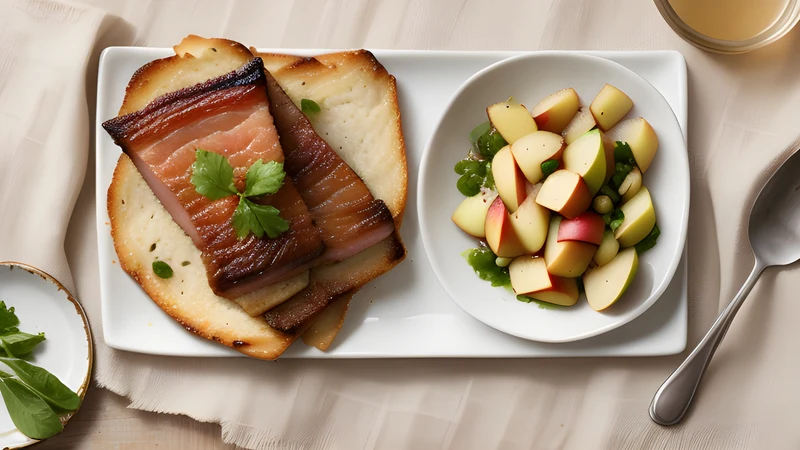
↓ Jump to recipeThe first time someone made me æbleflæsk I thought there had been a mistake. It arrives as a pan of pale gold mush with fried pork sticking out of it, and it looks like something you would find at the bottom of a very old cookbook under a heading about using things up. Which is roughly what it is. It is also one of the three or four best things you can do with a pig and an apple tree, and it takes thirty-five minutes.
The dish belongs to Danish autumn, to the fortnight when the apples come down faster than anyone can eat them and the weather turns. It is a farm dish, and its logic is the logic of a farm: the pig provides the fat and the salt, the tree provides the acid and the bulk, the fat cooks the fruit, and the rye bread underneath catches whatever escapes.
Æbleflæsk: Danish Pork Belly With Apples
Ingredients
- 500 g rindless pork belly, sliced 5 mm thick (or thick-cut streaky bacon)
- 800 g cooking apples such as Bramley (about 4 large), or a mix of Bramley and Cox
- 40 g unsalted butter
- 2 tbsp (30 g) dark muscovado or demerara sugar
- 1 tsp cider vinegar
- 0.5 tsp fine sea salt
- 8 turns freshly ground black pepper
- 1 sprig fresh thyme (optional)
- 4 thick slices dark rye bread, to serve
Method
- Peel, quarter and core the apples, then cut each quarter into 3 wedges roughly 2 cm thick. Do this before you start frying — the pork moves fast.
- Lay the pork belly slices in a single layer in a cold dry frying pan, 28 cm or wider. Set over a medium heat.
- Fry for 12–15 minutes, turning every 3–4 minutes, until the slices are deep gold and crisp at the edges. Starting cold renders the fat properly instead of scorching it.
- Lift the pork onto a rack set over a plate. Pour off all but 3 tbsp of the rendered fat and keep the rest in a jar for roast potatoes.
- Add the butter to the pan over a medium heat. When it foams, tip in the apples and the thyme, if using.
- Cook for 10 minutes, stirring every 2 minutes, until the apples have taken colour on the cut faces and are beginning to slump at the edges.
- Add the sugar and 3 tbsp water. Turn the heat down to low, cover, and cook for 8–10 minutes until about half the apple has collapsed to a rough sauce and half still holds as wedges.
- Stir in the cider vinegar, salt and pepper. Taste: it should be sweet with a clear sour edge. Add another 0.5 tsp vinegar if the apples were mild.
- Return the pork to the pan, laying the slices on top of the apples rather than stirring them in, and warm through for 2 minutes so the crackling edges stay crisp.
- Serve straight from the pan with slices of buttered rye bread and a mustard on the side.
Where it comes from, and why it is sweet
Æbleflæsk appears in Danish print by the eighteenth century, and its shape tells you something about how Danish cooking worked before refrigeration. Flæsk is the salted, fatty side pork that hung in every farmhouse and functioned as the household’s calorie reserve — the word covers belly, side and the cured slab used for frying. Æble is what happened outside the door in September. Neither had to be bought, and the pairing was as automatic as pork and apple has always been across northern Europe.
The sugar is the part that surprises people, and it is genuinely traditional. Danish cooking is comfortable with sweetness against pork in a way that British cooking mostly abandoned — you see the same instinct in brunede kartofler, where potatoes are cooked in caramel and served with roast pork without anyone finding it odd. Sugar was a colonial import that arrived cheaply in Denmark through the eighteenth-century trade and stuck to the national palate. In æbleflæsk the sugar’s job is to caramelise on the apple’s cut faces and to give the vinegar something to fight.
Older versions used flæsk that had been salted for months, so the pork carried a heavy cure and the apples had to be sweeter to balance it. Modern belly is unsalted, which is why the recipe above adds salt at the end and leans on vinegar rather than on more sugar. If you are using proper salt pork or a heavily cured bacon, drop the added salt entirely and taste before you reach for it.
The apple question
This is where the dish is won. You want two textures in the pan — a soft, applesauce-like base and wedges that still have their shape — and a single variety rarely gives you both.
Bramleys collapse. That is what they are for: high malic acid, low dry matter, and a cell structure that gives up the moment it is hot. A pan of pure Bramley gives you a superb sauce with nothing to chew. Cox, Discovery, Egremont Russet and most eating apples hold their shape and taste of very little once fried, because the sugar that makes them nice raw is not the sugar that browns well.
The answer I have settled on is roughly two-thirds Bramley to one-third eating apple, added at the same time. The Bramley goes first and becomes the sauce; the eating apple survives and gives the fork something to find. If you can only get one, use Bramley and pull a third of the wedges out after six minutes, returning them at the end. Cutting the wedges at a full 2 cm matters more than people expect — 1 cm slices dissolve entirely, and you end up with a purée wearing bacon.
Do not peel them if the skins are thin and you like the flecks; do peel Bramleys, whose skins go leathery and separate into little rolled tubes that catch in the teeth.
The cold pan, and why it matters
Start the pork in a cold, dry, heavy pan. This is the single technique in the dish, and it is the difference between crisp and grey.
Pork belly is roughly half fat by weight, and that fat needs time at a moderate temperature to render out of the connective tissue that holds it. Drop the slices into a hot pan and the exterior proteins seize and brown in about ninety seconds, sealing a layer of unrendered fat inside. You get a slice that is dark outside and flabby within. Start cold and the fat begins to melt at around 40°C, long before the surface browns, so by the time the slice is taking colour it has already given up most of its fat to the pan. Twelve to fifteen minutes over a medium heat is the whole trick, and the slices should be turned every three or four minutes so neither face sits too long.
Cast iron or a heavy carbon steel pan holds its temperature when the cold apples arrive, which is the second reason to use one. A thin non-stick pan drops 30°C the moment 800 g of fruit lands in it and the apples stew rather than colour.
Pour off the rendered fat before the butter goes in and keep it. Three tablespoons is enough to carry the apples; the rest is the best fat in your kitchen for a week, and it belongs on roast potatoes or in a pan of fried eggs.
Seasoning it properly
Taste the apples before the pork goes back. They should be sweet, then sour, then salty, in that order and quite sharply. The vinegar is the pivot: without it the pan is cloying within three mouthfuls, and with too much it tastes of chutney. One teaspoon of cider vinegar into 800 g of apples is the starting point, and mild supermarket apples usually want another half.
Black pepper goes in generously — eight turns is not a typo. The heat sits against the sugar and stops it going flat.
Thyme is optional and slightly modern. A single sprig thrown in with the apples and fished out at the end is a good idea; a tablespoon of chopped thyme is not, and turns the dish herby in a way no Dane would recognise.
What goes wrong
The apples are watery and pale. Too much liquid, or the pan was crowded. Eight hundred grams of apple in a 24 cm pan sits three layers deep and steams; the same weight in a 28 cm pan makes contact with the metal and browns. Three tablespoons of water is all the recipe needs, because the apples release plenty of their own.
The pork is chewy rather than crisp. Either the slices were cut too thick — 5 mm is the number, and a butcher will do it if you ask — or the pan was hot when they went in. There is no rescue once the outside has set; you can only render the next batch properly.
It tastes of burnt sugar. Muscovado goes bitter fast against a pan that has just cooked pork at frying temperature. Turn the heat down before the sugar goes in and give it the water at the same time, which drops the pan below the point where sucrose starts breaking down badly.
Everything is uniformly mushy. One apple variety, or wedges cut too thin. Cut at 2 cm and mix your apples.
It tastes like an apple crumble with bacon on it. Not enough vinegar and not enough pepper. Both go in at the end, off the boil, and both should be obvious on the tongue rather than subtle.
Serving, storing and variations
Serve it from the pan. It looks better that way, it stays hot, and moving it to a serving dish tumbles the pork into the apples and softens the edges you spent fifteen minutes making crisp. Thick slices of Danish sourdough rye, buttered cold, are the correct base — the sourness of the bread does the same job as the vinegar, from underneath.
A sharp mustard on the side is standard in Denmark and I would not skip it. Pickled beetroot works too, though at that point you are building a plate rather than a pan.
It keeps for three days in the fridge, and the apples are honestly better on day two once the vinegar has settled through them. The pork is not — reheat the apples in a pan and fry fresh slices, or accept soft pork and eat it as a topping on rye with a fried egg, which is a breakfast worth planning for.
For variations: a splash of dark beer instead of the water gives a bitterness that suits a heavy cure, and a handful of thinly sliced onion softened in the fat before the apples turns it savoury enough to serve with mash. If you want the pork to be the point rather than the fruit, stegt flæsk med persillesovs is the dish that wins Danish national polls and uses the same slices with a parsley sauce instead. And if the apple-against-pork idea appeals but you want it as a side rather than a supper, German rotkohl runs on the same arithmetic of sugar, acid and fat.
Related Content