Sonos Era 100 vs a Pair of Powered Monitors: Which for a Small Room
Smart-speaker convenience against nearfield-monitor honesty
Contents
Someone furnishing a small room for music has, whether they realise it or not, two entirely different product categories to choose between, and the salespeople for each rarely mention the other exists. One is the smart speaker: buy a pair of Sonos Era 100s, plug them into power, tap a few buttons in an app, and have room-filling stereo sound in an afternoon. The other is the studio-monitor route: a pair of active nearfield monitors, an interface or a DAC to feed them, some cabling, and a listening position that actually matters. Both will fill a small room with sound. They are not solving the same problem, and conflating them is how people end up disappointed with whichever one they bought.
The promise, on both sides
Sonos’s promise with the Era 100 is convenience without compromise: proper stereo separation from a single unit’s internal driver array (a tweeter and a custom woofer angled to throw a wider soundstage than the mono Sonos One it replaced), automatic room correction through Sonos’s Trueplay tuning, and full multi-room integration with the rest of the Sonos ecosystem straight out of the box. Buy two, pair them as a stereo set in the app, and you have genuine left/right separation with none of the cabling, gain-staging or acoustic-treatment thinking a monitor setup demands. It plays from Wi-Fi, from Bluetooth, from a physical line-in with the right adapter, and it does all of this without a single visible cable between the speakers.
A pair of active monitors makes a narrower, more technical promise: an accurate, flat frequency response with minimal added colouration, so what you hear is closer to what’s actually in the recording. Brands in this bracket — Kali Audio’s LP6, JBL’s 305P Mk II, Yamaha’s HS5, PreSonus’s Eris range — are designed for people mixing and mastering audio, where “flattering” the sound is actively undesirable because it hides problems in the mix. The promise is honesty — accuracy chosen over flattery — and everything about how these speakers are built and sold assumes the buyer already has a source device with a proper audio output and is willing to do a small amount of setup work to get the geometry right.
What’s actually inside
The Era 100’s cabinet houses a single tweeter firing forward and a racetrack-shaped woofer that Sonos claims improves bass output over the original Sonos One despite a broadly similar footprint; independent teardowns of the Era range have shown a genuinely denser internal layout than earlier Sonos units, with amplifier boards positioned to maximise internal air volume around the woofer. It’s a sealed, non-user-serviceable unit — there’s no repairability angle here, and Sonos doesn’t pretend otherwise. Trueplay tuning uses the phone’s own microphone to measure the room and adjust the internal EQ, a genuinely clever trick that works differently depending on whether you’re on iOS (a walk-around calibration using the phone’s mic array) or Android (a simpler, static calibration), a platform asymmetry Sonos has been slow to close.
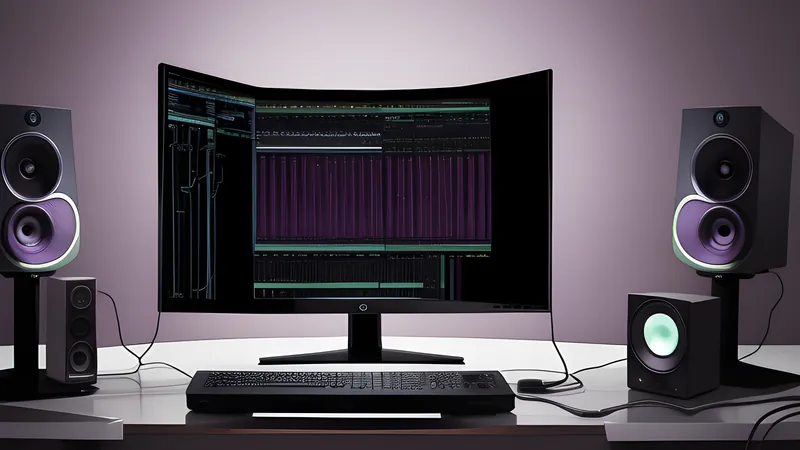
A pair of active monitors is a different kind of object entirely: each cabinet contains its own amplifier — usually a Class D or Class A/B design driving the woofer and tweeter separately through an internal crossover — with rear-panel gain, high-frequency and low-frequency trim controls, and a choice of balanced TRS/XLR or unbalanced RCA input. There’s no wireless path at all on most models in this bracket; you feed them from an audio interface, a DAC with line-level output, or in a pinch a phone’s headphone jack through an adapter, and the volume control lives on the back of the speaker rather than in an app or on the front panel. The cabinets are ported or sealed designs tuned specifically for nearfield listening at a desk, not for filling a room from a shelf across it — a genuinely different acoustic design goal from a lifestyle speaker like the Era 100.
Living with each in a small room
Day-to-day, the Era 100 pair wins on almost every axis that isn’t raw fidelity. Voice control (via Sonos Voice Control, a privacy-conscious on-device system, or Alexa if you opt in), instant grouping with other Sonos speakers around the house, streaming service integration that doesn’t involve a phone staying in Bluetooth range, and a setup process that takes minutes rather than an afternoon of speaker positioning and cable routing. For someone who wants music playing while they work, cook or read, and who isn’t critically listening for flaws in a mix, this is simply the easier machine to own.
A pair of monitors demands more from the room and from the owner. Correct placement — forming an equilateral triangle with the listening position, tweeters at ear height, some distance from reflective walls — genuinely changes what you hear, and skipping that step is the single most common reason people report monitors “sounding worse” than a lifestyle speaker at a similar price. Done properly, though, the tonal accuracy and the sense of instrument separation on a well-mixed track is audibly ahead of a sealed lifestyle cabinet doing its best to sound big from a single footprint. The trade is real in both directions: monitors reward correct setup with a genuinely more resolving sound, and punish a lazy setup by sounding thin or boomy in a way a Sonos speaker’s DSP would have quietly corrected for you.
Ecosystem and longevity
There’s a longer-term consideration that rarely comes up in a same-day purchase decision but matters over a five- or ten-year ownership span: what happens when the software stops being updated. Sonos speakers are computers with drivers attached, dependent on app support, cloud account infrastructure and periodic firmware updates to keep streaming services working. Sonos has a genuinely strong track record on long-term support compared to most smart-speaker rivals, but the Era 100 is still a product whose usefulness is tied to a company staying in business and staying interested in maintaining older hardware — a dependency a pair of passive-minded active monitors simply doesn’t have.
A powered monitor with a line-level input has no cloud account, no app to lose support, and no firmware to go stale. Feed it an analogue signal in a decade and it works exactly as it did on day one, provided the amplifier and drivers haven’t failed mechanically — and the amplifier boards in this category are generally simple, well-understood Class D or A/B designs that independent repair technicians can service long after the original manufacturer has moved on to newer models. That’s not a reason to buy monitors over a smart speaker on its own, but it’s a real asymmetry: one product category is built to be maintained by its manufacturer indefinitely, the other is built to keep working with no manufacturer involvement at all.
Two more names worth knowing
Buyers new to the monitor side of this comparison tend to fixate on a single recommended pair without realising how much the category has shifted in the last few years. Kali Audio’s entry-level range brought genuinely flat, well-reviewed measurements down to a price point that undercut the established Yamaha and PreSonus options considerably, forcing something of a race to the bottom on price without an equivalent collapse in measured quality — good news for anyone shopping this category for the first time. JBL’s professional monitor line, distinct from its consumer Bluetooth speakers, occupies similar territory with a slightly warmer tonal signature that some listeners prefer for casual use over the more clinically flat Kali and Yamaha alternatives. None of this changes the fundamental trade against a Sonos pair — wireless convenience against wired accuracy — but it matters for anyone who takes the monitor route and assumes there’s only one sensible option to choose from.
The case for each, and against
The case against the Era 100 for anyone who cares about sound quality specifically is that it’s still, underneath the room correction and the clever driver geometry, a small sealed cabinet doing its best with physics that favour size. No amount of DSP recovers bass extension a cabinet this size doesn’t have the internal volume to produce cleanly at volume, and critical listeners comparing it directly to a properly set-up monitor pair at a similar combined price generally hear the difference. It’s also a closed ecosystem: multi-room and voice features are excellent within Sonos’s own world and largely absent outside it, and platform-locked calibration quality (better on iOS than Android) is a real asymmetry worth knowing before buying.
The case against monitors for a casual listener is more practical than acoustic: no wireless streaming without adding a separate Bluetooth receiver or DAC, no cross-room grouping, and a setup that actively wants a desk and a semi-permanent listening position rather than a shelf across a living room. They’re also less forgiving of programme material recorded badly — a flat, honest speaker makes bad masters sound bad, whereas a lifestyle speaker’s tuning can flatter a rough mix. For someone who just wants their music library to sound pleasant while they do something else, that honesty becomes a cost rather than a feature.
The verdict
It depends on what “for a small room” actually means, but Buy the Era 100 pair for most people asking this question, and Buy monitors for the smaller group who know why they’re asking. If the room in question is a living room, a bedroom, or a kitchen, and the use case is streaming music, podcasts and the occasional voice command, the Sonos pair is the correct purchase: it’s built for exactly that, it requires no source device thinking, and the Trueplay correction genuinely helps in rooms with poor acoustics. If the room is a desk setup where you’re editing audio, producing music, or simply want the most accurate reproduction of a source you already control carefully, the monitor pair earns its extra setup effort with genuinely better fidelity per pound spent on the drivers themselves, since none of that spend goes towards wireless chips, voice assistants or app infrastructure.
The price verdict: a Sonos Era 100 pair and a competent active-monitor pair land in similar territory once you’ve added the DAC or interface the monitors need, which makes this close to a wash on pure cost — the real deciding factor is the setup effort and the source device you already own, not which is “worth more.” Skip the Era 100 if you already own a proper source chain and a listening position and want the most transparent speaker your money buys; skip monitors if the idea of a rear-panel gain knob and a cable run sounds like a chore rather than a Saturday well spent. Anyone weighing wireless portability more than a fixed desk setup should also look at the best budget bookshelf speakers for a first proper hi-fi, which sits in the gap between both of these, and at the FiiO KA11 dongle DAC if a monitor pair is the route chosen and a source device without a proper line-out is the only thing standing in the way.
Related Content