Nothing Ear (a) Teardown: What a £99 Earbud Is Really Made Of
Pulling apart the transparent shell to see if the honesty is more than skin deep
Contents
Nothing built its entire brand identity on the promise that showing you the components is itself a statement of confidence — transparent backs, visible screws, a “glyph” light strip instead of a hidden notification LED. The Ear (a), at £99, extends that philosophy to a product where the components are genuinely tiny and the manufacturing tolerances genuinely tight, which makes it a fair test of whether Nothing’s transparency is a real engineering choice or a styling trick applied over an otherwise ordinary earbud. Teardown and repair-focused outlets have opened the Ear (a) up, and what they found is a mixed but broadly honest picture: real component quality in the places that matter, and a couple of the same compromises every earbud at this price makes regardless of how much of the inside you can see.
The shell itself
The Ear (a)’s housing uses a clear polycarbonate outer shell over an inner structural frame, rather than a single moulded piece — a two-layer construction that’s more expensive to tool than a single-shot mould, and one of the clearest signs that the transparency isn’t a printed effect but an actual design constraint the engineers had to work around. Anything visible through that shell had to be laid out with cosmetics in mind as well as function, which teardown coverage notes as a genuine complication compared with an opaque earbud where component placement is purely an engineering decision. The trade-off is that clear polycarbonate scratches more visibly than a coloured or matte shell — hairline marks that wouldn’t show on a black earbud are more apparent here, a cosmetic cost of the design language rather than a durability failure.
The driver and how it’s mounted
At the core sits an 11mm dynamic driver, a size that’s become the practical ceiling for what fits in a compact true-wireless shell without pushing the whole earbud too far out of the ear canal. Teardown photography shows the driver mounted on a dedicated internal chassis rather than glued directly to the outer shell — a mounting approach that isolates driver vibration from the housing itself, reducing unwanted resonance and rattle, and a more considered assembly than the driver-glued-straight-to-shell approach some cheaper earbuds use to save an assembly step. It’s the kind of detail that doesn’t show up on a spec sheet listing “11mm dynamic driver” but does show up in how controlled the bass sounds in independent listening tests, which have generally rated the Ear (a)’s low end as tighter and less boomy than rivals using a similar driver size without the isolated mount.
Battery: the part every budget earbud quietly cuts corners on
Each earbud houses a small lithium-polymer cell rated at roughly 46mAh, a capacity broadly in line with what similarly sized true-wireless earbuds from other brands pack in — there isn’t a meaningful materials story here beyond confirming Nothing used a reputable cell format rather than an unbranded pouch battery, which teardown coverage was able to identify from the printed cell markings. The battery is glued into the shell rather than clipped, which is standard across the category and the single biggest reason true-wireless earbud batteries are effectively non-user-replaceable regardless of brand; a battery that degrades after eighteen months to two years of daily charge cycles means a full earbud replacement rather than a cell swap, a repairability limitation the Ear (a) shares with essentially every direct rival, including the Sony and Anker headphones covered elsewhere on this desk, where the larger over-ear form factor at least permits aftermarket cushion and cable replacement even if the core battery doesn’t.
The stem carries Nothing’s design signature
Unlike the company’s phones, which use an external light strip as a visible identity marker, the Ear (a)’s stem carries its branding through the shell’s internal layout itself — the driver housing, the tiny flex cables routing between the main PCB and the microphone array, all left visible rather than obscured behind an opaque cap the way most earbud makers finish the stem end. That’s a genuine manufacturing complication: an opaque stem cap hides any minor assembly variance (a slightly crooked cable run, an adhesive smear) that a transparent one exposes to a buyer holding the product up to the light. Teardown coverage found the internal assembly noticeably tidier than the category average for a sub-£100 earbud, which is consistent with a manufacturer that has to hold itself to a visibly higher assembly standard precisely because the alternative is a customer seeing sloppy work through the shell.
The main board and chipset
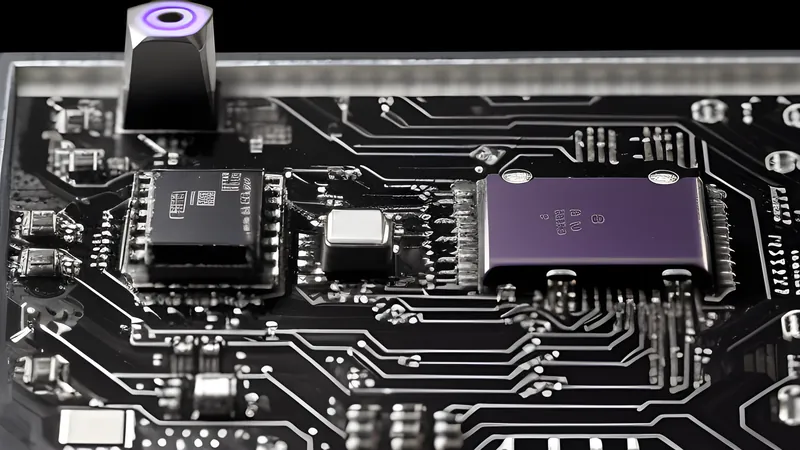
The internal PCB packs a Qualcomm audio SoC handling Bluetooth connectivity, LDAC codec processing, and the ANC digital signal processing in a single chip — a more integrated, more expensive component than the simpler standalone Bluetooth chips some sub-£50 earbuds use, and the reason the Ear (a) can support LDAC at all at this price point. Component-level identification from teardown photography is consistent with Nothing sourcing the same general class of audio silicon used in noticeably pricier true-wireless earbuds, which is the clearest single piece of evidence that the £99 price reflects genuine component cost control elsewhere (the shell, the accessories, the retail packaging) rather than a cut-rate chipset doing a worse job than the spec sheet claims.
The stem, the mics, and in-ear detection
The Ear (a)’s in-ear detection — the sensor that pauses playback the instant a bud is removed — uses a dedicated proximity sensor rather than relying purely on the accelerometer some cheaper implementations lean on, and it’s this dedicated sensor that measured reviews credit for the feature’s noticeably lower latency and false-trigger rate compared with accelerometer-only budget rivals. The microphone array for calls and ANC sits in the stem, sealed with a small mesh gasket that teardown coverage flagged as adequate for the IP54 splash rating Nothing claims, but not overbuilt relative to that rating — a gasket sized to meet the certification rather than exceed it by a wide margin, which is a completely normal engineering choice at this price but worth knowing if a buyer was hoping for more sweat resistance than IP54 actually promises.
The charging case gets less scrutiny than it deserves
Teardown attention almost always concentrates on the earbuds themselves, but the case is where a meaningful share of the £99 cost actually goes, and it’s the component most likely to fail first in ordinary use. The Ear (a)’s case uses a USB-C port with a metal-reinforced housing around the connector — a detail that matters because the charging port, subjected to thousands of cable insertions over the product’s life, is a documented failure point across the true-wireless category when the port is mounted directly into unreinforced plastic. Wireless charging is supported via a Qi coil embedded in the case base, adding a component and an assembly step that a cheaper case skips entirely; independent charging-speed tests found the wireless option meaningfully slower than the wired port, which is true of Qi charging generally rather than a Nothing-specific shortfall, but worth knowing before relying on it as the primary charging method. The case’s hinge — a simple spring-loaded lid rather than the more elaborate magnetic-latch mechanisms some rivals use — is mechanically simple enough that teardown coverage rated it as one of the more durable elements of the whole package, precisely because there’s less to go wrong.
Antenna placement and the connectivity trade-off
Bluetooth antenna placement inside a shell this small is a genuine engineering constraint, not a footnote: cram the antenna too close to the battery or the driver magnet and range and connection stability both suffer, a known failure mode teardown outlets have documented on cheaper earbuds that prioritised component density over antenna clearance. The Ear (a)’s internal layout, per component-level photography, keeps a deliberate gap between the antenna trace on the main PCB and the battery cell, and independent range testing found connection stability holding up comparably to pricier true-wireless earbuds through a couple of walls and at typical commuting distances from a phone. It’s a small, invisible design decision that never appears on a spec sheet, and it’s exactly the kind of choice that separates an earbud engineered with real care for radio performance from one where connectivity was an afterthought behind the driver and the styling.
Repairability: the honest limit of the transparency story
For all the component-level thoughtfulness, the Ear (a) scores no better than most true-wireless earbuds on actual repairability, because the category itself is fundamentally hard to repair regardless of how honest the manufacturer is about what’s inside. The shell halves are ultrasonically welded rather than screwed, meaning opening one without specialist tools destroys the seal and, in most cases, the housing itself — the same finding teardown outlets report across nearly every true-wireless earbud on the market, including flagships costing three times as much. Nothing’s transparency is a genuine act of design confidence — it means the company is comfortable with what a buyer sees when they look inside, right down to letting the driver and battery placement be part of the product’s visual identity — but it doesn’t translate into the earbud being any easier to actually open and fix than an opaque rival. The glass-half-full read is that Nothing had nowhere to hide a cheap component even if it wanted to; the glass-half-empty read is that showing the inside and making the inside serviceable are two entirely different promises, and only the first one is being kept here.
How the repairability compares to a flagship’s own limits
It’s tempting to assume a £99 earbud must be less repairable than something like Apple’s AirPods Pro 2, and the teardown evidence doesn’t actually support that assumption. iFixit-style repairability scoring has historically rated true-wireless earbuds from every price tier — including long-term flagship holdouts like the AirPods Pro 2 — near the bottom of the scale specifically because of glued batteries and welded shells, a structural limitation of the entire product category rather than something a bigger budget solves. Apple’s own case and earbud construction uses adhesive and ultrasonic welding just as extensively as Nothing’s does; the difference in price between the two products reflects driver technology, chipset sophistication, ANC processing maturity and brand ecosystem lock-in, not a difference in how repairable either one is once something actually breaks. That’s a useful piece of context for anyone assuming premium automatically means fixable: in this specific product category, it currently doesn’t, for anyone.
What this means for the £99 price
Put together, the teardown supports Nothing’s pricing rather than undermining it. The driver mounting, the audio SoC, and the battery cell are all components that would look at home in a considerably pricier earbud, and the corners that are cut — a gasket sized to spec rather than beyond it, a welded rather than serviceable shell, a glued non-replaceable battery — are cuts every rival at this price and above makes too, transparency or not. Compared against the wider field of sub-£100 earbuds, the Ear (a)’s internals justify its position at the top of that bracket: the components are as good as the exterior design implies, which is a rarer thing in this category than the marketing copy of most rivals would suggest.
Related Content