The Wife-Carrying World Championships: The Prize Is the Wife's Weight in Beer
How a Finnish village turned a robber legend into the world's most deadpan sport
Contents
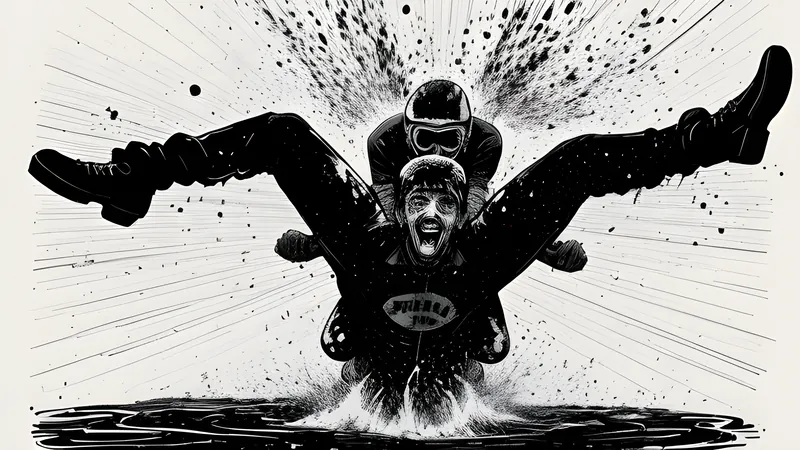
The finish straight at Sonkajärvi is 253.5 metres of sand and gravel with a chest-deep pit of brown water dug into the middle of it, and the man barrelling towards you has a fully grown adult hanging upside-down off his back like a rucksack that grew legs. She is gripping his waist with both hands. Her ankles are hooked over his shoulders. Her head is somewhere around his kidneys. He can’t see her, she can’t see where they’re going, and the pair of them are moving at a speed that would embarrass most club runners on dry, unencumbered ground. This is the Wife-Carrying World Championships, and the winner will be handed his teammate’s exact bodyweight in beer.
I want to be honest up front: everything about Eukonkanto sounds like a bit that got out of hand, a joke a Finnish tourist board ran too far with. It is not. It is a serious annual championship, held every July in a farming municipality of a few thousand people in North Savo, with a rulebook, a governing philosophy, and national qualifiers that feed it. The deadpan is the whole point. Finland built a genuinely difficult athletic contest and then refused, absolutely refused, to admit it was anything more than a laugh. That refusal is the funniest and most admirable thing about it.
The gloriously specific rules
Let’s start with the numbers, because the specificity is where the comedy lives. The course is exactly 253.5 metres — not 250, not 255, but that unarguable half-metre of Finnish precision. The surface is part sand, part gravel. There are two dry obstacles to clear and one water obstacle, a pool roughly a metre deep that every pair has to plunge through and haul themselves out of, soaked, with the run only half done.
The carried partner must weigh at least 49 kilograms. If she comes in under that, she straps on a rucksack loaded with sand or weights until the total load hits 49 kg, because the organisers decided a featherweight teammate would be an unfair advantage and legislated accordingly. She has to be at least 17 years old; the carrier at least 18. The carrier wears a belt — that’s the one permitted aid, a handle for the passenger to grip — and nothing else in the way of straps or backpacks or harnesses. The carried partner wears a helmet, which tells you everything about how these races actually go. No spiked shoes, no studs, no taping your footwear mid-run.
And then the rule that captures the entire spirit of the thing: there is no penalty for dropping your wife. If you drop her, you simply have to stop, pick her back up, and carry on. The clock keeps running, the humiliation is its own punishment, and the sport shrugs and says get on with it.
The word “wife” is doing heroic ceremonial work here, incidentally. The rulebook cheerfully clarifies that the woman you carry may be your own wife, your neighbour’s, or one you found somewhere further afield entirely. What matters is that everyone consents and everyone is having a laugh; the marital status is set dressing. Pairs race two at a time, head to head, so every heat is its own little sprint drama, which does wonders for a spectating crowd that has come precisely to watch grown adults fall over in a puddle.
The Estonian carry, and why it took over
For the first stretch of the championship’s life, competitors used the obvious techniques: the piggyback, or the fireman’s carry over one shoulder. Then Estonia showed up and rewrote the sport.
The Estonian carry is the upside-down method I described at the top — the passenger hangs down the carrier’s back, head towards the ground, legs wrapped forward over his shoulders and clamped, hands gripping his waist or belt. It looks appalling. It is also devastatingly efficient: it lowers the combined centre of gravity, frees both of the carrier’s arms for balance and pumping, and clamps the load tight so it stops swinging. Estonian couples used it to win the world championship again and again through the late nineties and two-thousands, an era so dominant that the technique simply took their country’s name and kept it. Watch the fast heats now and almost everyone is doing it. The image is grotesque and the physics is unimpeachable, which is a very Eukonkanto combination.
If you’ve read my piece on the Air Guitar World Championships in Oulu, you’ll recognise the pattern: a Finnish contest that starts as an obvious gag and then quietly develops a real competitive meta, a body of technique, a lineage of champions who train. The joke and the seriousness aren’t at war. They’re holding hands.
The robber, the legend, and what we actually know
Every good spectacle needs an origin myth, and Sonkajärvi has a magnificent one. The story goes that wife-carrying descends from a nineteenth-century forest brigand named Herkko Rosvo-Ronkainen — Ronkainen the Robber — who ran a band of thieves in these very woods and tested prospective gang members by making them race across rough terrain carrying heavy sacks of rye without dropping them. Toughen the recruits, filter the weak, and the fittest carriers get in. A darker variant of the tale has Ronkainen and his men raiding villages and hauling off the women, with the carrying part being rather less consensual than the modern rulebook insists on.
Here is where I have to put down the myth and be straight with you, because the folklore is doing a lot of romantic heavy lifting. The organisers themselves are refreshingly candid about it. The most detailed published version of the Ronkainen legend was written up by a local author who states plainly that the tale is largely a work of imagination, partly hung on scraps of known fact. There may well have been a real man behind it — the story places a Herman Ronkainen in the Sonkajärvi forests, born around the mid-1800s, supposedly dying an old man in 1922 — but the wife-carrying-as-recruitment-trial detail is legend, not documented sport. People also like to gesture vaguely at “the Viking age” and the ancient practice of stealing brides, which is the kind of thing that sounds like history and functions as vibes.
What we can date precisely is the modern event. The Wife-Carrying World Championships have run in Sonkajärvi since 1992. That is the real founding: a small municipality looking for a summer draw, reaching into its own folklore drawer, pulling out the robber, and building a formal championship around a story it was honest enough to admit was half-invented. The myth is the marketing; the sport is the achievement. Treating the legend as literal history would miss the more interesting truth, which is that a community consciously chose which of its old stories to resurrect and turned it into something people fly in for.
Why a village runs on this
The philosophy underneath the silliness is easy to miss because Finland would never dream of stating it out loud. But it’s there. Eukonkanto is a festival of the anti-glamorous. There is no billion-dollar sponsor demanding branded content, no influencer paddock, no dynamic-priced tiered ticketing. There is a field, a water pit, a PA, a load of sausage and beer, and a couple of thousand people who have decided that watching their neighbours humiliate themselves in the name of sport is a fine way to spend a July weekend.
The prize crystallises the whole ethos. The champions don’t get a car or a cheque. They get the carried partner’s exact bodyweight in beer — weigh the wife, match it in bottles, hand it over. It’s absurd, it’s generous, and it’s a quiet joke about value: your reward is measured in the person you carried. Second and third place take home product prizes and their dignity, more or less.
That refusal to take itself seriously is precisely why the thing spread. There are now spin-off wife-carrying championships across the world — a long-running North American event at Sunday River in Maine, contests in the UK, Australia, and beyond, most of them looping their winners back towards the Finnish original as the true world final. It travelled because it’s impossible to be pretentious about. You cannot gatekeep a sport whose entire premise is a man running through a bog with a person on his back.
Take the daft ritual seriously
I’ve stood in enough car parks at enough serious festivals to know the difference between manufactured spectacle and the real thing, and Sonkajärvi is the real thing. It has the same DNA as the best Nordic gatherings — the bonfire communality of Sankt Hans aften, the fire-and-fellowship spectacle of Up Helly Aa in Shetland — where the event exists for the people in the field rather than a camera pointed at them.
So here’s my verdict on the daftest championship in the world: take it seriously. Not the robber legend, which is candied folklore and should be enjoyed as such. Take seriously the choice a small Finnish village made — to build something joyful, physically genuine, and completely unmarketable in the modern sense, and to keep running it for over thirty years purely because it’s good. A man sprints through a metre of muddy water with his laughing teammate folded upside-down on his spine, wins a stack of beer equal to her weight, and everybody goes home happy. There is nothing to sell you here. That’s the whole miracle of it.
Related Content