Why Bands Break Up on Stage
The physics of putting four exhausted people in a small space with live microphones
Contents
Most bands that end, end in a rehearsal room, a lawyer’s office, or a group text nobody wants to send. It is quieter that way, and quieter is usually safer for the money still owed on the tour. So when a split happens instead in front of two thousand people with a live microphone still hot, it tends to become the story the band is remembered for, however many good years preceded it.
The room that makes it worse
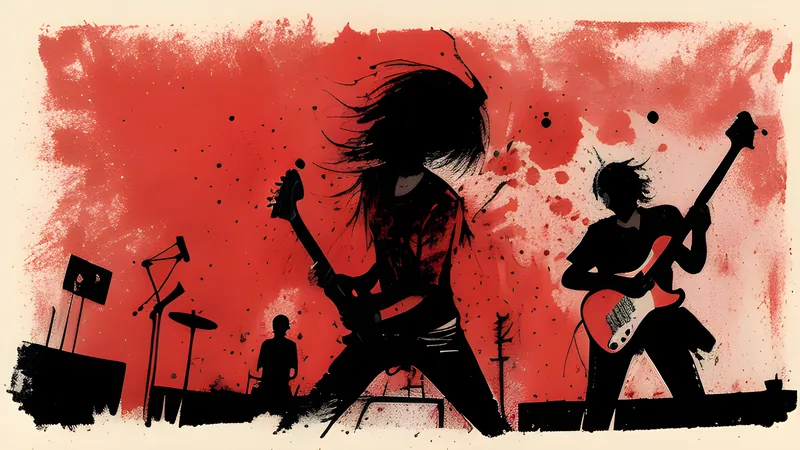
A stage is one of the worst possible places to have a disagreement, and that is precisely why so many happen there. Four or five people who have spent every day for weeks in the same van, same green room, same hotel corridor are suddenly put in front of a paying crowd, wired to microphones that broadcast every word at volume, standing close enough to see each other’s face but too far apart to speak privately. Anything said is said in public, in the same breath as the last verse of the last song. There is no door to close.
Touring compresses ordinary friction into something sharper. A guitarist who quietly resents playing lead over the singer’s ad-libs for a decade, a drummer sick of a setlist he did not choose, a rhythm section that has stopped speaking off stage but still has to lock in on it — none of that needs a single trigger. It needs an audience and a bad monitor mix on the wrong night, and the argument that has been building for months finally has somewhere to go.
When the walk-off is the message
The clearest version of an on-stage breakup is the walk-off: someone puts down their instrument mid-set and leaves, and the rest of the band either finishes without them or does not finish at all. It has happened often enough, and publicly enough, to be its own recognisable genre of music-press story, because unlike a backstage row it happens in front of the one audience with a direct financial and emotional stake in the answer — the fans who paid for a ticket.
The Jesus and Mary Chain built an entire early reputation on this in the mid-1980s: gigs advertised as forty-five minutes running to less than twenty before Jim or William Reid abandoned the stage, feedback wailing, audience left standing in a suddenly silent room. Some of it was a deliberate confrontational bit borrowed from the era’s art-school provocations. Some of it, by the band’s own later account, was genuine sibling conflict that the short, chaotic sets made no attempt to hide. The two things were never cleanly separable, and that is exactly the point — an on-stage collapse always sits somewhere between real anger and a performance of real anger, and audiences rarely know which they watched until years later, if ever.
Guns N’ Roses spent the 1990s and 2000s producing walk-offs frequent enough that “Axl left early” became close to a genre convention of its own touring history, documented across decades of music press covering delayed start times, abrupt set-ending exits, and cancelled dates. Whatever the underlying causes on any given night — and they varied — the pattern itself became part of the band’s public identity, for better and worse, in a way a quieter falling-out never could.
The backstage version that becomes public anyway
Not every famous split needs the actual walk-off; some just need the backstage version to leak fast enough that it might as well have happened under the lights. Oasis’s cancelled 2009 Paris show, called off after a well-documented altercation between Liam and Noel Gallagher backstage, ended the band within hours in a way that made the following night’s empty stage its own kind of public statement — the crowd got no set at all, and the story that filled the silence was, in its way, louder than any onstage row would have been. The mechanism is the same as the on-stage version: a tour puts people in close quarters for so long, night after night, that whatever tension exists off stage has almost nowhere left to be contained, and it finds the nearest microphone or the nearest exit.
Why the audience amplifies it
None of this happens in a vacuum most bands can control, because a stage removes the one thing that makes most workplace conflict survivable: privacy. Say something cruel in an office and it might reach three colleagues by the end of the day. Say it into a stage microphone and it reaches everyone in the room instantly, then everyone with a phone recording it within the hour, then — for as long as the internet holds a grudge — everyone who searches the band’s name afterwards. The permanence changes the stakes. A musician who might otherwise let a bad moment pass now has to decide, in real time, whether to say the thing that ends the tour in front of witnesses who will never forget it.
It also changes what “finishing the show” means as a professional obligation. Bands owe promoters a contracted performance, and abandoning one mid-set has real financial consequences — refunds, insurance claims, damaged relationships with venues that book the next tour. That knowledge sits underneath every on-stage argument like ballast: the person walking off is not just angry, they are choosing anger over a specific, quantifiable cost, which is its own kind of tell about how far things have actually gone. Nobody storms off over a merely bad night. They storm off when the bad night is standing on top of a much older one.
The spark is usually technical, not personal
Talk to enough touring crews and a strange pattern emerges: a huge number of on-stage blow-ups start with something as mundane as a bad monitor mix. A guitarist who cannot hear their own amp over the drums will play harder and sing sharper trying to compensate, a singer who cannot hear their own voice will oversing to compensate for that, and within two songs everyone on stage is fighting the sound rather than playing the music, each one convinced the others are the problem. The person actually building that mix is rarely on stage to explain that a wedge blew a fuse or a wireless pack cut out, so the frustration lands on the nearest bandmate instead, because that is the only target within shouting distance. A technical failure and a personal grievance are almost indistinguishable from the audience’s side of the barrier, and often from the band’s side too, in the moment.
Add basic exhaustion. A touring schedule that puts a band in a different city most nights for six weeks strips away ordinary conflict-resolution tools — sleep, private space, the ability to simply not see someone for a day after an argument. Small resentments that would dissolve on their own given a weekend apart instead compound show after show, with no real gap to let them cool. By the time a genuine flashpoint arrives, whatever it happens to be, it is rarely really about that night. It is about the previous forty nights, arriving all at once, in front of an audience that has no idea any of the previous forty happened.
The exit that is also, sometimes, the plan
There is a colder reading worth holding alongside the emotional one: a walk-off generates a news cycle a quiet split never would, and some bands and managers have learned to use that. A dramatic final show, whether or not the drama on stage was entirely spontaneous, sells more of the archive back catalogue and more tickets to whatever the “one last chance” reunion eventually becomes than a press release ever could. This is not a claim that any specific breakup was staged — most demonstrably were not, and the human cost documented around several of the most famous ones was plainly real. It is a reminder that the music industry has strong financial incentives to let the myth of the spontaneous stage collapse do work a calm announcement cannot, which is part of why the story of “the band that broke up on stage” gets told and retold long after the argument that actually caused it has been forgotten by everyone except the people who were on it.
That afterlife is its own kind of encore, the band never intended, playing on a stage they already left. It runs for years after the actual argument has faded from anyone’s memory but the two or three people who were standing closest to it, which is the strange arithmetic of the whole phenomenon: the more publicly a band falls apart, the longer the fall itself gets remembered, often long after the music that made anyone care in the first place. It sits close to the reunion tour as a phenomenon — the collapse becomes the legend that makes the eventual comeback show a bigger event than a fresh act starting from nothing ever could be, and every promoter counting the house that night knows it. It is also, at bottom, the same pressure that produces every setlist built to survive a bad night: most bands manage it. The ones remembered for breaking up on stage are the ones who, on one specific night, couldn’t.
Related Content