What the Mosh Pit Is Actually For
The physics, the etiquette and the strange trust of a room full of people colliding on purpose
Contents
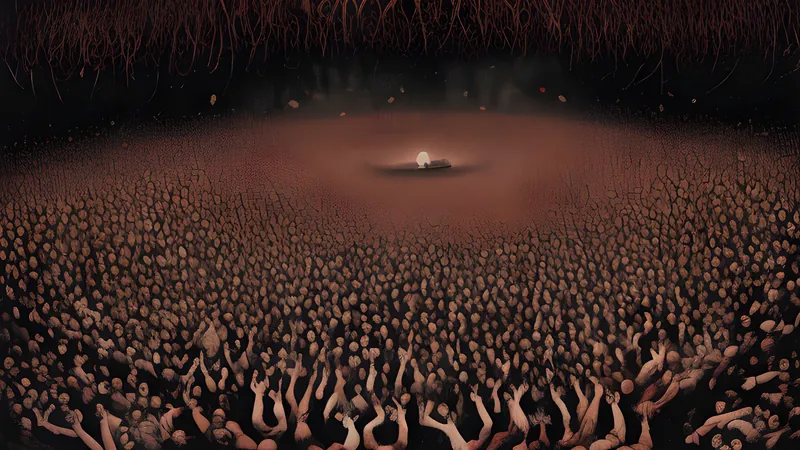
The first time you see one from the outside it looks like a bar fight that got funding. A hole opens in the middle of the crowd, thirty or forty people start throwing themselves at each other in a rough circle, and someone goes down. Then the thing that confuses every newcomer happens: the person who went down is back on their feet in under two seconds, hauled up by two of the same strangers who were, a moment ago, apparently trying to kill them. Nobody stops. Nobody checks a scoreboard. The hole widens, breathes, closes, and reopens somewhere else. If you have never stood inside one, the mosh pit reads as chaos with a soundtrack. Stand in a few hundred of them and you start to see the opposite: a system with rules so consistent that a physics lab was able to model it as a fluid.
A gas made of people
In 2013 four physicists at Cornell — Jesse Silverberg, Matthew Bierbaum, James Sethna and Itai Cohen — published a paper in Physical Review Letters with the gloriously deadpan title “Collective Motion of Humans in Mosh and Circle Pits at Heavy Metal Concerts.” They had done what any bored researcher with access to the internet might do: pulled dozens of crowd videos off YouTube, corrected the footage for camera shake and perspective, and run particle image velocimetry — the same technique used to track how smoke or water moves — across the bodies in the pit.
What they found is the good part. The disordered mosh pit, the churning mess where everyone slams in random directions, has a speed distribution that closely matches the Maxwell-Boltzmann distribution of a two-dimensional gas at equilibrium. Not loosely, not as a metaphor. The moshers move statistically like molecules of an ideal gas bouncing around a heated box. The circle pit — where the crowd organises into a single rotating current, everyone running the same way around a central hole — turned out to be the ordered, vortex-like state of the same system, the way a gas can settle into a coherent flow.
The team then built a stripped-down simulation they called MASHers: Mobile Active Simulated Humanoids, little self-propelled agents governed by three simple urges — bump off your neighbours, drift toward the average motion of the people around you, and add a bit of random noise. Turn the flocking urge up and the noise down, and the model spontaneously produces a circle pit. Turn it the other way and you get the gaslike mosh. Two dials. That is nearly all it takes to reproduce, in software, a behaviour that human beings think of as pure adrenaline and abandon.
I find this genuinely beautiful, and I want to be careful about what it says. None of it makes moshing mindless. If anything it shows the reverse: a room full of people, each making fast individual decisions about where to throw their weight, settles into patterns stable enough to predict. That is emergence. It is the same maths that describes flocking starlings and schooling fish, and it is running, unspoken, in the dark of every hardcore basement in Europe.
The taxonomy of controlled violence
Outsiders lump it all under “moshing,” but the pit has genres, and mixing them up is how people get hurt. Learning the difference is the first thing a regular internalises, usually the hard way.
The circle pit is the runner. On a cue — often a specific riff, sometimes a band’s direct instruction — the crowd opens a ring and everyone charges anticlockwise (or clockwise; it varies by room and no one knows why) in a stampede that looks lethal and is mostly momentum. You are not aiming at anyone. You are a molecule in the vortex. The danger is tripping, so the etiquette is absolute: if the person in front of you falls, you leap or swerve, and the two people behind you pick them up.
The push pit, or mosh proper, is the gaslike state from the Cornell paper: bodies slamming shoulder-to-shoulder in no coherent direction, a churn of collision for its own sake. This is the default at most metal shows. The force is real and the impact is honest, and the target is the whole churn rather than any single person. You give a shove and you take one back, and the whole point is that the exchange is symmetrical.
The wall of death is the set-piece, a whole ritual with its own history: the crowd parts down the middle into two facing ranks, waits for the drop, and sprints headlong into each other on the beat. It is the most theatrical and, oddly, one of the more controllable formats, because everyone knows exactly when the collision is coming.
Then there is hardcore dancing — the two-step, the windmill, the spin-kick — which is a different animal altogether. Call it a kind of violent solo dance, arms and legs thrown out in wide arcs, closer to shadow-boxing than to collision, and it evolved in American hardcore rather than metal. Done in its own space, with a ring of people giving the dancer room, it is thrilling to watch and internally consistent: the flailing limbs are the point, and the circle around them is the safety margin. The trouble starts when that margin collapses, which brings us to the ugliest word in the vocabulary.
The contract, and the people who break it
Here is the thing the physics can’t capture and the thing that actually matters: the pit runs on consent. Not the paperwork kind — the fast, physical, mutually-understood kind. Everyone inside has opted in. Everyone outside the ring is off-limits. When you step to the edge you are signalling I’m in, and when you step back and someone lets you back into the wall of bodies at the perimeter, that is the crowd saying received. The ring is a membrane. Cross it and the terms change.
The single clearest sign that a pit is healthy is what happens when someone falls. In a good room it is reflexive and instant — hands down, person up, sometimes three or four people forming a brief shield until the fallen one is vertical again. I have watched two-hundred-kilo blokes stop dead mid-charge to scoop up a stranger half their size and set them back on their feet like it was nothing, because to them it was nothing; it was simply the rule. That reflex is the whole ethic in one gesture. The violence is a costume. Underneath it is care.
Which is why crowd-killing is such a betrayal, and why the scene argues about it endlessly. Crowd-killing is the practice — mostly in some corners of modern hardcore — of deliberately throwing those wide two-step kicks and punches outward, into the people standing at the edge who never opted in. It takes the one inviolable line — the ring is a membrane — and treats it as a target. Its defenders call it energy and tradition. My honest opinion, and I’ll mark it plainly as opinion: it is the coward’s version of hardcore, aggression aimed precisely at the people least ready to absorb it, and it inverts everything the pit is supposed to protect. There is a bottomless difference between a shove you both signed up for and a spin-kick to the jaw of a teenager who came to watch. One is play. The other is just assault with a breakdown behind it.
The same goes for the bloke — and it is almost always a bloke — who mistakes the pit for a place to settle a mood, who throws real closed fists, who targets a specific person, who doesn’t stop when someone’s down. Every regular has seen him, and every good room deals with him the same way: he gets ejected by the crowd itself, frozen out or physically walked to the edge, long before security notices. The pit polices its own contract because the contract is the only thing keeping the whole beautiful mess safe.
What it’s actually for
So why do it? Why walk willingly into a two-dimensional gas of elbows?
The cheap answer is catharsis, and there is real truth in it, though it stops well short. There is a specific, hard-to-find permission in the pit: for a few minutes you are allowed to be a body among bodies, to hit and be hit and mean none of it, to spend the whole day’s clenched-jaw tension in something loud and physical and finite. You come out bruised and weirdly serene. Anyone who has done manual labour or contact sport knows the feeling — the quiet after real exertion.
But the deeper thing is trust, and this is where the collision becomes the opposite of what it looks like. You are throwing your body into a crowd of strangers on the explicit understanding that they will catch you when you fall. And they do. Over and over, they do. In a culture that spends most of its waking hours keeping careful distance from other people’s bodies, the pit is one of the last places where a total stranger will grab you, hold you up, and be gone before you can thank them. It is contact without agenda. For a lot of us — the socially awkward, the too-intense, the people who never quite found the room where they fit — that turns out to be worth more than the music.
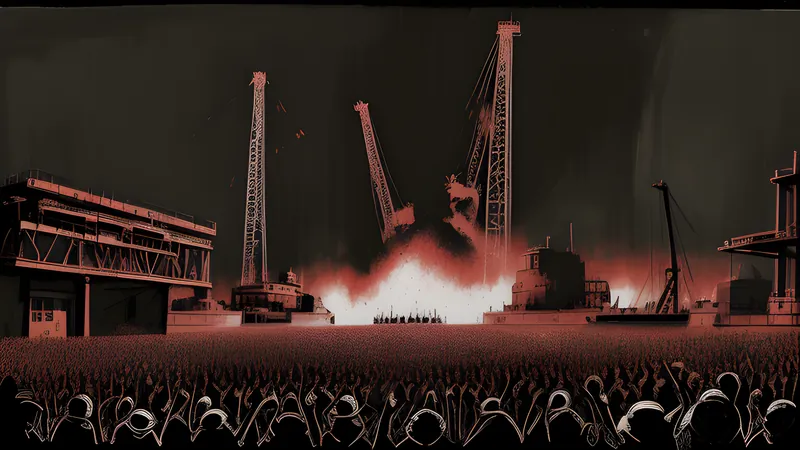
I have found that trust in the sweatbox up at Loppen, a room so small the pit and the crowd are the same object, and in the vast churn out on the harbour at Copenhell, where the circle pits get big enough to have their own weather. Same ritual, same physics, same unwritten law. Different only in scale.
The mosh pit is a machine for practising a hard human trick: colliding hard and taking care of each other in the same motion. It behaves like a gas because thousands of fast, selfish little decisions add up to a stable, generous whole. Understand that and you understand why the people who break the contract are hated, and why the ones who keep it will haul a stranger off the floor for the rest of their lives without ever once thinking of it as kindness. Get in. Watch for the person who falls. Pick them up. That is the entire manual, and it has never needed writing down.
Related Content