Watain: Swedish Black Metal as Ritual Theatre
Erik Danielsson's Uppsala coven turned the stink and blood of orthodox black metal into a genuine live event
Contents
You smell a Watain show before you see it. The band are famous for dousing their stage and sometimes their gear in rotting animal blood, and the stench travels — through the barrier, into the pit, up into the balcony. It is deliberate, it is disgusting, and it is the single most honest piece of stagecraft in extreme metal, because it forces the audience to physically share the thing the music is about: death, decay, ritual, the deliberate breaking of the comfortable. Whatever you think of Watain, and there is a great deal to think, they mean it.
Watain formed in Uppsala, Sweden, in 1998, founded by vocalist and bassist Erik Danielsson with guitarist Pelle Forsberg and drummer Håkan Jonsson. Danielsson was 16. They took their name from a song by the American black metal band Von, and from the start they positioned themselves as orthodox, theistic Satanists — the belief was the point, and the music the vehicle for it. That framing matters, because it separates Watain from bands who wear the imagery as decoration. For Danielsson, the corpse paint and the blood are liturgy.
The sound: the second wave, sharpened
Musically Watain are a direct descendant of the Norwegian second wave — the tremolo-picked riffing, the blast beats, the icy melody riding over churning low end. They took the template that the Norwegian black metal scene built in the early nineties and gave it a Swedish sense of craft and drive, cleaner in execution while keeping the malevolence. Where a band like Satyricon eventually pushed toward slower, groove-driven rock structures, Watain held the line on ferocity for years before letting more overtly melodic, almost heavy-metal songwriting creep in.
The catalogue traces that arc clearly. Rabid Death’s Curse (2000) and Casus Luciferi (2003) are raw, orthodox statements of intent. Sworn to the Dark (2007) is the record where the songwriting sharpened and the band’s reach widened. Lawless Darkness (2010) won a Swedish Grammis and is widely held as their masterpiece — a long, ambitious album that balances savagery with genuine grandeur. The Wild Hunt (2013) divided the faithful by including a clean-sung ballad, “They Rode On”, which was either a bold expansion or a betrayal depending on which forum you read. Trident Wolf Eclipse (2018) was a deliberate snap back to lean, aggressive form, and The Agony & Ecstasy of Watain (2022) leaned further into big, anthemic black-metal songwriting.
That willingness to evolve has kept them relevant across more than two decades, which in a genre that prizes stasis is its own kind of transgression. The purists who wanted Casus Luciferi forever were always going to be disappointed, because Danielsson treats the band as a living organism rather than a museum piece.
The debt to their Norwegian forebears is worth being precise about, because Watain wear it openly. Danielsson has spoken repeatedly of the early-nineties Norwegian records as formative texts, and the band emerged from a broader circle of Swedish orthodox black metal — Dissection’s Jon Nödtveidt was a mentor figure and collaborator in the years before his death, and that connection placed Watain squarely inside a lineage of theistic, ritual-minded black metal that took the Norwegian aesthetic and gave it a Swedish rigour. You can trace a clean line from the second wave’s founding statements to Watain’s blood-soaked stage, and the band would be the first to draw it for you.
The show is a rite
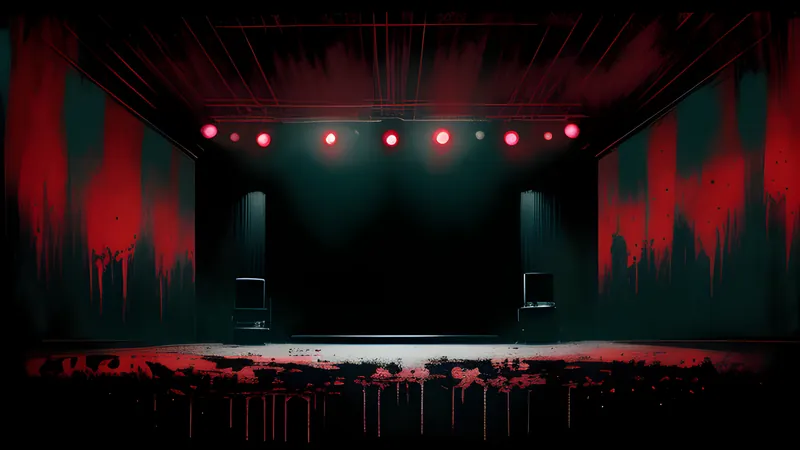
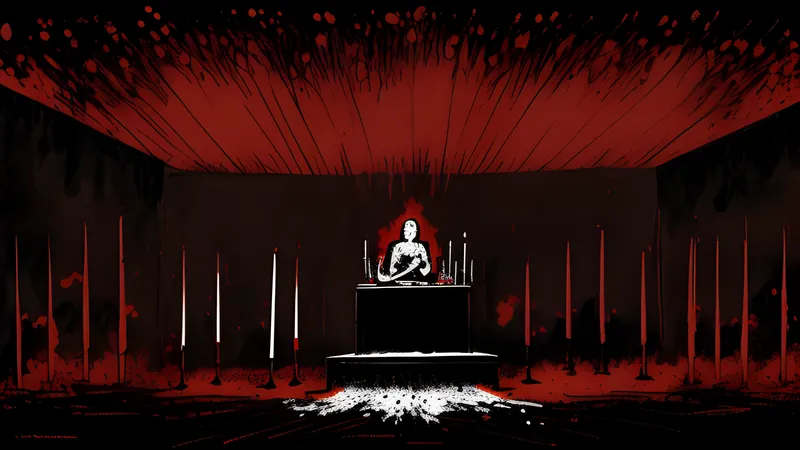
Here is where Watain earn the “ritual theatre” tag properly. A Watain live show is built as a ceremony: banks of candles, inverted crosses and animal skulls, a fog of incense and blood, pyrotechnics and open flame, the four musicians in full corpse paint moving with a stiff, deliberate solemnity. Danielsson conducts it like a priest working a congregation. There is real theatrical intelligence in the staging — the sightlines, the pacing, the way the lighting keeps the band half-hidden so they read as figures in a rite rather than blokes with guitars.
It is also genuinely confrontational, and Watain have never pretended otherwise. Danielsson has said in interviews that black metal has to retain the capacity to be problematic, to make people uncomfortable, or it stops meaning anything. The blood is the clearest expression of that philosophy: it makes the show impossible to consume passively. You cannot check your phone through a Watain set, because the room stinks of carrion and something is on fire.
The stagecraft has a discipline to it that the shock-value framing tends to miss. Watain rehearse the ceremony as carefully as the music — the placement of the candelabra, the timing of the pyro, the moment Danielsson raises a bone or a chalice and holds it. There is a knowing theatricality here that puts them closer to performance art than to a straightforward metal gig, and Danielsson clearly relishes the role of officiant. It can tip into self-parody if you are in an uncharitable mood, and the band flirt with that edge deliberately, daring you to laugh. Most nights the sheer conviction carries it past the giggle threshold and into something genuinely unsettling, which is a difficult trick to pull off in a lit venue full of people holding pints.
The controversy is real, and documented
You cannot write honestly about Watain and skip the trouble, because the trouble is part of the record. The most notorious incident came at a 2014 show in Brooklyn, where the band’s blood-throwing reportedly left some audience members retching and the story got picked up by the tabloid press. Venues have refused to book them; promoters have fretted over fire regulations and animal-welfare complaints. The band’s whole aesthetic is engineered to provoke exactly this kind of reaction, so the controversy is arguably part of the art — though that argument only stretches so far, and reasonable people draw the line in different places.
Danielsson’s public statements have themselves drawn criticism over the years, and the band have at times been dogged by questions about where transgression ends and something uglier begins. I am not going to relitigate every allegation here, because much of it is contested and this is a piece about the music and the performance. What is not contested is that Watain court discomfort on purpose, that they have paid a commercial price for it, and that they consider the price worth paying. That is a coherent, if deeply uncomfortable, artistic position, and it is theirs to hold and yours to reject.
Why it lasts
Strip away the shock and there is a serious band underneath, which is the only reason any of this endures. The controversy would be tiresome if the songs were bad; the songs are not bad. Lawless Darkness alone is a landmark, and the live show, stink and all, is one of the most committed spectacles you can see in the genre. The musicianship holds up to scrutiny on its own terms: Forsberg’s riffing is precise and inventive, the songwriting has grown genuinely dynamic across the catalogue, and Danielsson has developed into a frontman with real command of a room. Take away the blood and the incense entirely and there is still a serious, capable black-metal band playing well-constructed songs, which is the acid test the pure shock merchants always fail. Watain sit alongside their Scandinavian peers in Enslaved as proof that black metal’s second and third generations could take the original blueprint somewhere new without draining it of menace — Enslaved through progressive expansion, Watain through sheer ceremonial intensity.
It is worth saying plainly that Watain are the kind of band you can admire the craft of while keeping the belief system at arm’s length, and most of their audience does exactly that. You do not have to be a theistic Satanist to recognise a superbly constructed black-metal record or a rigorously staged live rite, any more than you have to share a film director’s politics to admire the shot-making. Danielsson would probably bristle at that framing — for him the belief and the art are one thing — but the reality of the audience is that plenty come for the spectacle and the songs and treat the ideology as costume. That gap between the band’s total sincerity and the crowd’s partial engagement is part of what makes a Watain show such an odd, charged event: everyone in the room has decided for themselves exactly how seriously to take it.
The last time the band rolled through the Nordic venue circuit, the reaction split the room exactly as it always does: half the crowd transfixed, a few near the front visibly regretting their choice of standing spot, everyone talking about it for a week. That is the Watain effect. They built a career on making people feel something strong and unpleasant on purpose, and in a live-music economy that increasingly rewards the frictionless and the phone-friendly, a band that stinks of blood and sets the stage on fire is a genuinely rare thing. You do not forget it, which is precisely the point.
Related Content