Wacken 2016: First Time in the Holy Mud
A Copenhagen punter finally makes the pilgrimage south, and watches Iron Maiden close a world tour in a cow field
Contents
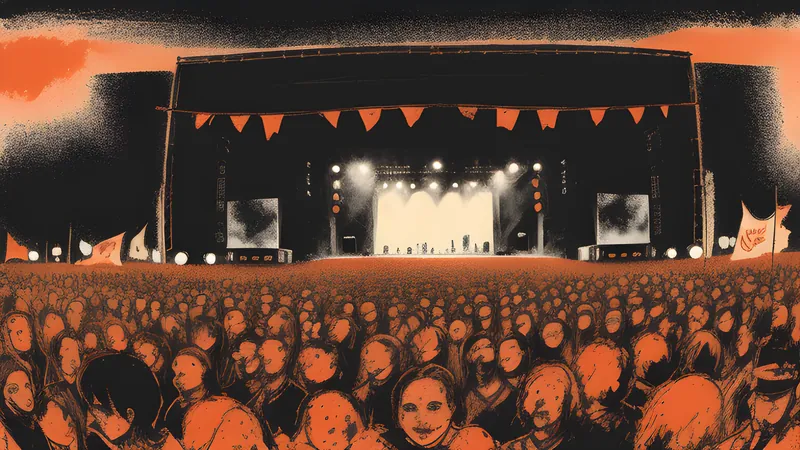
You hear about Wacken for years before you go. Every metalhead in Copenhagen has a Wacken story, or a friend with one, and they all end the same way — a grin, a shake of the head, the word “mud” said like a benediction. In August 2016 I finally stopped listening to other people’s versions and drove south to make the pilgrimage myself. Three days later I understood every grin. Wacken is the biggest heavy-metal festival on the planet, held in a farming village of roughly 1,800 people in Schleswig-Holstein, and the first time you stand in it the scale simply refuses to fit in your head.
The drive south and the field that swallows you
From Copenhagen it is a straightforward run: down through the Danish islands, across the border, and into the flat green nothing of northern Germany where the horizon is wind turbines and church spires and very little else. Then the traffic thickens, the cars around you start flying band flags, and you realise every vehicle on the road is going to the same cow pasture you are. Around 75,000 people came to the 2016 edition. The village they descend on could fit in one corner of the campsite.
I have written elsewhere about how the Wacken machine actually works — the leased farmland, the tractors, the improbable logistics of turning fields into a temporary city. Standing in it for the first time, all of that theory dissolved into a single physical fact: the site is enormous, and you will walk more than you think, and the ground beneath you is agricultural soil that becomes something else entirely the moment it rains. Which, at Wacken, it always does.
The mud is not a bug. It is the festival’s entire self-image. The official motto is “Rain or Shine,” the merch leans hard into it, and veterans wear their filthiest boots like campaign medals. By the second afternoon I had stopped fighting it. You surrender to the mud early or it ruins your weekend; that is the first lesson Wacken teaches a first-timer, and it teaches it fast.
Iron Maiden, and the end of a world tour
The headline reason 2016 mattered — the thing that pulled me down there that specific year — was Iron Maiden. They played the Thursday, 4 August, and it was no ordinary festival slot. Maiden chose Wacken to close their entire Book of Souls World Tour, the sprawling campaign that had run since February and taken the band across six continents in their repainted Boeing 747, Ed Force One, with Bruce Dickinson himself at the controls. Their manager Rod Smallwood said outright that they picked Wacken as the finish line because ending in front of tens of thousands of core metal fans at the sport’s most famous festival was the right way to put the tour to bed.
You could feel that weight in the set. A band playing the last night of a year-long tour plays differently — looser and more ferocious at the same time, a crew that knows the machine inside out and is about to switch it off. They ran the Book of Souls material alongside the old artillery, the songs that have been detonating festival fields since before half the campsite was born. Dickinson tore around the stage the way he has for forty years, the production did its full theatrical business, and 80,000-odd voices did the wordless Maiden chant that no other band on earth quite commands. As a first Wacken headliner it set an unfairly high bar. Nothing else all weekend touched it, and I did not expect anything to.
Twisted Sister say goodbye, and the German bands come home
The other farewell in the air that year belonged to Twisted Sister. 2016 was the band’s final run, a valedictory lap under the gloriously blunt banner they gave it, and Dee Snider led them through the hits one last time on European soil. There is a particular energy to a goodbye set that everyone in the crowd knows is a goodbye — a warmth over the top of the noise, people singing past the band itself, at the whole idea of the band ending. Wacken has always been good at hosting that kind of moment. It is old enough now, and self-aware enough, to know it is partly a museum as well as a festival, and it treats its retiring legends with real ceremony.
Then there were the German bands, playing the closest thing they have to a national stage. Blind Guardian, the Krefeld power-metal institution, drew the kind of home reception you only understand once you have watched a German crowd sing German metal on German soil — a full-throated ownership that a visiting Dane can hear but never quite feel from the inside. Testament brought Bay Area thrash sharpened over three decades. Saxon reminded everyone that the New Wave of British Heavy Metal built the foundations the whole festival stands on. Down the bill, Lamb of God, Arch Enemy, Parkway Drive, Ministry, Clutch and a young, ascendant metalcore contingent kept the smaller stages roaring while the main-stage giants set up their pyro.
What struck me, wandering between them, was the sheer democratic sprawl of it. Wacken does not really have an off-hour. There is always another stage, always another band you half-know, always a wall of noise coming from somewhere across the churned-up field. You cannot see it all. Accepting that is the second lesson.
The village, the camp and the temporary nation
Away from the stages, the thing that stays with a first-timer is how completely the festival becomes its own society. The campsite — the largest part of the whole footprint by far — is a sprawling, improvised city that assembles itself in a couple of days and dissolves just as fast. People build compounds. Flags mark territory. Whole crews return to the same patch of field year after year, and the campsite culture is at least half the reason regulars keep coming back. You are not just seeing bands. You are moving into a temporary nation for a week, and the passport is a wristband and a willingness to be filthy.
The village of Wacken itself sits at the edge of all this, a tiny farming hamlet that for fifty-one weeks of the year is one of the quietest addresses in Germany and for one week is overrun by an army in black. The locals have long since made their peace with the invasion — many of them profit from it, leasing fields and driving the tractors that haul bogged cars out of the mud — and the relationship between the village and the festival is one of the odder, warmer things in European music. It is a genuinely symbiotic arrangement, and it is why a hamlet of 1,800 keeps saying yes to 75,000 metalheads every August.
What a Copenhell regular notices at Wacken
I came to Wacken as a Copenhell creature — my home festival is the Copenhagen shipyard, industrial and compact and staged against real cranes and harbour water. Wacken is a different animal, and the contrast taught me things about both.
Copenhell is urban; you are in a city, you can see the skyline, you can go home to a real bed if you crack. Wacken is rural in a way that is almost total. The nearest thing to a city is the campsite itself, which for one week is one of the larger settlements in the whole state. That isolation changes the mood. There is no escape valve, no “I’ll pop back into town” — you are committed to the field for the duration, and the festival becomes your entire world for three days. It breeds a specific intensity, and a specific exhaustion.
The scale is the other gulf. Copenhell feels big until you stand in Wacken, and then Copenhell feels like a well-run club night. Wacken’s 75,000 move like weather systems. Getting from one side to the other is a genuine expedition, and the infrastructure — the food rows, the bars, the endless merch cathedral — is sized for a small city because for a week it is one. The trade-off is that intimacy is harder to find. At Copenhell you keep bumping into people you know. At Wacken you can lose your entire group for six hours and simply accept it.
Neither is better. They are doing different jobs. But you do not really understand your home festival until you have stood in a bigger one, muddy to the shins, watching a band you love from four hundred metres back.
The verdict on a first pilgrimage
Was it worth the drive? Completely, and I have gone back since. But I would tell any first-timer the honest version rather than the postcard. Wacken is huge, and huge has costs. You will walk kilometres. You will get muddy — surrender to it on day one. German festival beer and food will empty your wallet at a steady clip, and the queues at peak times are the price of 75,000 people wanting the same currywurst at the same moment. The sheer size that makes the lineup so absurd also means you will miss bands you wanted to see because they clashed, or because you simply could not cross the site in time.
Set against that: a lineup so deep you could see something worth seeing every hour of every day, a festival culture that has had since 1990 to become genuinely itself, and, in 2016, the specific privilege of watching Iron Maiden switch off a world tour in a German cow field while Twisted Sister took their bow one field over. That is not a normal weekend. That is the kind of thing you drive south for.
If Wacken’s model of turning farmland into a metal metropolis fascinates you, the full portrait of the festival digs into how the village pulls it off year after year. And if you want to see how the rain behaves when it really means it, my Wacken 2019 report is the wet one. In 2016 I got off comparatively light. I still came home caked to the knee, grinning, understanding at last why everyone in Copenhagen says the word “mud” the way they do.
Related Content