Viking Markets: Denmark's Living Iron Age, Every Summer
On the beaches at Moesgård and the old streets of Ribe, thousands of re-enactors rebuild the Viking Age from the ground up — forge, longship and shield wall
Contents
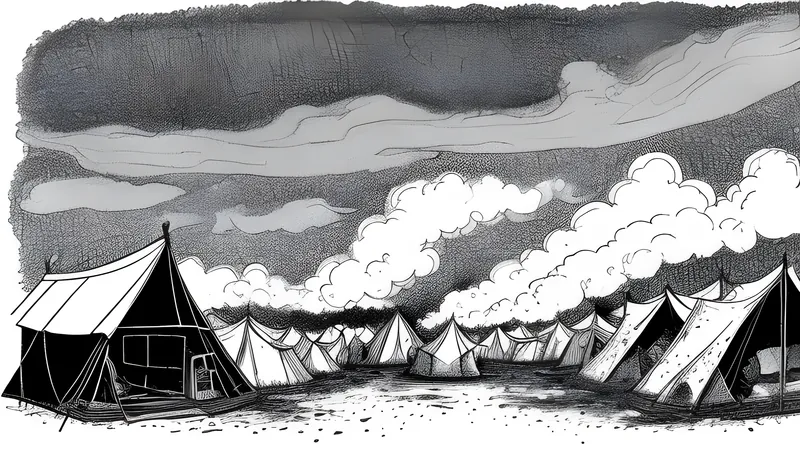
There is a stretch of beach south of Aarhus where, for a few days at the end of every July, you can walk out of the twenty-first century and into the ninth. The tents go up in their hundreds, modelled on the encampments of a raiding army; the forges are lit; the longships are drawn up on the sand; and somewhere down the line a thousand people in wool and iron form up into shield walls and go at each other with a noise that carries the length of the bay. This is the Moesgård Viking Moot, the largest Viking-age reenactment in Denmark, and it is the flagship of a summer-long circuit of living-history markets that quietly makes this small country the beating heart of European Viking re-enactment.
I say this as a Dane who grew up with the Vikings as a kind of national wallpaper — on the money, in the museums, in the endlessly recycled tourist branding — and who was genuinely unprepared, the first time I walked into a proper Viking market, for how far past the wallpaper the real thing goes. These are not people in horned helmets posing for photos. The Danish Viking-market scene is a serious, obsessive, decades-deep living-history movement, and the standard of reconstruction at the top end of it is high enough to make an archaeologist nod.
Moesgård, and the beach that becomes an army camp
Moesgård is the one to build a trip around. The Viking Moot — Vikingetræf in Danish — has been running on and near the beaches below the Moesgård Museum since 1977, which makes it one of the oldest continuous events of its kind anywhere, and it has grown into the largest Viking market in Scandinavia. It is pinned to the calendar by the weekend closest to 28 July, the feast day of St Olaf, a nice touch of historical calendar-keeping in an event about a pre-Christian and newly-Christianising age.
The scale is what floors people. A temporary encampment goes up along the shore, its layout modelled on the great Viking armies, and the numbers involved run past 1,400 participating re-enactors drawing something like 20,000 visitors across the event. The market itself is a working economy of craft — smiths, woodworkers, leather-makers, weavers, silversmiths, and people working amber, glass, willow and wool by hand, mostly with period tools and techniques, most of it for sale. You can buy a knife that was made in front of you that morning by a method a thousand years old.
Then there is the fighting. Over the closing days the beach hosts single combat, tournaments and full mass battles involving up to a thousand fighters, complete — on a good year — with a troop of Icelandic-horse cavalry. Watching a shield wall actually form and hold and then collapse, hearing the specific flat clatter of a few hundred wooden shields taking blows at once, is the sort of thing that permanently rearranges your mental picture of what the sagas are describing. It is choreographed for safety, obviously, but it is not gentle, and the commitment of the fighters is total.
A whole summer circuit
Moesgård is the giant, but it anchors a summer-long circuit that spreads the living Iron Age across the whole country, and each site brings something the others cannot.
Ribe, down on the west coast of Jutland, is the oldest town in Denmark — founded around the year 700, a genuine Viking-age trading hub — and it runs the largest Viking market in the country each spring at the Ribe Viking Center, a permanent reconstructed settlement where re-enactors don’t just visit the period but live in a rebuilt one. The historical authenticity at Ribe carries a particular weight because the place itself is real: this actually was a Viking market town, twelve centuries ago, on the same ground.
Trelleborg — the name attaches to several of the famous ring-fortresses — stages Viking events built around the extraordinary geometry of a real Viking-age circular stronghold, with battle displays, archery and hands-on workshops set against earthworks laid out with military precision more than a thousand years ago. And Jelling, the great royal monument site with its rune-stones and burial mounds — the stone where Harald Bluetooth announced the Christianisation of the Danes, effectively the country’s birth certificate in granite — hosts its own living-history gatherings on ground about as historically loaded as any in Scandinavia.
The effect of the circuit, taken together, is that from spring through late summer there is almost always a Viking age happening somewhere in Denmark, and the same core community of dedicated re-enactors migrates between them, carrying the culture from site to site like a travelling repertory company of the Iron Age.
The longships deserve a paragraph of their own. Denmark has poured serious money and scholarship into reconstructing Viking vessels — the Viking Ship Museum at Roskilde has spent decades rebuilding sailing replicas from the excavated originals and then actually sailing them, crews of volunteers rowing and hauling sail across open water to relearn a lost seamanship by doing it. When one of those reconstructions is drawn up on the sand at a market, or run out onto the water under a square sail, you are looking at experimental archaeology as public spectacle: a hypothesis about how these ships were built and handled, tested in the flesh, in front of you. It is the single most impressive thing the scene puts on, and it is the clearest proof that the Danish Viking movement is a research culture wearing the costume of a fair.
The food and the fire pull their weight, too. Cooking runs over open flame with period ingredients and period methods, bread baked on hot stones, meat and fish smoked and stewed the slow way, and the whole encampment carries the low haze of woodsmoke that does more to relocate you in time than any amount of costume. Sit by a fire at a Viking market after the day-trippers have gone home, with someone quietly working a piece of bone into a comb across the embers, and the centuries thin out to almost nothing.
Why the living-history obsession runs so deep here
It would be easy to write all this off as heritage tourism, a national theme park cashing in on the one bit of Danish history everyone abroad has heard of. That misreads the people doing it. The re-enactors are not employees; they are hobbyists at the far, committed end of a hobby, people who spend their own money and years of their own time hand-sewing garments to documented patterns, forging their own gear, learning dead crafts and dead fighting styles because the reconstruction itself is the reward. The market is the visible tip of a research culture.
What that culture is really chasing is a particular kind of contact with the past — the moment when enough of the physical world is genuinely, tangibly real that the historical distance briefly collapses and you are, for a heartbeat, actually there. It is the same pursuit that drives the medieval crowd at the Horsens Medieval Festival to insist on period tools and real forge fire, and the same principle that the Nordic LARP scene formalised into a design ideal: build a world where everything you can see and touch is what it claims to be, and the mind does the rest. Denmark, for reasons tangled up in its self-image, turns out to be extraordinarily fertile ground for that pursuit.
There is also something specific about the Vikings for a modern Dane. This is a small, mild, consensus-loving welfare state whose distant ancestors were, for a couple of centuries, the terror of coastal Europe — and the gap between those two Denmarks is so vast that re-enacting the older one is a way of holding a strange, half-disowned inheritance at arm’s length and examining it. The markets let a gentle country try the shield wall on for a weekend and then put it back down, which may be the healthiest possible relationship to have with an ancestry like that.
How to do it
If you can manage only one, make it Moesgård in late July, for the sheer scale and the beach battles — it is the closest thing Denmark has to a full Viking army assembling in the open air, and the setting below the museum is superb. If you want the deepest authenticity and a real Viking town under your feet, Ribe in spring is the pilgrimage. Trelleborg and Jelling reward anyone who wants the archaeology and the monuments alongside the re-enactment.
Come for the spectacle of the shield wall, certainly. But leave time to stand at the edge of a working forge and watch someone make something the slow, correct, thousand-year-old way, because that quiet, obsessive craftsmanship is the real engine of the whole scene, and it is where you feel the Iron Age closest. Denmark keeps a surprisingly full calendar of large-scale public make-believe, from the imported samba of Aalborg Karneval to the midsummer fires of Sankt Hans Aften — and the Viking markets are the deepest, oldest and most patiently researched of the lot.
Related Content